
Wedgwood's Potworks
Wedgwood's Potworks





previous: Ivy House Works
next: Etruria Works
Brick House Works, Burslem
- Wedgwood's Expanding Pottery
-
Josiah Wedgwood manufacturered here from 1762 to 1772
|
The Brick House Works marked the transformation of Josiah Wedgwood's pottery from a small independent business into one of Britain's most innovative and successful manufactories. Occupied by Wedgwood between 1762 and 1772, the works became the centre of a period of remarkable expansion, during which Wedgwood established his reputation for quality, introduced new methods of factory organisation and developed markets throughout Britain and overseas. It was here that Queen Charlotte's patronage earned him the title "Potter to Her Majesty", creamware achieved international success, and plans were laid for the revolutionary Etruria Works. Known locally as the Bell Works after Wedgwood installed a bell to summon his workforce, the pottery symbolised the beginning of a more disciplined and industrial approach to ceramic manufacture. |
| The Brick House Works at a glance | |
| Works name: | Brick House Works, Bell Works, Bell Bank, Bell Bonk |
| Wedgwood's association |
Josiah Wedgwood manufactured here from 1762 to 1772. The move to the newly built Etruria Works started in 1769 but was not completed until 1772 |
| Location: | Lower Street (later Queen Street), Burslem. The Brick House Works stood on the site now occupied by the Wedgwood Institute. |
| Maps: | view location on Google Maps |
| Significance: | The pottery where Josiah Wedgwood transformed his small business into an internationally renowned manufacturer, laying the foundations of the modern Wedgwood company. |
| Relevant Links: | |
| Later
occupants of the Brick House Works |
|
| Date | Occupant/Owner |
|
|
|
| 1762-72 | Josiah Wedgwood leased the works from John Bourne. From 1769 Wedgwood started to move to Etruria. |
|
|
|
| by 1809 | Occupied by William Bourne, earthenware manufacturer. |
|
|
|
| Early 1800s | Operated as Bourne & Cormie. |
|
|
|
| 1836 | Works divided; Beech & Jones occupied part, another part cleared for the Independent Chapel, remaining buildings let for other uses. |
|
|
|
| 1839 | William Beech continued the pottery after the partnership dissolved. |
|
|
|
| 1846 | Beech leased almost all of the remaining works. |
|
|
|
| 1853-55 | Brief partnership as Beech & Brock. |
|
|
|
| 1847 | Estate ownership passed to Isaac Hitchin of Alsager. |
|
|
|
| 1855-64 | William Beech carried on the pottery until his death. |
Compiled from Llewellynn Jewitt, The Wedgwoods, pp. 133-4. |
|
|
|
|
The pottery was originally known as the Brick House Works, taking its name from the Brick House pottery that had long been occupied by the Adams family.
"At this new manufactory he put up a cupola with a bell, which was, as is now the case everywhere, rung to call the workpeople together. This was the first bell put up and used for the purpose in the district, and from this circumstance the Burslem potters... got into the habit of calling it the 'Bell Bank,' or 'Bonk,' as it was and is more commonly pronounced." - Llewellynn Jewitt, The Wedgwoods, p. 132. |
|
|
|
The Brick House Works was where Josiah Wedgwood transformed a small pottery business into a leading manufacturing enterprise. During the seven years he occupied the works, production expanded rapidly, new ceramic bodies and glazes were developed, and creamware became one of Britain's most successful export wares.
|
|
|
|
Key Events at the Brick House Works (1762-1769) |
| Year | Event | Significance |
| 1762 | Josiah Wedgwood rented the Brick House Works from the Adams family. | Provided the larger premises needed to expand production beyond the Ivy House Works. |
|
|
||
| 1763 | Production transferred from the Ivy House Works to the Brick House Works. | Marked the beginning of a period of rapid growth and experimentation. |
|
|
||
| c.1763 | A bell was installed in a cupola to summon the workforce. | The works became known locally as the Bell Works, symbolising a more organised approach to factory management. |
|
|
||
| 1763-65 | Production of cream-coloured earthenware expanded. | Creamware became Wedgwood's most commercially successful product and established his reputation for quality. |
|
|
||
| Jan 1764 | Josiah Married Sarah Wedgwood at Astbury Church, Cheshire. |
Sarah was a distant cousin, the daughter of Richard Wedgwood of Spen Green, and the marriage proved to be one of the most important events in Josiah's personal life. They eventually had eight children, including: - Susannah Wedgwood (mother of Charles Darwin), - Josiah Wedgwood II, who succeeded his father, - Thomas Wedgwood, the scientific pioneer of photography. |
|
|
||
| 1765 | Queen Charlotte ordered a creamware tea service. | Wedgwood received permission to style himself "Potter to Her Majesty", and the ware became known as Queen's Ware. |
|
|
||
| 1766 | Building of the Trent and Mersey Canal approved by and Act of Parliament on 14 May 1766 | Construction officially began on 26 July 1766, when Josiah Wedgwood ceremonially cut the first sod of soil at Middleport. |
|
|
||
| 1766 | Wedgwood purchased the Ridge House Estate at Shelton. | The site was chosen for the construction of the new Etruria Works and village. |
|
|
||
| 1766 | Partnership with Thomas Bentley formally began. | Combined Wedgwood's manufacturing expertise with Bentley's commercial knowledge and artistic taste. |
|
|
||
| 1766-68 | Planning and construction of the Etruria Works. | Designed as a purpose-built factory to accommodate the expanding business. |
|
|
||
| 1768 | Increasing exports throughout Britain, Europe and America. | Demonstrated the growing international reputation of the Wedgwood business. |
|
|
||
| 1769-72 | Production was moved to the new Etruria Works. | The remarkable success achieved during seven years at the Brick House Works laid the foundations of the modern Wedgwood company and made possible the creation of the purpose-built Etruria Works in 1769. |
| Although the Etruria Works began production in 1769, the transfer from the Brick House Works was gradual. Wedgwood continued to use both potteries for several years while buildings were completed, kilns commissioned and production transferred in stages. Following notice to quit the Brick House premises in November 1769, the move gathered pace, but the relocation was not fully completed until 1772. |
||
|
|
||
|
Two developments during the Brick House years were instrumental in transforming Josiah Wedgwood's business from a successful local pottery into an internationally recognised manufacturer.
|
||
|
|
|
The royal commission from Queen Charlotte marked a turning point in the history of both Wedgwood and the British pottery industry. In 1765 the Queen ordered an elaborate cream-coloured earthenware tea service from Josiah Wedgwood for St James's Palace. The commission demonstrated that Staffordshire pottery could rival the fashionable imported porcelains then favoured by the aristocracy.
The Lady in Waiting story
Queen's Ware - greatest success for decades Queen's Ware remained one of Wedgwood's greatest commercial successes for decades.
|
|
|
|
Views of the Brick House works |

Brick-House Works, otherwise
the Bell Works
|
The Brick House Works Burslem. Engraving published in Life of Josiah Wedgwood by Eliza Meteyard (1866), vol 1 p. 455. |

The "Bell Works" Burslem
|
"The Bell Works, of which, in their present state, I give the accompanying engraving from a sketch recently made by myself.." The Bell Works, Burslem. Engraving published in The Wedgwoods by Llewellynn F. W. Jewitt (1865), pp. 132-3. |
|
|
1800 plan of locations in Burslem associated with Josiah Wedgwood
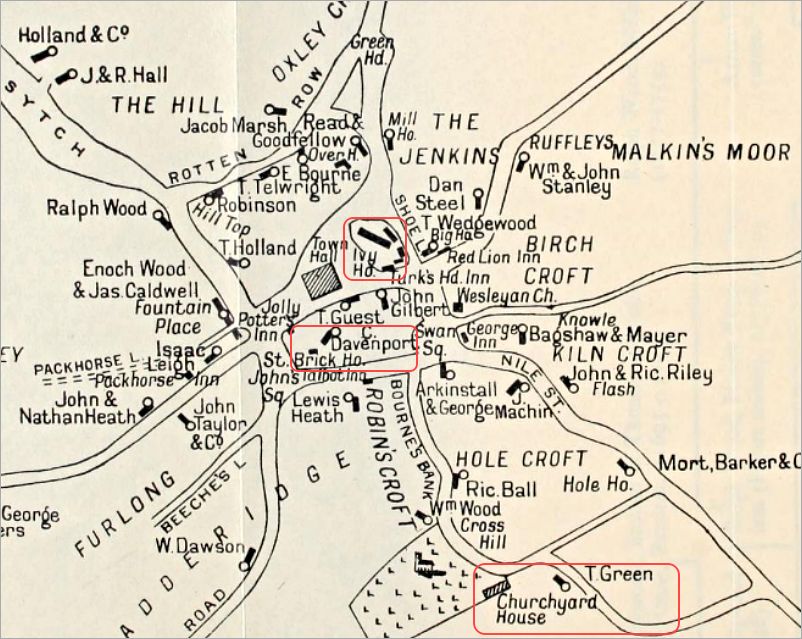
Map of the potworks in Burslem
- 1800
Locations
associated with Josiah Wedgwood (173-1795) are highlighted in red.
|
» The Churchyard House and Works is where Josiah was born. His eldest brother, Thomas Wedgwood IV, took Josiah as an apprentice here in 1744. » Near the Town Hall and on the opposite side of the road to the Wedgwood Big House is the Ivy House Works - Josiah established his own independent pottery business here in 1759.
» Josiah Wedgwood expanded his business in 1762 when he rented the Brick House Works from the Adams family of potters.
|
|
|
previous: Ivy House Works
next: Etruria Works
|
|