


|
|
|
Hanley and Shelton: From Twin Townships to Borough (1857)
The evolution of two separate townships into the municipal borough that became the heart of the Potteries.
Scroll down or use these quick links...
|
The town now known as Hanley developed from two originally separate settlements: Hanley and Shelton. Both were townships within the ancient parish of Stoke-upon-Trent, and for many years remained legally distinct despite growing side by side. In the 17th and early 18th centuries, Hanley itself consisted of small scattered hamlets, notably Upper Green and Lower Green, while Shelton was the larger and more established settlement.
A major change came in 1857, when Hanley and Shelton were formally united and incorporated as the Municipal Borough of Hanley. This created a single corporate authority with an elected council, replacing the older and more fragmented system of local governance. The new borough also encompassed the adjoining industrial district of Etruria, reflecting the wider urban area that had developed around the pottery industry.
|
|
|
1842 map of the townships of Hanley and Shelton
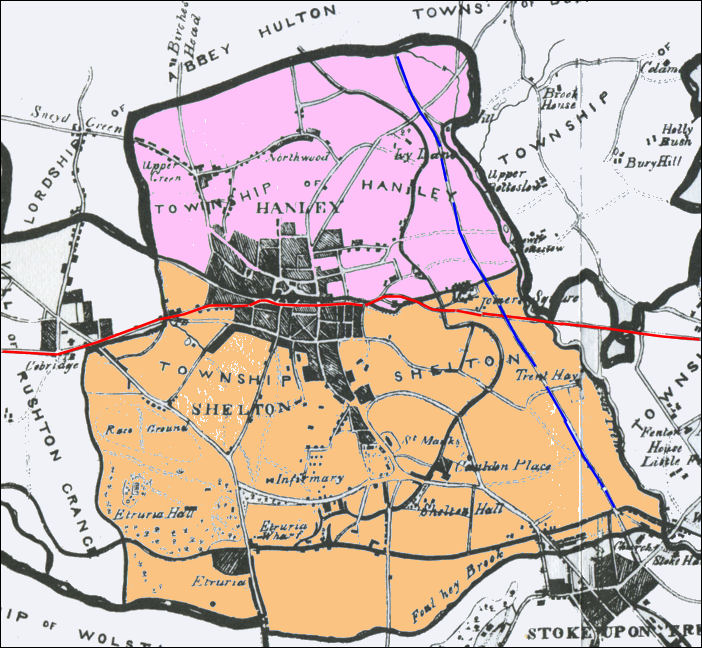
By the time of this map (1842), Hanley and Shelton were already one town in all but name.
Colours have been added to show the Townships of Hanley
& Shelton
and the route of two main thoroughfares
The Borough of Stoke-upon-Trent,
1843, John Ward
| Blue line: | The present Leek Road, running from Stoke church (St. Peters) through Joiners Square and Ivy House on towards Milton. |
| Red line | Victoria Road from Fenton through Joiners Square up Lichfield Street, then Stafford Street and up Waterloo Road to Cobridge. |
Explore
Hanley Lower Green » |
Explore the Township of Hanley »

|
|
| Example
of change of location name at the same pottery factory |
|
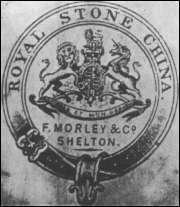 Royal Stone China F. Morley & Co Shelton |
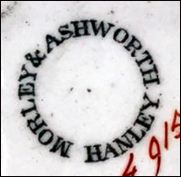 Morley & Ashworth Hanley |
|
1845-1858 |
1858-1862 |
|
Francis Morley mark (c.1845–1858) - marked “Shelton”, reflecting the earlier use of the township name before Hanley became the dominant place-name. Morley & Ashworth mark (c.1858–1862) - now marked “Hanley”, illustrating the shift in usage following the formation of the partnership and the incorporation of the Borough of Hanley in 1857. Both of these manufacturers operated at the Broad Street Works. |
|
|
|
| From: PIGOT'S Typology of England in 1841 - Staffordshire and the Potteries.. |
The principal part of the town is on an elevated site; the streets are not regularly disposed, but many of the houses are well built.
SHELTON is a township in the parish of Stoke, contiguous to Hanley, of which indeed, it forms an important portion, and its manufactures and police regulations are similar to those of that town. Shelton forms part of the borough of Stoke; and is the honour of Tutbury [NOTE], within the jurisdiction of a court of requests held at the latter town, every third Tuesday, for the recovery of debts under forty shillings.
|
|
|
| From: History, Gazetteer and Directory of Staffordshire, William White, 1851.. |
|
"Hanley and Shelton, though two distinct liberties, or townships, maintain their poor conjointly with the rest of the parish of Stoke-upon-Trent, and form one densely populated and well-built market town, ranking in size and consequence, the second in the county of Stafford, and the largest in the district called the Potteries, in which it holds a central situation, being pleasantly seated on rising ground near the Trent and the canal, about a mile N of Stoke, and two and a half miles ENE of Newcastle-under-Lyme.
|
|
|
| From: 1893 advertising and trade journal - A descriptive account of The Potteries (illustrated) |
|
"Hanley, the most populous town in North Staffordshire, is generally described as the capital of the Potteries, a title to which it has certainly the greatest pretensions; for, if it cannot claim that historic association with the industry which belongs peculiarly to Burslem, it has during the present century made such strides in the art, as to overtake and pass all competitors. At the census of 1891, the population of the municipal borough reached the total of 54,846; and such is the prosperity of the district, that at the present time this number has been very largely increased.
|
|
|