William Henry Goss


GOSS, William Henry (1833-1906), potter, Stoke upon Trent.
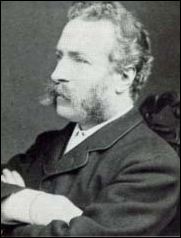
William Henry Goss
photo: Deana Goss MartinGreat, Great Granddaughter of W H Goss
William Henry Goss was born in London in 1833, the son of Richard and Sophia Goss.
He studied at the School of Design in Somerset House, London.
In 1853 William H Goss published a book called 'Ralph and Priscilla, A Poem' - he dedicated the book to "his kindest friend W F M Copeland, Esquire". William Fowler Mountford Copeland was one of the sons of William Taylor Copeland.
In March 1853 he married Georgiana Goldswain - they had seven children.
In 1857 Goss came to work at the pottery company of W. T. Copeland as chief artist.
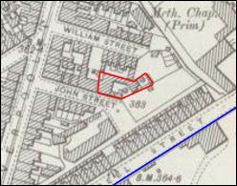
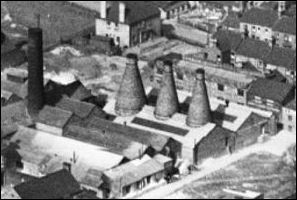
A disagreement led to his setting up in business on his own in 1858 at the nearby small Cock Works in John Street (now Leese Street), off Liverpool Road, Stoke.
the Cock Works- click for more information on Goss
at the Cock Works -
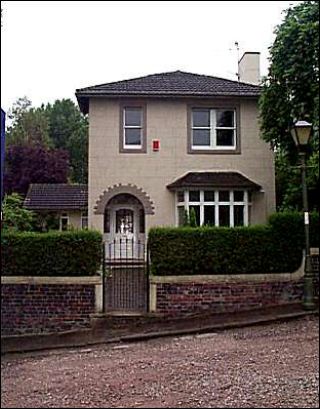
1861 census details: Wm Hy Goss / Head / married / age 28 / occupation Porcelain Manufacturer employing 14 Men 12 Women & 34 Boys / birthplace London Middlesex / living at 10 Stoke Villa, Stoke upon Trent, with wife Georgiana Goss, sons Adolphus Wm Hy and Godfrey Wm Goss, daughter Georgiana Goss, brother Abner Mitchener Goss, 1 servant.
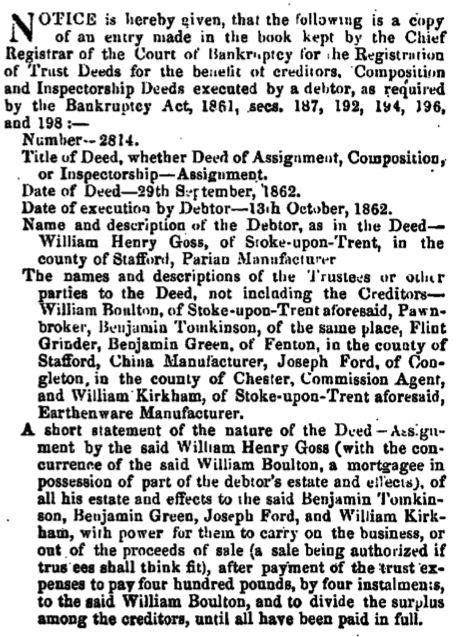
September 1862 Goss was bankrupt and a trust deed was set up to pay his creditors.
Around 1868 William Adams Peake joined Goss in partnership as and they traded as Goss & Peake.
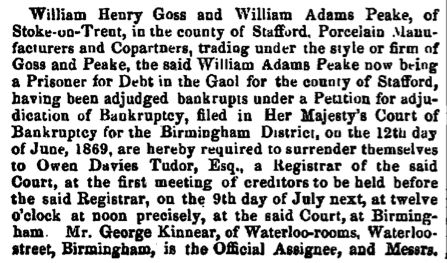
By early 1869 Goss's partner William Peake was jailed as a 'Prisoner for Debt' and in June 1869 both Goss and Adams were declared bankrupt.
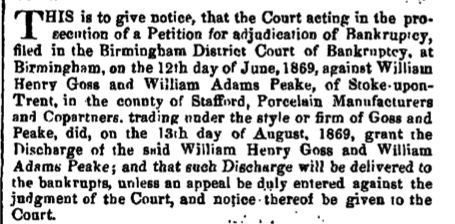
The bankruptcy was discharged in September of 1869 and Goss continued on his own - still at the Cock Works, John Street.
Around 1870 Goss transfered his business to the Falcon Works, Edward Street (now Sturgess Street), off London Road, Stoke.
In 1873 Goss registered a patent for improvements in manufacturer of various items made from ceramic materials.
the Falcon Works- click for more information on Goss
at the Falcon Works -
1881 census details: as Wm H Goss / Head / married / age 47 / occupation Porcelain Manufacturer employing 17 men / birthplace London / living at Rode Heath, with wife Georgiana Goss, daughters Georgiana, Eva A, Edith M and Florence Goss, sons Godfrey W, Victor H and William Goss.
1891 census details: as William Henry Goss / Head / married / age 57 / occupation Manufacturer of Porcelain / employer / birthplace London City / living at 1 Kirkham Street, Stoke upon Trent, with daughters Eva Adeline and Edith Maria Goss.
W H Goss was an improvement commissioner in 1866, a fellow of the Geographical Society and of the Royal Meteorological Society and was vice-president of the North Staffordshire Field Club.
He wrote a number of books and articles including.....
'Ralph and Priscilla, A Poem' (1853);
'Primitive Man and His Works' Vols. I and II;
'Hebrew Captives and the Kings of Assyria';
'The life and death of Llewellynn Jewitt, with memory of some of his friends, especially of S.C. Hall' (1889);
'Review of "Modern Science and Modern Thought," Etc. in a Series of Letters to a Lady' (1895)
his article on Stoke Wakes sports, entitled 'English Olympic Games', was published in the Pottery and Class Trades Review in 1878.
W H Goss was a friend and the biographer of Llewellyn Jewitt. Which may explain why the 'Goss' entry in Jewitt's Ceramic art of Great Britain is lengthy and reports the Goss products in glowing terms.
Goss died in January 1906
The Daily Telegraph recorded the following obituary:
'The death occurred on Thursday of the famous potter. Mr. William Henry Goss of Stoke-on-Trent, and Barthomley, near Crewe. He was the inventor of the healdic ware known throughout the world. He learned potting many years ago under the late Alderman Copeland, at one time Lord Mayor of London. At the International Exhibition of 1862 he won the much conveted award for the manufacture of articles in ivory porcelain.'
No.10 The Villas, where William H Goss
was living with his family in 1861
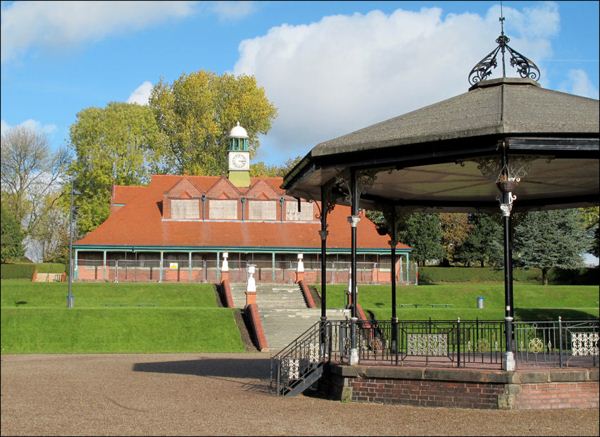
Bandstand and Pavillion, Hanley Park
the park opened in 1897 - W.H. Goss gave the vases on the terrace
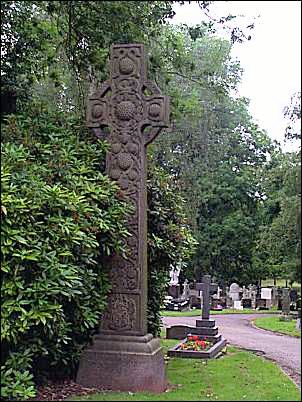
The impressive monument of William H Goss
situated in the 'first class' area of Hartshill cemetary
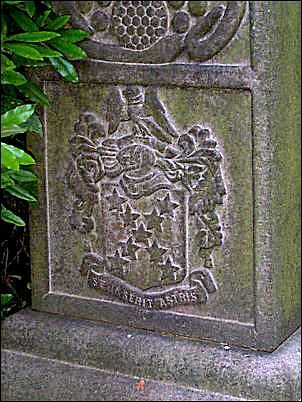
the arms at the base of the monument
at the top is the falcon - for the
Falcon Works
Take a 'walk' around
Hartshill cemetery
The London Gazette, November 7, 1862
details of trust deed to pay off creditors of
William Henry Goss
The London Gazette, June 29, 1869
William Adams Peake was jailed as a 'Prisoner for Debt'
and both he and William Henry Goss, Porcelain
Manufacturers and Copartners of Goss & Peake
were declared bankrupt
The London Gazette, September 7, 1869
notice of discharge of the bankruptcy of
William Henry Goss and William Adams Peake
The London Gazette, March 4, 1873
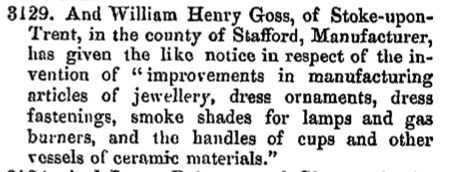
notice of patent for improvement in manufacturing various
articles in ceramic materials
London Road (and Eastwood Vale)
"The works of William Henry Goss (born in 1833: died in 1906) were commenced in 1858 for the production of Parian, ivory porcelain and terra-cotta, and iheir progress from that lime was very marked. The most famous of the specialities of Mr. Goss's manufacture was jewelled porcelain, in which vases, scent-bottles, tazzae, and other ornaments were prodaeed; also vessels to be filled with perfumes, including illuminated scent-vases, pomade-boxes, rice-powder jars, pastile and scented ribbon burners - the latter made largely for the great Paris and London perfume houses.
The process of modelling jewelled porcelain, which is of extreme richness and beauty, was the invention of Mr. Goss. who, observing that the enamel jewels on the old Sevres porcelain frequently dropped off or were rubbed off. turned his attention to the subject. The process adopted at Sevres was as follows: a gold foil was marked into Circles, ovals and other required forms for the reception of the enamels, which were then pencilled-on and fired before applying them to the article they were intended to decorate. After being vitrified into imitations of uncut rubies, emeralds, etc.. they were stuck on the surface of the porcelain with a flux and again fired. The adhesion was by this process often incomplete, and thus it frequently occurred that part of trie design became rubbed away.
The process invented by Mr. Goss for this mosaic jewellery was to indent the designs for the intended jewelled decoration in the dry or moist clay before baking, and in these to insert thejewels-which were all previously cut - and thus attain an increased brilliancy. Being inserted into the hollow or recess prepared for them, they were made secure. The process was an extremely delicate but very ingenious and beautiful one, and the effect produced was richer and finer than that attained by any other processes. Real pearls are said to have been also introduced by Mr. Goss with good effect.
The floral brooches and crosses are of great beauty, and in delicacy of modelling remind one of the famous old Bristol floral plaques. Some were produced in pure white bisque, others were tinted in the natural colours of the flowers represented, and others were in ivory porcelain prepared by a patented process.
In Parian - for which Mr. Goss ranked deservedly high - busts, statuary (notably an exquisite group of Lady Godiva), vases, tazzas, bread-platters and many other ornamental goods were made. Notable among these are admirable busts of Queen Victoria, the Earl of Beaeonslield. Mr. Gladstone. Lord Derby, etc. As portrait-busts, they rank far above the average and are, indeed, perfect reproductions of the original persons. It is not often that this can be said of portrait-busts, but il was a particular study of Mr. Goss and he succeeded admirably in it.
Another of Mr. Goss's specialities was ivory porcelain, which he produced in a full, soft, mellow tone which characterises the finest ivory. It possesses all the delicate beauty of ivory but with more durability: and, unlike ivory, it is unchanging. In this material, one of Mr. Goss's most successful productions was a pierced scent-bottle of the pilgrim-bottle or puzzle-jug form. Its centre was double-pierced in a very elaborate pattern and judiciously heightened with lines of gold.
Another of Mr. Goss's achievements was in the production of egg-shell porcelain, in which he stood pre-eminent. The pieces produced in this are so light and thin: and yet the body is of such extreme hardness and firmness that it is as strong as thicker and more massive ware. It is a liner and purer body than Sevres, thinner and far more translucent than Belleek, more delicate in tone than Worcester, and more dainty to the touch than any other.
In terra-cotta, of peculiarly fine quality and rich colour, water-bottles and all the usual articles were made. Many examples were decorated with fern motifs. All kinds of enamel colours and lustres were also made at these works. The name W. H. GOSS was generally stamped in the ware; and on the higher class goods, the crest -a falcon rising, ducally gorged - was used. Messrs. W. H. Goss continued into the twentieth century and became Goss China Co. Ltd. in 1934. '
To present-day readers, the name Goss is almost entirely associated with small trinkets bearing the arms of various towns or cities. These pieces only became an important branch of the Goss products in the 1890's continuing in high favour up to the period of the 1914-18 war."
Jewitt's Ceramic Art of Great Britain 1800-1900, Revised by Geoffrey A Godden
SOURCES: N Emery, W. H. Goss and Goss Heraldic China; E. A. Goss, Fragments from the Life and Writings of William Henry Goss;
J. D. Magee, Goss for Collectors; People of the Potteries; Jewitt's Ceramic Art of Great Britain 1800-1900; The London Gazette.