Charles Shaw


SHAW, Charles (b.1832 d.1906), Potter and Methodist New Connexion Minister - born in Tunstall.
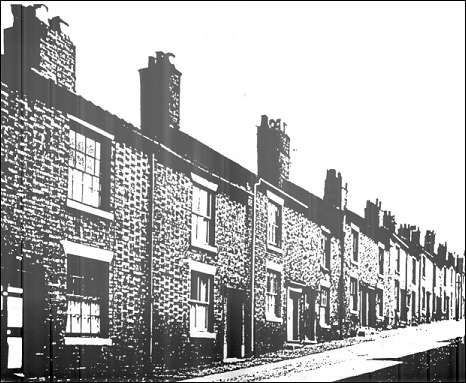
Piccadilly Street, Tunstall where Shaw was born in 1832
- click picture for more on Paradise and Piccadily Streets -
"A Building Society, begun in 1816, and of which many of the working Potters were members, gave rise to forty small houses, and the formation of two new streets, called Paradise Street, and Piccadilly Street"
The owners included Joseph Capper, the blacksmith a later noted Chartist
Early life, employment and the workhouse:
Charles Shaw was one of eight children of Enoch Shaw who was a painter and gilder, of Piccadilly Street, Tunstall, and Ann nee Mawdesley. He was was born in August 1832. Shaw attended a dame school run by Betty Wedgwood in Tunstall - this forms the basis of the first chapter of his book "When I was a Child", he then began work as a mould runner to an apprentice muffin maker, earning a shilling a week.
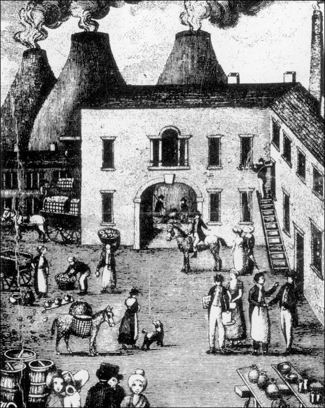
At seven he started work as a mould-runner in the pottery factory of Enoch Wood & Sons in Burslem. He earned a shilling a week, worked about fourteen hours a day, and suffered from exhaustion, hunger, beatings, and extremes of temperature.
When he was eight years old he moved to another factory, possibly Samuel Alcock's, as a handle maker. In 1842 his father lost his job as a result of his participation in a strike (at Davenport's - a severe employer), and the family were forced into Chell workhouse.
Shaw later wrote vividly and movingly of his experiences in the workhouse (in his book "When I was a Child), and this and the other events in his early life were used by Arnold Bennett in his novel Clayhanger.
Charles Shaw was in the workhouse only for about four or five weeks, then his father found a job and Charles was released - however this short period made a big impression on him.
He went to work with a toymaker, George Hood. His elder brother, Edwin, gave evidence to the inspector, Samuel Scriven, who reported on the employment of children and young persons in the Staffs. Potteries in 1843; Edwin is called Evan Shaw in the report.
Later life, chartism, cotton mills and the ministry:
Derided at the Wesleyan Sunday school when he appeared in workhouse clothes, Shaw transferred his allegiance to the New Connexion Methodist Sunday school. He began to take an interest in public affairs, greatly admired his elderly neighbour (in Piccadilly Street) Joseph Capper the Chartist, and witnessed the Burslem riots of August 1842. Shaw later wrote about the Chartism activities in the Potteries.
The Shaw family attended the Methodist New Connexion chapel in Tunstall.
At the age of 18 Charles Shaw joined a Mutual Improvement Society and by 1853 he was on the New Connexion local preachers' plan. He entered the ministry full time and was stationed in Oldham, Sheffield, Mansfield, Huddersfield and Aston during the 1850s.
Following a nervous breakdown he resigned from the ministry in 1861 and entered the family business of his wife, Jane Halliwell, at Radcliffe and Bent Mill, Grotton, near Oldham. Charles and Jane had three children before her death in the late 1860s.
When his wife died he became the co-owner of the mill. He carried on this business for a number of years.
By the early 1870s he was a partner in Radcliffe Mill, Springhead. In the 1880s the firm became Charles Shaw & Son, employing in 1881, forty-eight men and thirty-eight women.
In the 1890s the mill failed and Shaw re-entered the ministry.
In 1870 he married Maria Arthington (1839–1927) from Huddersfield, with whom he had three more children. Remaining an active layman at Zion Chapel, Lees, for many years he wrote leaders for the radical Liberal Oldham Express and also contributed to the Methodist New Connexion Magazine.
Shaw served in the ministry in Douglas, Isle of Man, from 1897 to 1900, and in Bangor, co. Down, from 1900 until 1905, when old age at last compelled him to retire.
He also writing leaders for the radical weekly newspaper, the Oldham Express, under its editor, Alfred Butterworth.
In 1868-9 Charles Shaw was prominent in support of the movement to disestablish the Irish Church.
Shaw died from heart failure at his home - Spring Cottage, Walker's Lane, Springhead, Oldham, Lancashire - on 5 March 1906. The funeral was held at Zion Chapel, Lees, and he was buried in Hey church cemetery, Oldham, on 8 March.
Charles Shaw's autobiography
When I Was a Child
In 1892–3 Shaw had contributed a series of anonymous articles on his childhood memories to the local Potteries newspaper - the Staffordshire Sentinel.
These reminiscences, considerably expanded, March 1903 as When I was a Child, by ‘An Old Potter’. Shaw, as a staunch Liberal and free-trader, evidently intended his account of the trials of his childhood and youth in the Potteries as, in part, a contribution to contemporary political debate, and in particular a warning of the dangers of a return to protectionism.
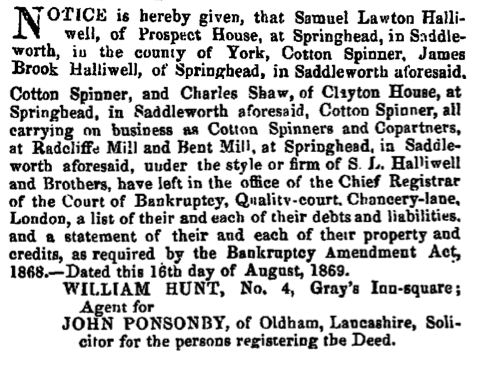
London Gazette August 17, 1869
notice regarding the bankruptcy of S.L.Halliwell,
Cotton Spinners at Radcliffe and Bent Millpartners were Samuel Lawton Halliwell, James Brook Halliwell and Charles Shaw
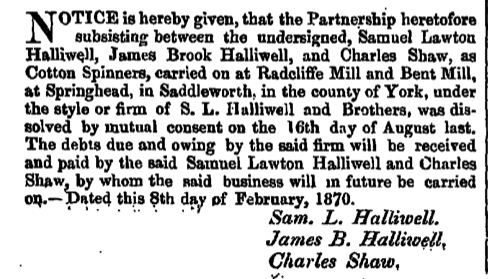
London Gazette February 11, 1870
notice regarding the dissolution of the partnership between
Samuel Lawton Halliwell, James Brook Halliwell and Charles Shawthe business to be carried on by Samuel Lawton Halliwell and Charles Shaw
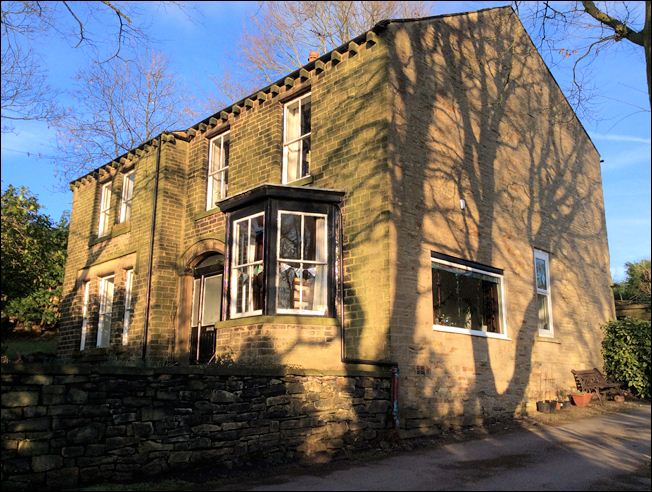
Spring House, Oldham
Charles Shaw died here on the 5th March 1906
The house was built by the Halliwell family in 1852. William Halliwell built the house and left it to his daughter, Jane, after his death. William also left his business to her, which consisted of Bent and Radcliffe mill in Grotton, Oldham (near the house). The name of the mill company was changed from Halliwell and Co. to Shaw and Co.
Information & photo: Samuel Payne - current (2014) owner of Spring House
Sources: People of the Potteries; Dir. 1864; VCH viii. 'When I was a Child'; Oxford Univeristy Press
|
Related pages.. When I Was a Child - transcription of Shaws book. Charism - for information on the 1842 strike & Chartism.
external links.. Charles Shaw - Wikipedia entry Charles Shaw - Oxford Univeristy Press
|