Arnold Bennett - Son of Stoke-on-Trent


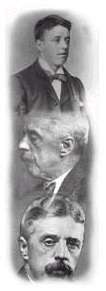
Bennett, (Enoch) Arnold (1867-1931), 

English novelist, playwright, and essayist, born in Hanley (27th May 1867), Stoke-on-Trent, Staffordshire (Hanley was the real-life model for one of the "Five Towns" of his novels). Bennett was educated at the University of London and for a time was editor of Woman magazine. After 1900 he devoted himself entirely to writing; dramatic criticism was one of his foremost interests. Bennett is best known, however, for his novels, several of which were written during his residence in France. 

Bennett's infancy was spent in genteel poverty, which gave way to prosperity as his father succeeded as a solicitor. From this provincial background he became a novelist.
His enduring fame is as a Chronicler of the Potteries towns, the setting and inspiration of some of his most famous and enduring literary work and the place where he grew up.

Many of the locations in Clayhanger and other Bennett novels are based in "The five towns" and correspond to actual locations in and around the Potteries district of North Staffordshire click here to see a list of some of the locations.


The Six Towns of Stoke-on-Trent

 Bennett's Five Towns

   Tunstall  Turnhill
   Burslem  Bursley
   Hanley  Hanbridge
   Stoke  Knype
   Fenton  The 'forgotten town'
   Longton  Longshaw

Bennett did not pursue a career as a writer until after leaving his father's practice and moving to London in 1889 when he won a literary competition in "Tit Bits" magazine. Encouraged to take up journalism full-time he became assistant editor of "Woman" in 1894. Just over four years later his first novel "A Man from the North" was published to critical acclaim, followed in 1902 by "Anna of the Five Towns", the first of a succession of stories which detailed life in the Potteries and displayed his unique vision of life in its towns.

Between the end of 1903 and 1911 Bennett lived mainly in Paris. During this time he continued to enjoy critical success with the publication of many novels including "The Old Wives Tale" (1908). After a visit to America in 1911 where he had been publicised and acclaimed as no other visiting writer had been since Dickens he returned to England where the "Old Wives Tale" was reappraised and hailed to be a masterpiece.

By 1922 he had separated from his French wife, but shortly thereafter he fell in love with the actress Dorothy Cheston and lived with her until his death in 1931 from typhoid. His ashes are buried in Burslem cemetery. Their daughter Virginia Eldin now living in France is today the President of the Arnold Bennett Society.

Although Arnold Bennett never returned to the Potteries to live he never forgot the debt which he owed to his birthplace for giving him a unique setting for so many of his novels, a setting which he enhanced with his penetrating description of people and places. It is perhaps unfortunate that Bennett felt the "The Five Towns" sounded more euphonious then "The Six Towns", and thus relegated the town of Fenton almost to oblivion, but as a chronicler of The Potteries he assured for the district a permanent place in English literature.


Novels by Arnold Bennett in print at Oct 1994

Anna of the Five Towns *
The Card *
Clayhanger *
Grand Babylon Hotel
Grim Smile of the Five Towns *
Old Wives Tales *
Riceyman Steps

Penguin

The Pretty Lady
Buried Alive
A Man from the North *
Helen with a High Hand
Whom God Hath Joined
Matador of the Five Towns *
Tales of the Five Towns *

Alan Sutton Publications

Teresa of Watling Street

Bookcastle

* Indicates a Five Towns Novel


"In front, on a little hill in the vast valley, was spread out the Indian-red architecture of Bursley - tall chimneys and rounded ovens, schools, the new scarlet market, the high spire of the evangelical church……the crimson chapels, and rows of little red houses with amber chimney pots, and the gold angel of the Town Hall topping the whole. The sedate reddish browns and reds of the composition all netted in flowing scarves of smoke, harmonised exquisitely with the chill blues of the chequered sky. Beauty was achieved, and none saw it".

Clayhanger 1910