|
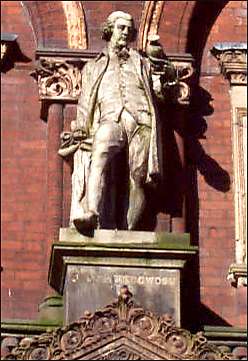
Statue of Josiah Wedgwood
on the 'Wedgwood Memorial Institute' Queen Street, Burslem |
|
Josiah
Wedgwood (1730-1795) contracted smallpox early in his youth, this left him
lame in his right leg. Later in life his leg was amputated just below the
knee.
It may be that the infirmity
Wedgwood suffered from resulted in his development as a Master Potter and
the foundation of Josiah Wedgwood & Sons who continue as pottery
manufacturers in Stoke-on-Trent to this day.
Josiah was born into a potters family, and in
1744 he was apprenticed as a thrower to his elder brother Thomas. He may
have remained in that position all his life had it not been for the
smallpox which reduced his mobility.
Because of the infirmity Josiah began to read, research and experiment in
producing "various ornamental and fancy articles, and to experiments
in imitating the natural agates, jaspers....."
|
|
The Right Hon. W.E.
Gladstone (Chancellor of the Exchequer) on the occasion of his
laying of the foundation stone of the Wedgwood Memorial Institute
(around 1863) |
| "Then comes the
well-known attack of smallpox, the settling of the dregs of his
disease in the lower part of the leg, and the amputation of the
limb, rendering him lame for life.... in the wonderful ways of
Providence, that disease...drove him to meditate upon the laws and
secrets of his art.." |
|
Josiah Wedgwood I had his right leg amputated (midway between the
thigh and knee) on 28 May 1768.
Surgical opinion
suggests that smallpox suffered as a boy left him with an
infection known as ‘Brodie’s abscess’, which eventually disabled
the joint completely. With no anaesthetics and no antiseptics, the
risks of such an operation were considerable. But Josiah I made a
rapid recovery and had a wooden leg made by Mr Addison of Long
Acre, who made ‘lay figures for artists’.
In later years,
the artificial limbs were produced by a local cabinet maker. |
|
From
Jewitt's 'a Life of Josiah Wedgwood' 1865:-
"It would be far from my wish to destroy, or to
entrench,
even
in the slightest degree, on the true poetry of this
relation;
but as its sentiment cannot be altered, or its
beauty
impaired, by correcting one of the statements, I do
not
hesitate to say, what I have every reason for believing to be the
case, that the amputation of the leg was not altogether the result
of the small-pox, which had produced a disorder and weakness in
that limb, but of an accident; and
that
it did not take place during the boyhood of the great
man,
but at a much later period of his life. The boy had
genius
and thought, energy and perseverance, in him, which
wanted
not the bodily affliction to become developed, and to
bring
them to active perfection. His mind was such as would
have surmounted every obstacle which manual employment
could offer, and would have risen above every
unfavorable
circumstance by which he might be surrounded.
The
smallpox, it is true, at that early period gave him
leisure
and opportunity to think, to experimentalise, and to
form
those ideas which in after life he so successfully and
beneficially,
both to himself and to the world, worked. out; but he would have
become a great man even without that
ailment
to help him on.
The
small-pox left a humour which settled in the leg, and
on every
slight accident became so painful, that for one half
of
the time of his apprenticeship he sat at his work with his leg on
a stool before him. The same cruel disorder continued with
him till manhood, and was at one time so much aggravated by an
unfortunate bruise, that he was confined to his
bed
many months, and reduced to the last extremity of
debility.
He recovered his strength after this violent shock but was not
able to pursue his plans for some years without
frequent
interruptions from the same sad cause. At length
the disorder
reached the knee, and showing symptoms of
still
advancing so as to endanger his life, he was advised to
undergo
amputation, and submitted to it, it is said, about
the
34th year of his age. From this period he enjoyed a tolerably good
state of bodily health and activity, and has
been
known to attribute much of his success of life to his confinement
under this illness, because it gave him opportunities to read, and
to repair the defect of an education
which
had, as I have shown, been necessarily narrowed by
circumstances."
|

 |
index page for 'did you know? |
|
index page for 'did you know? | 