|
Josiah Wedgwood
1730-1795
|
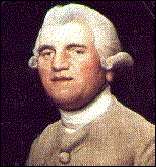
Josiah
Wedgwood
1730-1795 |
English
potter, whose works are among the finest examples of ceramic art.
Wedgwood was born in
Burslem, Staffordshire, on
July 12, 1730, into a family with a long tradition as potters. At the
age of nine, after the death of his father, he worked in his family's
pottery.
In 1759 he set up his own pottery
works in Burslem. There he produced a highly durable cream-coloured
earthenware that so pleased Queen Charlotte that in 1762 she appointed
him royal supplier of dinnerware. From the public sale of
Queen's
Ware, as it came to be known,
Wedgwood was able, in 1768, to build near Stoke-on-Trent a village,
which he named Etruria, and a second factory equipped with tools and
ovens of his own design. At first only ornamental pottery was made in
Etruria, but by 1773 Wedgwood had concentrated all his production
facilities there.
During his long career Wedgwood
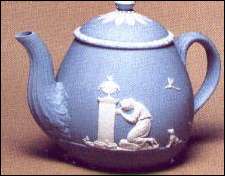
developed revolutionary ceramic materials, notably
basalt
and
jasperware.
|
|
In 1754 Wedgwood began to experiment
with coloured creamware. He established his own factory, but often
worked with others who did transfer printing (introduced by the
Worcester Porcelain Company in the 1750s). He also produced red
stoneware; basaltes ware, an unglazed black stoneware; and
jasperware, made of white stoneware clay that had been coloured by
the addition of metal oxides. Jasperware was usually ornamented with
white relief portraits or Greek Classical scenes. Wedgwood's
greatest contribution to European ceramics, however, was his fine
pearlware, an extremely pale creamware with a bluish tint to its
glaze.
Wedgwood's basalt, a hard, black, stone-like material known also as
Egyptian ware or basaltes ware, was used for vases, candlesticks,
and realistic busts of historical figures. Jasperware, his most
successful innovation, was a durable unglazed ware most
characteristically blue with fine white cameo figures inspired by
the ancient Roman Portland Vase. Many of the finest designs were the
work of the British artist John Flaxman.
|
Artists |
The most famous artist
Wedgwood employed at Etruria was the sculptor John Flaxman,
whose wax portraits and other relief figures he translated
into jasperware.
|
|
Competitors |
Wedgwood's wares appealed
particularly to the rising European bourgeois class, and
porcelain and decorated and glazed earthenware factories
suffered severely from competition from him.
The surviving factories switched to the manufacture of
creamware (called on the Continent faience fine or faience
anglaise) to try to imitate and compete with Wedgwood. Even
the great factories at Sèvres, France, and at Meissen,
Germany, found their trade affected.
Jasperwares were imitated in biscuit porcelain at Sèvres, and
Meissen produced a glazed version which they even called
Wedgwoodarbeit.
|
|
The Royal Society |
Wedgwood's invention of the
pyrometer, a device for measuring high temperatures
(invaluable for gauging oven heats for firings), earned him
commendation as a fellow of the Royal Society.
|
|
Timeline:
The youngest child of the
potter Thomas Wedgwood, Josiah came from a family whose members had been
potters since the 1600's.
|
1730 |
Baptised July 12, 1730,
Burslem,
Stoke-on-Trent, England. |
|
1739 |
After his father's death
in 1739, he worked in the family business at
Churchyard Works, Burslem, becoming exceptionally skilful at the
potter's wheel. |
|
1744 |
Became an apprentice to his elder
brother Thomas.
However an attack of smallpox seriously reduced his work (the disease
later affected his right leg, which was then amputated); the result of
this inactivity, enabled him to read, research, and experiment in his
craft as a Master Potter. |
|
1752-3 |
In 1749 Thomas (Josiah's
elder brother) refused his proposal for partnership and Josiah formed
a brief partnership with John Harrison at Stoke-on-Trent,
Staffordshire. |
|
1754 |
Wedgwood formed a partnership with
Thomas
Whieldon of Fenton Low, Stoke-on-Trent, probably the leading
potter of his day. This became a fruitful partnership, enabling
Wedgwood to become a master of current pottery techniques. He then
began what he called his "experiment book," an invaluable source on
Staffordshire pottery. |
|
1759 |
After inventing the
improved green glaze which is still popular even today, Wedgwood
finished his partnership with Whieldon and went into business for
himself at the Ivy House factory in Burslem. |
|
1762 |
On one of his frequent visits to
Liverpool to arrange export of his ware, Wedgwood met the merchant
Thomas Bentley. |
|
|
Because the sale of his ware had spread
from the British Isles to the Continent, Wedgwood expanded his
business to the nearby
Brick House (or Bell Works) factory. |
|
1765 |
Queen Charlotte's
patronage of Wedgwood's cream-coloured earthenware in 1765, led the
well finished earthenware which Wedgwood produced to be called
Queen's
ware.
Queen's ware became, by virtue of its durable material and serviceable
forms, the standard domestic pottery and enjoyed a worldwide market. |
|
1768 |
The merchant Bentley became his partner
in the manufacture of decorative items that were primarily unglazed
stonewares in various colours, produced and decorated in the popular
style of Neoclassicism.
Chief among these wares were:
- black
basaltes, which by the addition of special painting (using
pigments mixed with hot wax, which are burned in as an inlay), could
be used to imitate Greek red-figure vases; and
- jasper, a
fine-grained vitreous body resulting from the high firing of paste
containing barium sulphate. |
|
1771 |
Wedgwood built a factory
called
Etruria, for the production of his ornamental vases. Later the
manufacture of useful wares was also transferred. (At this site his
descendants carried on the business until 1940, when the factory was
relocated at
Barlaston, near Stoke-on-Trent, Staffordshire - the Etruria site
was used as part of the "National
Garden Festival" and
Wedgwood's great
house can still be seen as it has been incorporated into an hotel. |
|
1774 |
Evidence of the popularity of Wedgwood's
creamware is found in the massive service of 952 pieces made for
Empress Catherine the Great of Russia |
|
1775 |
Jasper's introduction in
1775 was followed by other wares such as: - rosso antico (red
porcelain), cane, drab, chocolate, and olive wares. |
|
1782 |
In 1782 Etruria was the first factory to
install a steam-powered engine. |
After
Wedgwood's death in Etruria on January 3, 1795, his descendants carried on
the business, which still produces many of his designs.
Other relevant
links
 Queens Ware
Wedgwood
Ware
Identifying
marks on Wedgwood ware
Wedgwood's
potworks
Wedgwood's own Internet site:
www.wedgwood.co.uk
Bibliography
 Wolf Mankowitz, Wedgwood
(1953) Wolf Mankowitz, Wedgwood
(1953)
Alison Kelly, The Story of
Wedgwood (1962)
Eliza Meteyard, The Life of Josiah
Wedgwood (1865, repr. 1970).
Wolf Mankowitz, The Portland Vase
and the Wedgwood Copies (1954).
|