» History  | » 1701 Parish Listing


The Stoke-upon-Trent Parish Listing of 1701


The Stoke-upon-Trent Parish Listing of 1701 provides a remarkable snapshot of life in the ancient ecclesiastical parish at the beginning of the eighteenth century. Compiled decades before the Industrial Revolution transformed North Staffordshire, the survey records more than 1,600 inhabitants living in the parish's six liberties of Penkhull, Clayton and Seabridge, Shelton, Hanley, Fenton Culvert and Fenton Vivian.

It is important to note that this was a parish listing rather than a survey of the whole Potteries area. The ancient parish of Stoke-upon-Trent did not include neighbouring settlements such as Burslem and Tunstall, which lay in separate parishes. Nevertheless, the listing provides one of the earliest and most detailed records of the population from which much of the industrial Potteries would later emerge. 


As well as the population size and distribution the listing also tells us a great deal about naming practices in the late seventeenth and early eighteenth centuries. 

A glance at the listing reveals that most people named their children after biblical characters. 

It is also evident that the stock of names used by parents was much smaller than it is today. Thus, nearly half the females and more than half the males were known by just three names. The most popular female names were Mary (20.8%), Elizabeth (14.0%) and Anne (13.6%), and the most popular male names were John (23.6%), Thomas (16.5%) and William (12.6%). Among the more unusual names were Merab, Damaris, Segreaves and Newton.


Related Pages:  |  Domesday Stoke  |  Formation of the City  |  Key Dates  | 


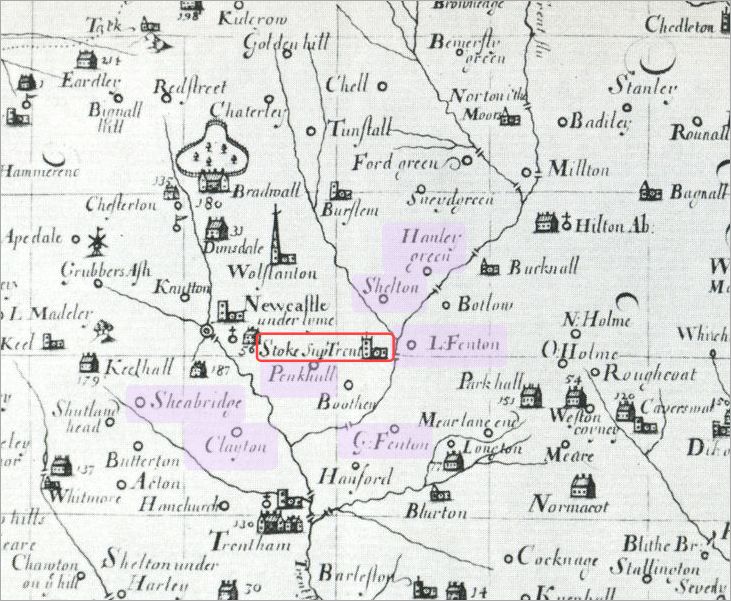
Location of the Liberties 

The six liberties in the 1701 Listing -  Penkhull, Clayton, Seabridge, Shelton, Hanley, Fenton Culvert and Fenton Vivian

These liberties are superimposed on an extract of a map of North Staffordshire compiled by the naturalist Dr. Robert Plot c.1670. 


1701 Parish listing at a glance 
Total population: 1,629
Families recorded:  373
Largest liberty: Shelton - 500 individuals living in 108 families
Smallest liberty: Seabridge - 77 individuals  living in 19 families
Average family size: 4.4 people

Notes:

The 1701 listing covers only the ancient ecclesiastical parish of Stoke-upon-Trent. It does not include Burslem, Tunstall, Wolstanton, Audley or other neighbouring parishes.

Recorded before major industrial expansion.

One of the earliest detailed population records for the Potteries area. 

In the listing families are arranged according to liberty (or township). All families in the six liberties of Penkhull, Clayton, Seabridge, Shelton, Hanley and Fenton Culvert are presented in sequence. The next page is headed 'Fenton Vivian' but no families are shown and the listing comes to an abrupt end.

  • Families, consisting of two or more persons, are numbered in sequence. 

  • Persons living alone are not numbered but they are listed in sequence between families. 

  • The information recorded for most people is as follows: their full names, their relationship to the first person listed in each family and their ages. Additional information is also given for some individuals relating to their occupations, illegitimacy and aliases. 

  • Finally, the number of communicants residing in each family is shown. 


Format of the Listing 

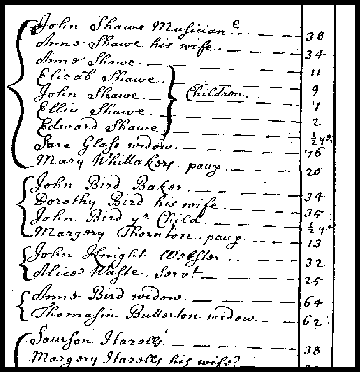
The Stoke-upon-Trent listing is dated the 2nd June 1701. It is written on the first 40 pages of a 72-page quarto paper booklet. The listing begins with the date and a brief description at the beginning of the area included and the format of the entries.

"2nd June 1701 - A collection of the names of every particular and individual person in the parish of Stoke-upon-Trent, in the County of Stafford, as they are now residing within their respective Liberties and Families within the said parish; together with the age of every such person, as near as can conveniently be known, as also the number of families and souls qualified (as to their ages) for communicating, in each family."

Who Undertook the Listing

The listing was prepared by or on behalf of Thomas Allen, who was rector of Stoke from 1697 to 1732. 

Thomas Allen was a local man, who was young at the time of his appointment, and seems to have been active and able. Although Allen was probably the person who inspired this information-gathering activity the work of sorting out and writing up the listing was evidently left to his curate, John Ward, and the parish clerk, John Poulson. 

At the time of the listing they were living together, with a female servant (Margaret Elkin) and the aged Michael Ward, who was almost certainly the curate's father. Poulson, the parish clerk, wrote out the listing. His occupation is recorded in the listing, and the handwriting of the listing is that of the register at the time.

Why the Listing was Compiled

What motivated Allen to have the parish listing compiled is uncertain, but it should be noted that Allen was particularly methodical in recording details of his parishioners. The parish registers which he compiled between 1698 and 1710 were particularly detailed. We do not know why Allen should have kept such detailed records of his flock. 

  • There is, however, some evidence, contained in both the parish register and hearth tax returns, that suggests that the population of the parish had increased markedly in the last thirty or so years of the seventeenth century, and Allen may, therefore, have had the listing compiled simply because he wanted to know more about his expanding community.

  • Another factor that may have influenced Allen may have been a concern for the poorer inhabitants of his community. If, as seems likely, the population of the parish was increasing then this may have meant that the area was experiencing some difficulty in meeting the needs of its poorer inhabitants. 
    Some support for this view is contained in the Stoke poor law accounts cited by Ward in the 1840s, and now lost, which show us that expenditure on the poor law rose markedly in the late seventeenth century. Thus the listing might have been drawn up to help in the administration of the poor law. Some of the entries in the listing lend support to this view. Paupers, parish boys and parish girls are shown, and the document lists the names of illegitimate children.

  • Another, although less likely explanation, for the compilation of the listing is that it was influenced by the Marriage Duty Act of 1695. Under this Act fees were charged for the registration of births, marriages and deaths, and bachelors and childless widowers were subject to what was in effect a poll tax. 
    The Act, which remained in force until 1706, also stipulated that lists were to be drawn up of those who were eligible to pay the tax. However, the information given in the listing is considerably more than was required by the Marriage Duty Act, and thus, it seems highly unlikely that it was drawn up simply to comply with the requirements of the Act.


Elizabeth Hatton Widow 64 3 Com
Jane Hatton ) Children 31
Elizabeth Hatton ) 20
Abigail Hatton ) Spurious 5
William Hatton ) Jane's children 2 wks
 

Table 1 - Penkhull household (PE17) 

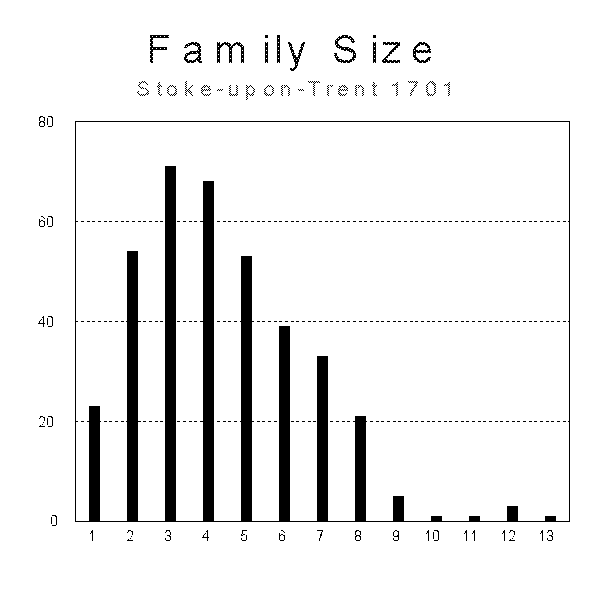
Fig 1 - comparison of family sizes 

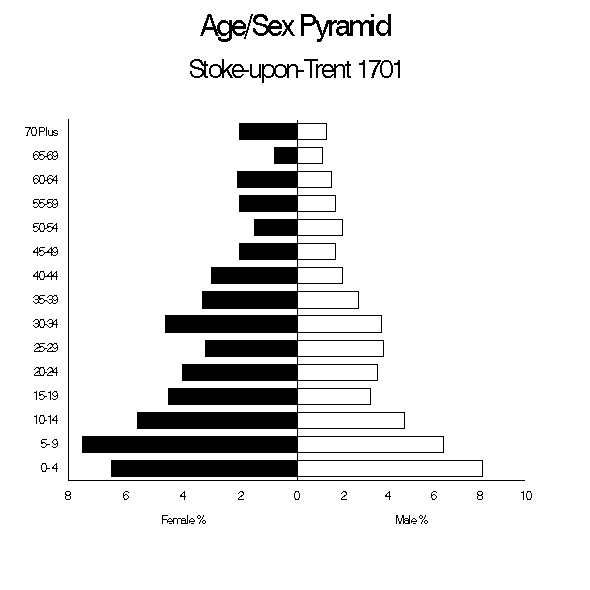
Fig 2 - age/sex pyramid


Table 1 - Penkhull family 

Table 1 shows household, referenced as PE17, in the format given by the listing: 

The family consists of Elizabeth Hatton, widow, her two children Jane and Elizabeth and two illegitimate grandchildren Abigail and William. There were three communicants in the family.

Fig. 1 - Comparison of family sizes

Figure 1 shows the distribution of family sizes in the area - from this we see that:

  • Over half the families (57.4%) contained fewer than five persons. 

  • There were 23 individuals living alone and at the other extreme one family contained thirteen people. 

Work by the Cambridge Group for the History of Population and Social Structure suggests that family size in Stoke-upon-Trent did not differ markedly from that revealed in other parish listings carried out in England and Wales at this time. 

The mean family size for Stoke-upon-Trent, of 4.4 people per family, is very similar to the figure of 4.3 people per household calculated by Arkell for England outside London for the period 1662-1712. 

Perhaps the most interesting finding of the Cambridge Group was their discovery that the nuclear family (consisting of a husband, wife and children) was the predominant type of family in pre-industrial England. 

Extended families, containing grandchildren and aunts and uncles, were comparatively rare although many families contained boarders and servants. 

Detailed analysis of the Stoke listing shows us that this was true of Stoke-upon-Trent also. In all some 70.2% of families were nuclear in form and only 13.9% contained three generations.

Fig. 2 - age/sex pyramid

Figure 2 shows the age/sex pyramid of the area as a whole. 

From this we see that, as in Britain as a whole at this time, nearly four out of ten people were children under fifteen years of age.

Exactly half the population were aged under 21 years, and the mean (average) age of the population was 25.8. 

What is particularly interesting about the age/sex pyramid is the bulge in the numbers aged 25-34 years. This might be explained by outsiders moving into the parish in search of work.


Liberty

Population

Families

MFS*

Penkhull

420

95

4.4

Clayton

105

26

4.0

Seabridge

77

19

4.1

Shelton

500

108

4.6

Hanley

327

74

4.4

Fenton Culvert

200

51

3.9

Totals

1629

373

4.4


Table 2: Population of each Liberty.

* Mean (or average) family size.

What the listing tells us


Finally, we look at what the listing tells us about life in Stoke-upon-Trent in the early 1700s. Table 2 shows the numbers of people and families in each liberty. 

From this we see that Shelton with 500 individuals living in 108 families had the largest population and Seabridge with 77 individuals in 19 families had the smallest population. 

The average (or mean) family size in the area as a whole was 4.4 people, but this figure varied from 3.9 in Fenton Culvert to 4.6 in Shelton.


Female

Male

unknown

Total

Penkhull

230

189

1

420

Clayton

53

52


105

Seabridge

38

38

1

77

Shelton

257

243


500

Hanley

168

153

6

327

Fenton Culvert

102

95

3

200

Totals:

848

770

11

1629


Table 3: Liberty by Gender


Table 3 shows the numbers of females and males residing in each liberty. 

In the area as a whole there were 848 females and 770 males. The sex of eleven individuals is unknown because their first names did not appear in the listing. 

The two smallest liberties (Clayton and Seabridge) had roughly equal numbers of males and females. The other four liberties had more females than males.


Sources

Transcription of the Stoke-upon-Trent Parish Listing of 1701 held by Stoke-on-Trent City Archives.

Historical analysis and population statistics derived principally from The Stoke-upon-Trent Parish Listing 1701 by David Alan Gatley, with Margaret Midgley and Sheena Bateman.


Page History:

  • Page created: 6 July 1997

  • Updated: 2 September 2007 - Page reformatted, no change in content.

  • Last updated: 8 June 2026 - Significant update, all content retained but reformatted. Table & figures renumbered. Added - introduction, map of Liberties, source details.