|
"When we are told that trade is bad in The Potteries, we are aware that the master potter is not the only one who suffers from that condition. . . .
When there is a fall in selling prices, the manufacturer has no alternative but to curtail his working expenses in one way or another.
The easiest way of doing this is by reducing the amount of the weekly wages bill. For upwards of a quarter of a century, prices paid to the workers in the pottery trade have steadily declined. The loss to the workers has been a double one — the reduction in the rate of wages has been accompanied by such changes in the character of the articles made as have militated against the wage-earning power of the operators.
Some manufacturers who, by virtue of their name, have been able to maintain the prices of their goods, have not allowed their workpeople to suffer from the indirect reductions [of alterations in shapes and sizes] we have just instanced.
But many others, who have been willing to deal liberally with their
employés, have yet been compelled to keep down their wages to the lowest possible amount. This has not been from inclination, but sheer necessity, and the result has been an undercurrent of dissatisfaction on the part of the
employés that, coming to the surface at intervals, has produced no little friction between them and their employers. We think we are right in saying that every section of the potting trade admits that this is a true statement of the condition of affairs. "—
Pottery Gazette (manfacturers' trade organ), January 1899.
It is a matter of singular difficulty to arrive at any definite knowledge of the average earnings of the Staffordshire potter. Almost every reference to his wages deals with the rate at which he is paid for various articles, and any comparisons instituted are those between the price paid for such an article at one period, and the price paid
at another.
The question is further complicated by a reference to sizes, and again to shapes. It is obvious that it would convey no information to quote any figure showing that, for example, at a certain period "Hand-basins, size 6, Shape Regina," were made at so much each, or per score ; unless one also knew how many such articles a workman could produce in a week when exclusively employed in making that article.
But the work of each operative, within the limits of his branch, is of a somewhat varied character —
a hollow-ware presser, for instance, may make half-a-dozen different articles, each article varying in shape, size, and price ; and the weekly wage-earning capacity of any operative in any branch varies according to many circumstances, but mainly depends upon his branch, his individual skill, the quality of the work entrusted to him, and the rates and custom prevailing at the manufactory at which he is employed.
It is, therefore, extremely difficult to give a summary average of a potter's earnings, but a few instances, given as representative cases, may be first cited.
In 1836 the Chamber of Commerce issued a return of wages paid at the principal manufactories, which showed that in 1833-4 an average workman earned between
17s. and 21s. a week, a woman about 6s. to 11s., a child of fourteen from
3s. to 3s. 6d.
In 1836-7, according to the same authority, the average earnings of a man had risen from 21s. to
28s., of a woman from 10s. to 15s., and of a child from 3s. 6d. to 4s. 6d. per week.
Probably the figures given were correct, though the source is partial, and inasmuch as the purpose of the figures was to show the improvement that had taken place in wages at the time of the strike of 1836, it is possible that either the rate of wages in the first period was unduly depressed, or in the later period slightly exaggerated.
But the same objection applies to all the figures given, at any period, and by either
side — they are all vitiated by being the statements of interested parties, using those figures for their own purposes ; and never in the course of the history of the potting trade has any attempt been made to arrive at a correct estimate of wages for the sake of the information in itself — the figures given upon that matter have always been employed as arguments, and neither side has ever completely accepted the figures of the other.
In 1843, an oven-man asserted that his wages for a week's constant work amounted to
17s. only, but there is nothing to suggest that his case was representative of the whole of his branch, the average earnings of the members of which appears to have been, at about that time,
24s. for adults.
1877-9
At the arbitrations before Mr Davies (in 1877) and Lord Hatherton (in 1879), the evidence of the workmen went to show that the rate of wages prevailing in all the branches, so far as an average could be taken, did not amount to
30s. a week ; but, on the other hand, the manufacturers quoted instances in which the wages were considerably higher.
At the Brassey arbitration, it was officially stated, on behalf of the hollow-ware pressers, that at few firms was the average in that branch as high as
30s., and that if all the hollow- ware pressers in a whole town — journeymen, and not apprentices — were taken, the average would not come out higher than
25s. a week.
The flat-pressers spoke particularly of the effect of machinery upon their wages, and the following may be given as an example : —
A flat-presser, working by hand, produced twelve score of ware, which, after paying his attendant labour and various deductions, earned for him
£1 13s. 6d. as the result of a week's work; after the introduction of machinery, he was able to make eighteen score a week, but, owing to a consequent reduction in the price, was only able to earn
£1 4s. 7½d.
Another said that by the same process his wages had been reduced to £1,
2s. from
£1, 8s.,
others admitted that they could earn
£1, 10s., whilst some declared their earnings to be as low as 20s. a week.
At the same arbitration, the turners (one of the higher branches) declared that they could not, upon an average, command
30s. a week, the printers spoke of 25s. to 30s., and the oven-men said that
4s. to 4s. 7d. per day was the average rate of payment at the various manufactories, and that
27s. 6d. was the highest wages earned by an ordinary journeyman oven-man, working from sixty to seventy hours per week.
In 1891, a flat-presser, a good and steady workman, receiving the best kind of work, and employed at a good manufactory, said he could earn
£1, 11s. to £1, 12s. a week, but others spoke of £1, 5s., £1, 2s. 6d,
and £1, 1s. as representing their average earnings.
The employers, however, gave
£1, 9s. 5d. as the average earnings, for twelve weeks, of a flat-presser.
The
hollow-ware pressers declared that the best work yielded only £1, 8s. to
£1, 10s., and the employers gave an average of a certain hollow-ware presser, for twelve weeks, as
£1, 17s. 10d, of a printer £1, 9s., and of an oven-man £1, 8s. 9d.
The last two figures do not show a very great discrepancy from those of the workmen ; but it is practically impossible to arrive, by any process of arithmetic, at anything more than an approximate estimate of a potter's average earning, and, taking the statements of both masters and men, it appears as though the average wages, in
later periods, fluctuated on either side of 30s. a week, but that many more potters were earning wages less than that sum than above it.
PLATE MAKERS
In the absence of any absolutely reliable and impartial return of the wages paid, it is necessary to take the figures given in the course of the various arbitrations that have been held, and the following are the results of the collation of these particulars, tabulated according to the various branches : —
FLAT-PRESSERS.— A branch engaged in making flat-ware — plates and dishes, as distinguished from hollow - ware — formerly made by hand, but now by machine, and also including saucer-makers and cup-makers, articles also made by the "jigger." The flat-pressers are the worst paid of any branch, and particularly the maker of plates. They pay the wages of their attendants out of their gross earnings.
PLATE-MAKER.—
"I shall call one witness who will prove by his wage bills that whereas he could earn £2, 2s. 6d., he is now earning about £1,
5s. per week, and for that sum, which is left to him after paying his attendants, he has to make, considering his losses in the oven and in the clay state, 440 dozens of plates per week. . . .
Averaging all sizes of plates together, every dozen costs about
1d. for the making.
Now, a dinner-set of 121 pieces, for twelve persons, includes 7 dozen plates, which would mean, so far as the flat-pressers are concerned, at 20 per cent, advance (asked for), less than 2d. per dinner-set.
Will the manufacturers contend that it would be impossible for such an advance in selling prices to be obtained as would give this advance in wages ? . . .
Now, the Umpires must yield to the common-sense of my statement, after the figures I have given as to the prosperous state of this trade, that manufacturers could, so far as the flat-presser is concerned, afford to add 2d. to the 539 pence that is put down as the selling price of the common dinner-set, and I may add that the price of the richest dinner-set that is produced in earthenware need not be increased to any greater extent by this addition to the
flat-presser's wages."
— Opening statement for workmen, Arbitration of 1891.
"There is no desire to reduce the wages of plate-makers, because their wages at the present time, according to our view, are as low as we could reasonably ask them to be, and, therefore, they are excepted from the reduction asked for."
— Manufacturers' case, Arbitration of 1891.
This branch obtained an advance in 1871-2, equal to about 7 per cent. ; reduced by Lord Hatherton's arbitration, 1879, by
8⅓ per cent. ; appealed for restitution of Lord Hatherton's "penny" before Mr Brassey, in 1880, unsuccessfully; appealed in 1891 for an advance of 20
percent, (other branches asking for 10 per cent.) unsuccessfully ; strike in 1900 resulted in 5 per cent, increase ; general feeling among the employers at the time favourable to this advance. Have suffered loss through machinery, and increased sizes of articles made at same price as smaller ones formerly.
" He had worked full time for the last 13 weeks, and his average earnings for himself and attendants were,
£2, 17s. 6d. He paid his attendants £1, 5s. 9d., leaving him £1,
11s. 7d. The proposed reduction of 10 per cent, would reduce his wages by
5s. 9d. on the gross, as he could not think of reducing his attendants who were by no means over-paid. Then he had to buy his own sponges, at a cost of 8d. to
1s. per week."
— W. Gibson, flat-presser, Hatherton Arbitration, 1879-
" His average earnings for self and attendants were £1, 8s. to £1, 12s. He had two attendants at
13s. a week, leaving his nett earnings, 19s." (Probably a poor workman.)
— Flat-presser's evidence, ibid.
" I earn 30s. a week. I pay 5s. rent, firing, 2s., school-wage, 2s., and rates,
1s. That leaves me £1 to clothe and feed 9 of us. That is below poorhouse fare, which is, I think,
2s. and something per head."
— Weaver, flat-presser, Brassey Arbitration, 1880.
Average of plate-makers' earnings, given by manufacturers, at Arbitration of 1891, £1,
9s. 5d. per week. Workmen contended that this was 10 per cent, above the average.
CUP AND SAUCER-MAKER.—
" How little it would be upon a tea-set to give an advance (10 per cent.) of wages to the saucer-maker may be readily computed by the Umpires, when I tell them that for
4s. or 4s. 6d. 720 saucers are made. The additional expense upon a tea-set would be even less than the flat-presser's 2d. upon a dinner-set."
— Operatives' case, Arbitration of 1891.
"With regard to cup-makers and saucer-makers, they are being gradually driven out of the market by women labour, and
if they don't choose to take our terms we can supply their places with women and apprentices."
— Advocate for manufacturers, on cross-appeal for 10 per cent, reduction, Arbitration of 1891.
Advanced in 1872; reduced by Lord Hatherton, 1879, 8⅓ per cent, or
1d. in the shilling; unsuccessful in arbitration (with every other branch) in appeal for advance, 1891 ; advanced by strike, 1900, 5 per cent.
"The man is a good average workman, and can work both by hand and jolly. When working by hand he could make twelve score dozen per week. There are 36 cups counted to the dozen, and 720 to the score.
He was paid by hand 6s. 6d. per score, so that the twelve score would amount to
£3, 18s.
He employed three attendants, to whom he paid 24s. ; and a woman sponger, to whom he paid
1s. per score, so that would be 12s. ; he paid his employer 2½ per cent, to mill the clay, which would be
2s., and the reduction (of Lord Hatherton) had to come off the gross amount of
£3, 18s., so that would be 6s. 6d. more, which left him £1, 13s. 6d.
But by the employer investing £2 in a jolly, the man's price was reduced from 6s. 6d. per score to
4s. 3d. — a reduction of 2s. 3d. between hand-made and jollied. I am not going to say that he is not able to make so much work by the jolly as by hand, for I find he makes eighteen score dozen by the jolly at
4s. 3d. per score. This amounts to £3, 16s. 6d. He is obliged to employ four attendants, to whom he pays £1,
12s. There is also the sponger, to whom goes 18s. ; the use of pug-mill,
1s. 10½d. This leaves the man £1, 4s. 7½d. for eighteen score cups."
— Evidence of George Bloor, Brassey Arbitration, 1880.
Arbitration of 1891 : — Workmen's evidence — £1, 5s. for cup -maker, and
£1, 5s. 8d. for saucer - maker. Employers' evidence — Cup-makers (women),
£1, 7s. 6½d., saucer-maker (man), £1, 7s. 1d.
DISH AND
BASIN-MAKER —
"What would the
10 per cent
advance upon these low prices mean on a toilet-set ? It would mean less than a penny on every twelve hand-basins, or the twelfth part of a penny per toilet-set.
Would there be even one face less washed in a Staffordshire-made toilet-set because of this enormous advance to the basin-maker ? . . .
Now, there are twelve dishes included in a dinner-set that I have taken as an illustration ; and 10 per cent, on the dish-maker's prices would only mean increasing the cost of the dinner-set by about three halfpence."
— Workmen's case, Arbitration of 1891.
"There are the dish-makers and the hand-basin-makers. They can already earn wages which I venture to submit will bear some slight reduction."
— Employers' cross appeal, Arbitration of 1891.
Fluctuation of wages as in other departments of flat-presser branch ; the same decrease in earning-power through increase of sizes and introduction of more difficult shapes.
" Gross earnings,
£4, 5s. ; reduced by Lord Hatherton's award (1d. in the shilling) on the gross amount
(7s. 1d.) to £3, 17s. 11d. ; attendants' wages, £2, 12s. od. ; leaving nett wages,
£1, 5s. 11d., out of which he has to pay for pugging of clay, gas, and sponges."
— Evidence of basin-maker, Brassey Arbitration, 1880.
" Previous to Lord Hatherton's reduction, could earn from £1, 17s. to £2. At present prices I could not earn more than
25s. if I did my best."
— Evidence of basinmaker, Arbitration of 1891.
Wages of basin-maker given by employers, 1891,
£1, 17s. 10d. ; dish-maker, £1, 13s. 8d.
HOLLOW- WARE PRESSERS. —
In 1891, workmen's census showed 1873 journeymen, and 993 apprentices.
Have suffered through increase in sizes, and easy work being taken from them to the "jigger," leaving difficult work to be made by hand, reducing earning capacity.
Gradual informal reductions in working prices ; formal advances and reductions same as in other branches, but advance in 1872 only partial.
"Bread and butter plates, that were made by the hollowware presser at 1s. 2d. per dozen, are now made by the flat-presser (on the "jigger") at
5s. per score dozen — a
reduction of 300 per cent.
Sponge-bowls have been taken to the jigger, and cost 50 per cent, less to make ;
soapboxes for which the hollow- ware presser received
1s. 10d., are now made on the jigger at from 9d. to 1s. per dozen," etc.
— Operatives' case, Arbitration of 1891.
"We say that the hollow-ware presser can earn, at the (proposed) reduced 10 per cent., if he chooses to work with a little added industry for six days, even more than he makes at the present time."
— Employers' advocate, Arbitration of 1891.
"Since 1872, my average wages have not been more than 30s."
— Workmen's evidence, 1877 Arbitration.
"Average wages, £1, 10s. ; rent, 4s.; rates, 8d. ; coal, 1s 6d. ; school pence,
10d. ; books and newspapers, 6d. ; sick and benefit clubs, 2s. 6d. ; leaving £1 for food and clothing."
— Workmen's evidence, Arbitration of 1879.
"An average of 24s. to 26s. full time." "An average of £1, 8s. 1d. working four days a week. In cross-examination, an average of £2, 2s.
9d. for certain weeks, but working full time. Had the best work; at his place 3 men averaged £2 per week, but 38 men averaged
10s. a week less, some £1 less. Average for whole manufactory, about
26s."
— Workmen's evidence, 1891 Arbitration.
Evidence of employers: average of
£1, 15s. 8½d. for general hollow-ware; £1, 11s. 10½d. for ewer-makers.
MOULD-MAKERS.—
Makers of the mould in which the ware is made, "requiring much skill and the application very often of original contrivance." The use of machinery has made their work more exacting in finish. Altogether a highly skilful branch for an operative.
"Ours being the stage or portion in the process of manufacture next following the modeller or designer, it requires a considerable amount of training and skill."
— Workmen's case, Arbitration of 1891.
"The mould-makers have received notice of a reduction equal to 15 per cent. These mould-makers, I will show conclusively, make almost fabulous wages. They come and go
generally at times which suit themselves, and are a superior class in every way ; and in the circumstances can afford, if anybody can, to have a percentage taken off."
— Employers' advocate, Arbitration of 1891.
Received no advance in 1871-2, as did other branches, but were included in Lord Hatherton's reduction in 1879. Have received no advance since.
Workmen's evidence of average wage: £1, 10s. to £2, 5s.
— Brassey Arbitration of 1880.
Workmen's evidence in 1891 Arbitration: £1, 16s. to £2, 2s. " We (Doulton's) employ three mould-makers, and their average earnings for the first 13 weeks of 1891 were
£3, 2s. 11½d., £2, 11s., and £2, 3s. 1d."
— Employers' case, 1891.
Manufacturers' statement of average earnings of mould-makers, at twelve places,
£2, 3s. 4d. per week.
— Arbitration of 1891.
THROWERS.—
"The throwers' case is an interesting one, and illustrates the great changes that have taken place in potting during the period covered by the great arbitrations in this trade.
The thrower's wheel— the first machine, perhaps, in any industry — no longer occupies the prominent producing position it once did, for most of the articles that were made by the thrower are now taken away from the wheel, and are either pressed or made on the jigger.
Seventy-five per cent, of these articles have been taken away from him, and the articles left to him have been increased in size."
— Workmen's case, Arbitration of 1891.
"Taking the thrower as an example, that which was formerly entirely done by the men is now done on the machine by women and boys equally well for the purposes of the manufacturer, and the result is that machinery drives out these men from positions which they previously held alone. If there were any added wage given to the thrower at the present time the result would be his extinction the more rapidly."
— Manufacturers' case, Arbitration of 1891.
The thrower is probably the most complete example of manipulative skill in any industry. It is his work, giving
shape to shapeless clay by the movement of the fingers, which best illustrates the saying of "clay in the hands of the potter."
"A thrower who worked a week would get £2, 10s. to £2, 15s. in 1875 to 1879" (reduced by Lord Hatherton in 1879), "but it is a fair average man who gets £2 now."
— Workmen's case, 1891.
Average of thrower's earning stated by manufacturers, 1891, to be
£2, 10s. 3½d.
TURNERS.—
They finish on the lathe the work of the thrower, and sometimes the rougher work of the jiggerer. Like the thrower, they have suffered by much of their work being taken to and completed by the jigger, and by increase of sizes. The introduction of the steam lathe has reduced prices. They pay their attendants.
"Head-turner, £2, 2s., average of others, £1, 6s., ordinary turners,
£1, 13s. Average at different firms: £1, 8s., ;£i, 45. 9d., £i, 55., and £it 73. 6d." — Workmen's case, 1891. Manufacturers' average of turners' earnings, £1,
14s. 2½d.
Were only partially advanced in 1872, but reduced same as other branches in 1879 by Lord Hatherton.
HANDLERS.—
No material increase in 1872; reduced by Lord Hatherton in 1879 ; further reduced 1885 ; sizes larger, prices rather less than formerly. They pay their attendants.
"It is impossible for a handler to get more than
5s. per day, and, after paying attendants and other deductions, his day's wages are brought down to
4s. 2d."
— Workmen's case, 1891.
Employers' statement
of average earnings, 1891, £1, 17s.
PRINTERS. —
The printer prints upon tissue paper from the copper-plate, which he passes under his press, the design which is to be imprinted on the ware ; this is then transferred to the ware by the transferrer (a woman), and the paper is washed off, leaving the print behind, by a girl attendant.
In 1872 there were in The Potteries district 705 printers (journey-men and apprentices), with 1500 women transferors and girl assistants ;
in 1879, 807 printers, with 1620 women and girls ;
in 1891, 1223 printers (journeymen 822, and apprentices 401), with 2500 women and girls.
The wages are paid on the basis of the "count" —
i.e. 5½d. is paid for each dozen of ware printed; but the "count" decides how many pieces shall go to the dozen.
In recent years the count has been lengthened —new patterns have largely been taken as long counts, and short counts have become long counts. The shorter the count the fewer pieces to be printed to the dozen.
Advanced in 1872, reduced in 1879, prices unaltered, but counts gradually lengthening ever since.
"Our wages are insufficient to meet our rents, rates, firing, insurance for sickness and death, religious and social
charities (!), clothing for ourselves and families, and twenty-one meals per week for parents and children ; and a printer cannot work ten hours a day at a press and over a hot stove on red herrings and broth.
If an English operative cannot obtain substantial food, he loses his native stamina, and will sink to the inertness of a Continental operative. Living in towns, we cannot go out full-rigged in a smock-frock, hobnailed boots, and for our head-gear a fourpenny tommy-cap."
— Evidence of John Goodwin, printer, Brassey Arbitration, 1880.
"The printer's position is a dignified one. His occupation is not a laborious one. There are certain drawbacks— the mixing of paint [colour], and having to allow a reduction for soap are objectionable, no doubt— but to stand and turn a handle and pass a thing backwards and forwards is not a very laborious occupation. For some years past, for my own amusement and information, I have visited various potteries in the district, and I have always admired the dignified ease of the printer's position. We say that the printer can afford to allow us
¼d. a dozen."
— Employers' advocate, Arbitration of 1891.
"I say a good printer can earn £1, 13s. 9d., paying 1s. 4½d. out of that
(1s. for oil, 3d. for soap, and 1½d. for tar), if he comes at breakfast-time on Monday and works the usual hours until 2 o'clock on
Saturday."
— Mr Ridgway's evidence (manufacturer), Arbitration of 1877.
"We admit that printers can earn that amount, but we affirm that whilst at Mr Ridgway's place the deduction would be only
1s. 4½d., in general it is 5s. for mixing colour, size, cutting, tools, and so on."
— Workmen's case, Arbitration of 1877.
"Printer, £1, 13s. 9d., gross; 5s. deductions, leaving £1, 8s. 9d. nett, working full time and producing 120 dozens; journey woman transferrer,
15s. gross, deductions, 2s. 8d., nett, 12s. 4d. ; apprentice, 10s. gross, deductions,
2s. 8d., nett, 7s. 4d. Average for journeymen generally, £1, 5s.
9d."
— Summary given in 1879, by workmen.
"So far back as 1836, nearly half-a-century ago, we, as printers and transferrers, were paid more than we received previous to the reduction of last year (1879). There has been a gradual reduction, whenever a manufacturer had an opportunity of making it."
— Statement of George Ingleby, printers' representative, Brassey Arbitration, 1880.
Evidence being given on the part of the workmen that the printers averaged £1,
5s. 8d., Mr Powell, leading for the manufacturers, said : "We say the average is £1,
7s. 1d."
— Brassey Arbitration, 1880.
"A journeywoman transferrer earns 12s. 10d. ; deductions,
2s. 6d., nett, 10s. 4d. Journeywomen transferrers, as a rule, are married, and pay
3s. or 4s. for nursing."
— Workmen's evidence, 1880.
" Here is an article we counted as 24's — it is now counted 36's. That is 50 per cent, added on that article. There are places where tea-pots counted as
12's previous to 1884, are now counted as 15's.
There are articles that have been doubled from 6's to 12's, as in vases, comports, and all that sort." — "120 dozens of ware is considered an average week's work.
It is
£1, 11s. 3d. for 120 dozen.
A man has to pay
3s. for mixing colour, and 3d. for soap, as well as 6d. to the girl who cuts
papers — the cutter we call her. That reduces his wage to £1, 7s for the full week. Holiday times and
other things will reduce the full time by half-a-day a week, and in that case his nett wages are £1,
4s. 6d.
A woman transferrer earns
13s. 9d., less 2s. 4d. for the cutter, and 1d. for soap."
— Workmen's case, 1891 Arbitration.
Average earnings of journeymen printers as stated by manufacturers, 1891 — £1,
9s. 2d.
OVEN-MEN. —
" No labour upon a manufactory is so heavy, and they must be men of strong constitution, or they are soon out of the ranks.
Their work includes the carrying of the ware and the sagger to the bench, the placing of the ware in the sagger, the carrying of the full sagger to the oven and the lifting and placing of it in the oven.
Then, after firing, the oven has to be drawn ; the saggers to be carried out, to be emptied, and the ware carried into the warehouse, and this makes up the tale of the oven-man's work. . . .
During the last winter the clay they have used for ' wads ' has been frozen on the bench outside ; and after that they have had to go to work in the oven in heat which has singed the flannels with which their hands and heads have been swathed. When the oven-men receive the advance they are asking for, it will not amount, for the journeymen, to
5d. per hour."
— Opening statement for workmen, Arbitration of 1891.
"A question has been much pressed by the workmen as to whether the manufacturers thought
5s. was too much to find the comforts which every man needed. He said 5s. was not too much, but unfortunately political economy and England could not afford to pay it, and if he were asked whether, compared with skilled labour,
5s. was too much for an oven-man, he held that it was above the market price. . . .
Lord Hatherton : A good hedger and ditcher is a very valuable man. —
Mr Jones : So is a good placer a very valuable man, but that is no reason why we should pay
5s., when in the country (for farm labourers) they pay 3s. or 3s. 6d., including everything." —
" Mr Finder (manufacturer) : Before the pug - mill was introduced, women were selected, many of whom were physically strong, for the wedging of the clay, a toil that was perhaps the most laborious on the manufactory. In that respect it could only be matched with
oven-work." —
" Mr Clement Wedgwood : Two or three years ago witness's brother had gone round on a (Continental) tour of inspection, and from the notes he gathered that the wages of oven-men— who his Lordship had heard were well worth
5s. a day— were there only 2s. 6d. and 2s. 9d. per day. This was, he thought, a proof of the co-operation of men and masters abroad."
— Extracts from employers' evidence, Hatherton Arbitration, 1879.
"Witness: He had worked in France. It was a fact that there were two Frenchmen to carry a sagger up in the oven, but an Englishman put it on his back and did it himself, besides placing 20 more saggers in a day. He does three times as much work as a Frenchman. He could not stay in France, as he feared for his life, having introduced so much more work for them to do.
Lord Hatherton : All this is very interesting, no doubt, but I fail to see how it bears on the point before us.—
Mr Oakes : Yes, the employers say foreign competition interferes with them, as French manufacturers get their work done cheaper than in England."
— Extract from workmen's case, Hatherton Arbitration, 1879.
" The amount of work that an English navvy will get through in comparison with an Italian is almost incredible."
— Mr Brassey, Arbitration of 1880.
"The oven-men have received a notice to the effect that the reduction in their branch would be equivalent to 3d. a day. It is true these men have to work hard, but in these days to pay more than
4s. 6d. or 4s. 3d. for such work is not the rule."
— Employers' advocate, Arbitration of 1891.
" I take my average at 5½ days a week (though that is not always the case) at
5s. a day, which brings me in 27s. 6d. a week, which, with my children's
3s. per week, makes me 30s. 6d.
Out of that I pay 3s. a week for rent, 3s. for coal and light, which, with my
1s. 6d. for my clubs, makes 7s. 2d. Then I have to pay 1s. for school wage for my children, which makes me 8s. 2d.
I take out of 21s. 10d., 2s. a week for my clothing for myself and family, and that won't cover it, which leaves me 2d. short of a pound to support my family.
There are eight of us in the family, and I think that under the present circumstances
the oven-men should not be reduced."
— Evidence of Mr Thomas Edwards, oven-man, Davies Arbitration, 1877. (No reduction was awarded.)
"At different manufactories different rates were paid for oven-men.
At one firm the average was
4s. 2d. per day ; at another 3s. 9¾d. (names given)." —
Lord Hatherton : " I think we have got enough to show that the oven-men do not all get
5s. a day." — " Other evidence having been given, Lord Hatherton said again enough had been quoted to show that oven-men did not get
5s. a day as a whole." —
" Mr Spooner gave evidence showing that of 10 firms, with 68 ovens, employing 155 men, the average wages of oven-men were
4s. 6d. per day."
— Evidence of workmen, Hatherton Arbitration, 1879, p. 20.
(In 1872 advances were made to oven-men, making their day wage
5s. Lord Hatherton decreed a reduction of a penny in the shilling in 1879.)
" Mr Edwards was entering upon the question of the price of provisions, when the Umpire said this was not an element of which he could take cognizance. —
Mr Edwards said inasmuch as the employers sought to show what a large percentage of their money went in materials —coal and borax, etc. — he wished to show in what food 50 per cent, of his earnings went.
He had to cut up twenty-eight loaves a week, and the price of flour had risen."
— Workmen's case, Hatherton Arbitration, 1879.
" You will see that our work has been increased " (by new methods of placing the ware in the saggers, by which more ware was consequently placed in the oven), "and our wages reduced from an average of
4s. 7d. per day." — Workmen's case, Brassey Arbitration, 1880.
In 1891 wages had not materially changed, but the oven-men complained of the increase of the apprentices in each " set " throwing more work on the journeymen, who were responsible for the whole job. Manufacturers gave evidence
of the average wages of oven-men being £1, 8s. 9d.
Reduction of wages asked for by the employers (3d. per day) and advance of 10 per cent, asked for by oven-men were both refused at Arbitration of 1891.
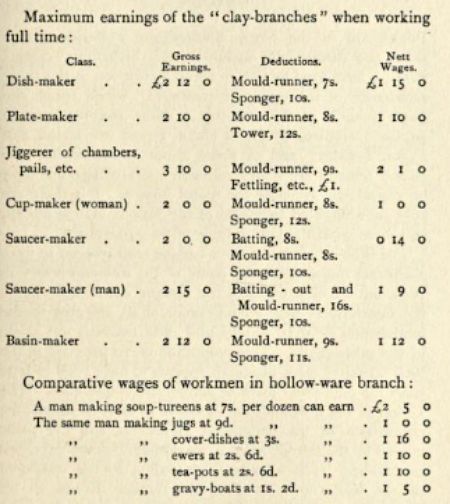
The above figures are supplied by a manufacturer in 1900, and represent the possible earnings of workmen when working full time, and when " not waiting for clay or steam."
Calculated on basis of 5 per cent, advance obtained in 1900.

  
previous: Appendix 2 - The
use of Machinery and its Effect on Wages
next: Appendix 4 - The Weakness of Their Union
|
