
Wedgwood's Potworks
Wedgwood's Potworks





next: the Ivy House Works
Churchyard Works, Burslem
- the Wedgwood family pottery -
Josiah Wedgwood's association here:
|
|
The Churchyard Works, adjoining St John's Church in Burslem, were the home of the Wedgwood family pottery for more than a century. Four generations of the Wedgwood family worked here before Josiah Wedgwood established his own independent pottery at the Ivy House Works in 1759. |
| The Churchyard Works at a glance | |
| Works name: | Churchyard Works |
| Operating period: |
By 1656, Thomas Wedgwood had taken possession of the Churchyard Works. The Wedgwood family operated these works until the later eighteenth century. Sold to Thomas Green in 1795 who operated until 1811. The pot-works were then held by various tenants and, until about 1858, were let off in small holdings to different potters. In 1887, Messrs. A. J. Wilkinson took the Churchyard Works from Edward Clarke, and continued into the twentieth century. |
| Location: | Situated alongside the Parish Church of St. John, Burslem. |
| Maps: | view location on Google Maps |
| Significance: | Birthplace of Josiah Wedgwood. |
| Relevant Links: | |
|
|
The Churchyard Works - the birthplace of the Wedgwood pottery dynasty.
| Generation | Name | Connection with the Churchyard Works |
|
|
||
| 1st | Thomas Wedgwood I (c.1617–1679) |
Believed to have taken possession of the Churchyard Works around 1656. He established the pottery that became the family's base for over a century. |
|
|
||
| 2nd | Thomas Wedgwood II (1653–1716) |
Inherited and continued the pottery business at the Churchyard Works. |
|
|
||
| 3rd | Thomas Wedgwood III (1685/1687–1739) |
Josiah
Wedgwood's father. Operated the Churchyard Works until his death in 1739. Josiah was born there in 1730. |
|
|
||
| 4th | Thomas Wedgwood IV (1716–1773) |
Josiah's eldest brother. Inherited the works after their father's death and took Josiah as an apprentice in 1744. |
|
|
||
|
|
||
|
|
|
The works, situated beside St John's Church in Burslem, were the original home of the Wedgwood family pottery business and the birthplace of the Wedgwood ceramic dynasty. The works were established by Thomas Wedgwood I during the mid-seventeenth century and remained in family ownership for generations.
|
|
|
|
Josiah Wedgwood's apprenticeship After leaving the family pottery in the early 1750s, Josiah Wedgwood broadened his experience by working with several of the leading potters of North Staffordshire.
The Churchyard Works therefore represent the beginning of the Wedgwood story rather than the beginning of the Wedgwood business. It was here that Josiah acquired the foundations of his craft, but his years working alongside other Staffordshire potters gave him the knowledge and confidence to establish his own pottery at the Ivy House Works in 1759. From that point onward, the Wedgwood name became synonymous with innovation, quality and artistic excellence. |
|
|
|
Two Views of the Churchyard Works Two distinctly different illustrations of the Churchyard Works have been published.
|
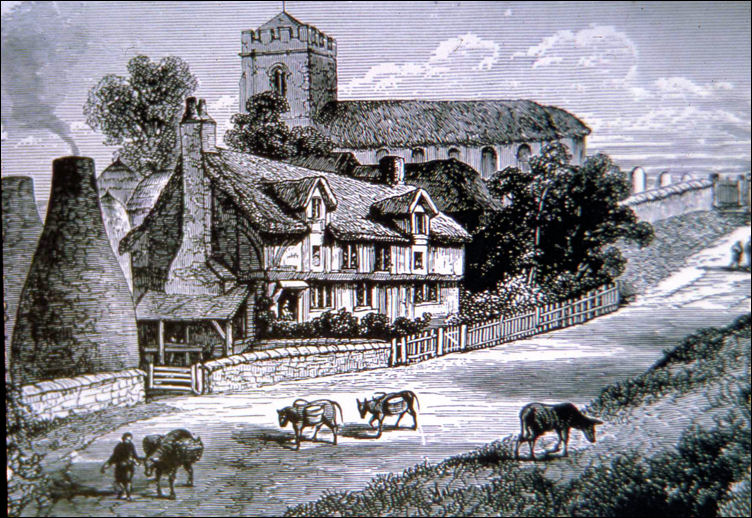
Churchyard House and Works, Burslem.
Behind the house is the Parish Church of St. John
|
Churchyard House and Works, Burslem. A historical
reconstruction appearing in volume I of Eliza Meteyard's Life of Josiah Wedgwood (1866), depicting the works as they are thought to have appeared during Josiah Wedgwood's youth. |
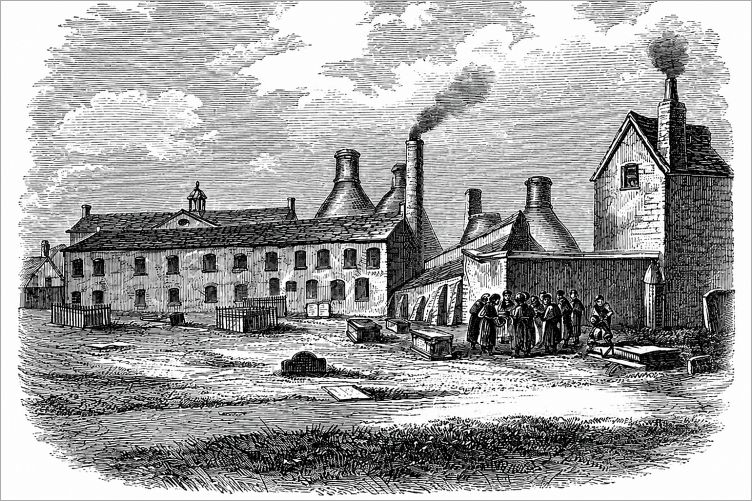
The " Churchyard Works," Burslem
| Churchyard Works, Burslem. Contemporary engraving published in Llewellynn Jewitt's The Wedgwoods (1865), showing the rear of the works from St John's
Churchyard
|
|
Unlike the better-known illustration showing Churchyard House and St John's Church commonly attributed to Eliza Meteyard, this engraving depicts the Churchyard Works from the opposite direction.
|
|
|
1800 plan of locations in Burslem associated with Josiah Wedgwood
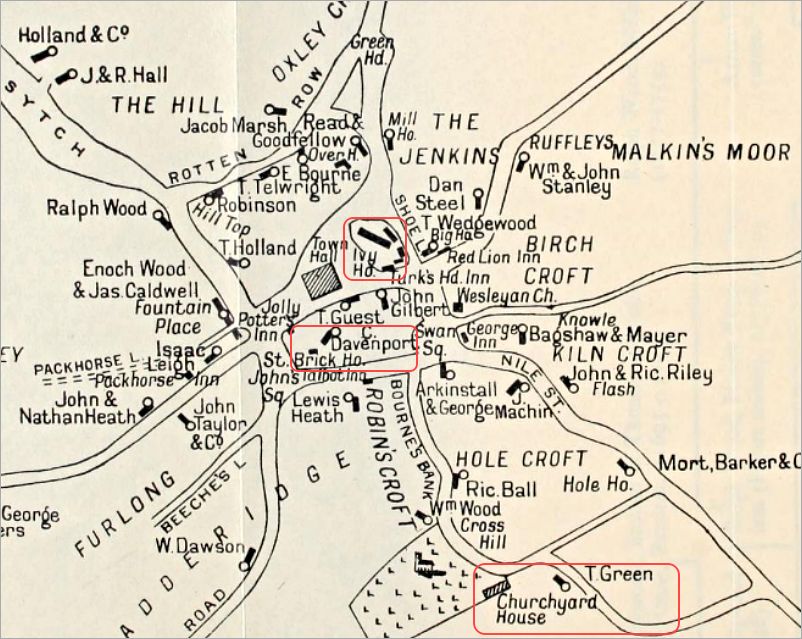
Map of the potworks in Burslem
- 1800
Locations
associated with Josiah Wedgwood (173-1795) are highlighted in red.
|
» The Churchyard House and Works is where Josiah was born. His eldest brother, Thomas Wedgwood IV, took Josiah as an apprentice here in 1744. » Near the Town Hall and on the opposite side of the road to the Wedgwood Big House is the Ivy House Works - Josiah established his own independent pottery business here in 1759.
» Josiah Wedgwood expanded his business in 1763 when he rented the Brick House Works from the Adams family of potters.
|
|
|
next: the Ivy House Works
|
|