
Wedgwood's Potworks
Wedgwood's Potworks





previous: Churchyard Works
next: the Brick-House Works
Ivy House Works, Burslem
- Josiah Wedgwood's First Independent Pottery
-
Josiah Wedgwood manufacturered here from 1759 to 1762
|
The Ivy House Works occupied a pivotal place in the history of the pottery industry. Although Josiah Wedgwood worked there for only about three years, from 1759 until 1762, it was here that he established his first independent business and laid the foundations of the Wedgwood company. During this brief period he developed the disciplined approach to experimentation, quality control and manufacturing that would later transform the pottery industry and lead to the creation of the much larger Brick House Works and, ultimately, the purpose-built Etruria Works. |
| The Ivy House Works at a glance | |
| Works name: | Ivy House Works |
| Operating period: |
Josiah
Wedgwood rented these works starting May 1, 1759, from his distant
cousins John and Thomas Wedgwood of the Big House for £10 per year. The original buildings were later sold in the 19th century and demolished around 1835 to clear space for Burslem's new market hall. |
| Location: | Situated alongside the Burslem Town Hall |
| Maps: | view location on Google Maps |
| Significance: | Josiah Wedgwood's first potworks |
| Relevant Links: | |
|
|
|
Although Josiah Wedgwood occupied the Ivy House Works for only about three years (1759–1762), its importance in the history of the pottery industry cannot be overstated. It was here that he took the decisive step of becoming his own master and established the principles that would underpin the extraordinary success of the Wedgwood company.
|
|
|
|
Key Events at the Ivy House Works (1759-1762) |
| Date | Event |
|
|
|
| 1759 | Josiah Wedgwood established his first independent pottery business. |
|
|
|
| 1759-1762 | Developed the systematic experimentation that became the hallmark of the Wedgwood company. |
|
|
|
| c.1760-1762 | Continued refining cream-coloured earthenware, leading to the later success of Queen's Ware. Wedgwood had already been experimenting with cream-coloured bodies during his partnership with Thomas Whieldon, and he continued refining them at the Brick House Works before achieving the celebrated Queen's Ware. |
|
|
|
| 1762 | Met Thomas Bentley, who would become his lifelong business partner. |
|
|
|
| 1762 | Outgrew the Ivy House Works and moved production to the larger Brick House Works. |
|
|
|
View of the Ivy House Cottage and Works |
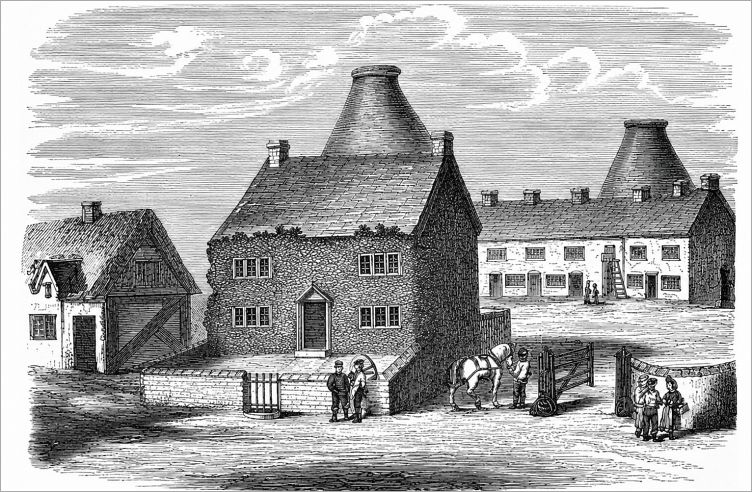
The Ivy House Burslem
|
The Ivy House and Works, leased by Josiah Wedgwood in 1759, stood on the corner of Shoe Lane (now Wedgwood Street) in the centre of Burslem. The house, named for the ivy that covered its walls, belonged to his cousins Thomas and John Wedgwood, from whom he rented the property and adjoining pottery for £10 per year. The engraving, published by Llewellynn Jewitt in The Wedgwoods (1865), shows the house with its small front garden, together with the workshops and bottle kilns where Wedgwood established his first independent pottery business. It was here that he produced many of the innovative wares and carried out the experiments that laid the foundations of his later success. The Ivy House was also the first home of Josiah and Sarah Wedgwood after their marriage in 1764. The buildings survived long after Wedgwood had moved to larger premises but were demolished in the 1830s to make way for the enlargement of Burslem Market and the construction of the Market Hall. Jewitt lamented their loss, describing the Ivy House as "one of the most interesting memorials of Josiah Wedgwood which the neighbourhood possessed."
The Ivy House and Works, Burslem. Engraving published in The Wedgwoods by Llewellynn F. W. Jewitt (1865), p. 121. |
|
|
1800 plan of locations in Burslem associated with Josiah Wedgwood
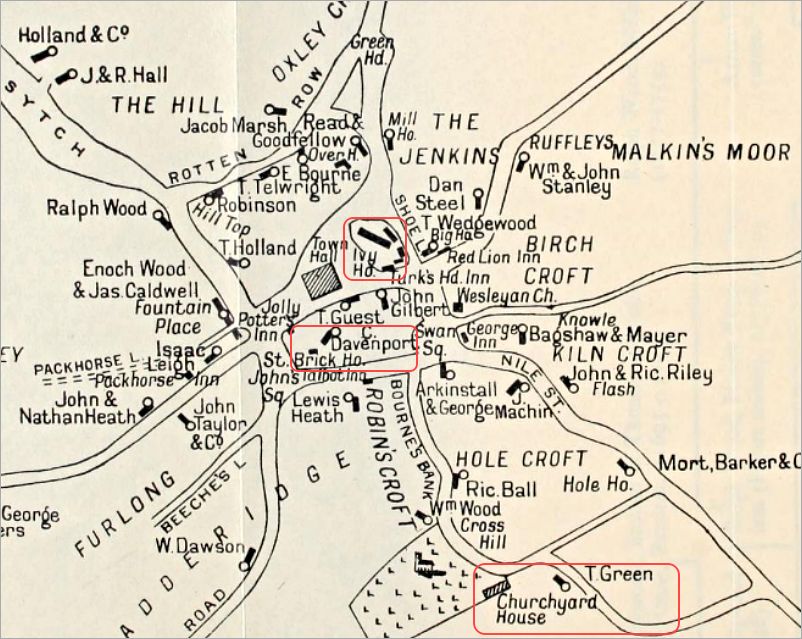
Map of the potworks in Burslem
- 1800
Locations
associated with Josiah Wedgwood (173-1795) are highlighted in red.
|
» The Churchyard House and Works is where Josiah was born. His eldest brother, Thomas Wedgwood IV, took Josiah as an apprentice here in 1744. » Near the Town Hall and on the opposite side of the road to the Wedgwood Big House is the Ivy House Works - Josiah established his own independent pottery business here in 1759.
» Josiah Wedgwood expanded his business in 1763 when he rented the Brick House Works from the Adams family of potters.
|
|
|
previous: Churchyard Works
next: the Brick-House Works
|
|