
Wedgwood's Potworks
Wedgwood's Potworks





previous: Brick House
Works
next: Barlaston Works
Etruria Works
- Wedgwood's Great Industrial Pottery -
Josiah Wedgwood started manufacturing here from 1769
|
The Etruria Works represented the culmination of Josiah Wedgwood's vision to create a purpose-built pottery that combined scientific innovation, efficient manufacturing and modern transport.
|
| The Etruria Works at a glance | |
| Works name: | Etruria Works |
| Wedgwood's association |
Josiah Wedgwood built the new works between 1767 and 1772. |
| Location: | On the rural Ridge House Estate between Burslem, Shelton and Newcastle-under-Lyme. |
| Maps: | view location on Google Maps |
| Significance: | One of the world's first purpose-built industrial potteries. |
| Relevant Links: |
Etruria Valley - Rural Origins and Industrial Growth Etruria Hall - Wedgwood's home The Roundhouse - the only surviving building |
|
|
|
When Josiah Wedgwood purchased the land for his new pottery in the late 1760s, there was no place called Etruria. The site lay in open countryside between Burslem, Hanley and Shelton, an area of fields, small farms and scattered cottages with no recognised settlement. Wedgwood chose the name Etruria in honour of the ancient civilisation of Etruria (modern Tuscany in Italy), whose finely decorated pottery and artistic achievements had inspired eighteenth-century collectors and designers. Classical Etruscan vases were widely admired throughout Europe, and Wedgwood himself studied their forms and decoration when developing many of his own ornamental wares. The new pottery soon became known as the Etruria Works, while the surrounding estate, hall and growing industrial community adopted the same name. Over time, Etruria entered everyday use and eventually became the recognised name of the district that still exists today. |
|
|
|
By the mid-1760s, Josiah Wedgwood had transformed his small independent pottery at the Brick House Works into one of the most successful ceramic businesses in Britain. Demand for his cream-coloured earthenware was increasing rapidly, new ornamental wares were under development, and orders were arriving from customers throughout Britain and overseas. Although the Brick House Works had served him well, the site had become increasingly cramped and offered little room for further expansion.
In 1767 Wedgwood purchased the Ridge House Estate for £3,000—a substantial investment that reflected both his growing prosperity and his confidence in the future. Rather than buying land solely for a new pottery, he acquired an entire estate that provided space for a factory, a family home, workers' housing and the proposed route of the Grand Trunk Canal. Although the site was largely open countryside when construction began, it lay within easy walking distance of Burslem, Shelton and Hanley. Many of Wedgwood's existing workforce are likely to have transferred from the Brick House Works, making the move to Etruria without leaving their homes.
The Grand Trunk Canal One of the most important factors influencing Josiah Wedgwood's decision to build the Etruria Works was the proposed Grand Trunk Canal, later known as the Trent & Mersey Canal. During the eighteenth century roads in North Staffordshire were often little more than rough tracks, making the transport of fragile pottery slow, expensive and hazardous. Breakages were common, while the movement of bulky raw materials such as clay, flint and coal added significantly to production costs.
|
|
|
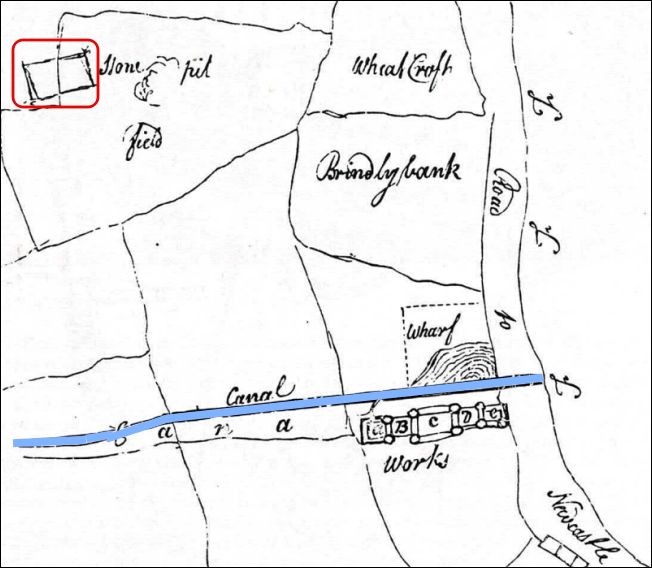
map showing part of the Ridge
House Estate bought by Josiah Wedgwood
from a Mrs Ashenhurst for £3000 in 1767
This site was chosen because it combined an existing
trackway with the proposed canal.
That was one of the most forward-looking aspects of Wedgwood's planning.
|
"The Ridge-House Estate as sketched by Mr. Wedgwood" - Life of Josiah Wedgwood by Eliza Meteyard (1866), vol 1 p. 496. |
|
"The line of the new Trent and Mersey Canal has been drawn across the existing fields. Below this the new factory is shown arranged around a series of courtyards next to the turnpike road to Newcastle-under-Lyme. On the other side of canal in Stone pit field is the site of Etruria Hall" Andrew Dobraszczyc, Social History Walks -Josiah Wedgwood & Etruria. |
|
|
1775 plan showing locations associated with Josiah Wedgwood

The Burslem and Etruria area in
1775
from W. Yates' A Map of the County of Stafford, 1775
|
» Burslem is where Josiah Wedgwood was born in 1730. He manufacturered here at the Ivy House Works (1759-64) and Brick House Works (1764-73) » In 1766 he purchased the Ridge House Estate and by 1769 built his new factory here - this he called "Etruria". Wedgwood completed the move from Burslem to Etruria in the Autumn of 1772. » The location he chose for his new factory was adjacent to the road from Burslem to Newcastle-under-Lyme (orange line) - the Newcastle–Leek Turnpike Act was passed in 1765 and so this road was transformed into a properly maintained turnpike road.
|
|
|
|
The Move from Burslem to the New Etruria Works Although the Etruria Works began production in 1769, the transfer from the Brick House Works was gradual. Wedgwood continued to use both potteries for several years while buildings were completed, kilns commissioned and production transferred in stages. |
| Year | Event | Details |
| 1766 | The Vision & Land Purchase | Facing production bottlenecks at Brick House, Wedgwood purchased the 350-acre Ridgehouse Estate for £3,000. He renamed it "Etruria" after the Italian region famous for ancient Etruscan pottery. |
|
|
||
| June 1769 | Ornamental Works Open | The Etruria factory officially opened. Production began immediately on highly lucrative "ornamental" wares like Black Basalt, while his "useful" everyday creamwares temporarily remained in Burslem. |
|
|
||
| November 1769 | The Eviction notice | The landlord of the Brick House premises, William Adams, gave Wedgwood notice to leave because he required the buildings for his own business. |
|
|
||
| 1771 | Domestic Move | Construction on the grand Etruria Hall was completed, allowing the Wedgwood family to relocate their home permanently from Burslem. |
|
|
||
| Autumn 1772 | Full Relocation |
The remaining manufacturing infrastructure and the production of "useful" Queen's Ware were entirely transferred from the brick House Works to Etruria. |
|
|
||
| 1795 | Death of Josiah Wedgwood |
The business passes to the next generation. |
|
|
||
|
|
|
Views of the Etruria works |
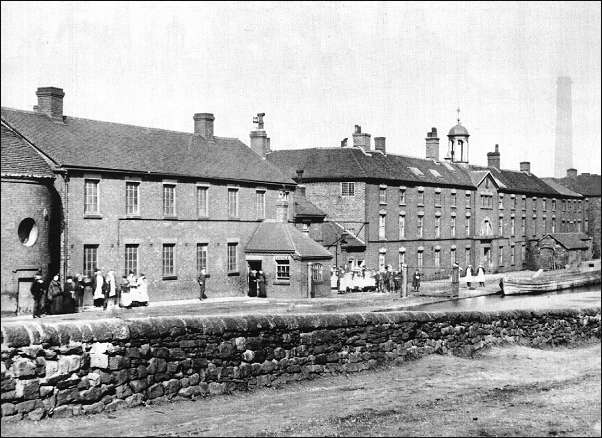
The Etruria Works alongside the
Trent & Mersey canal
|
|
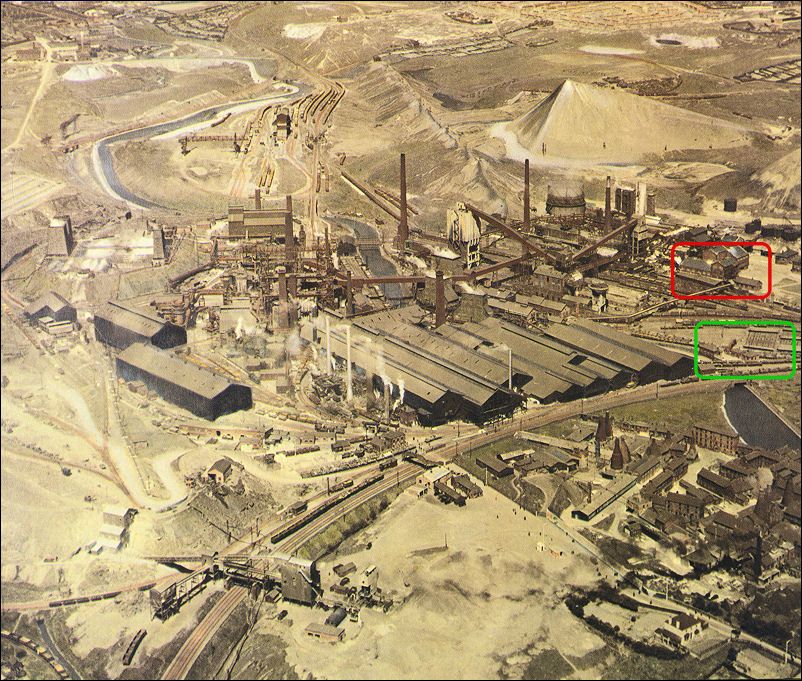
Aerial photograph of the works c.1950
|
Dominating this picture is the sprawling Shelton Iron and Steel Works with it's railway tracks and spoil heaps. The pollution and ground subsidence caused by these steel works were significant factors in the relocation of the Wedgwood business to a new factory in Barlaston. In the bottom right corner the blue rectangle is Wedgwood's Etruria Works - at the time of this photograph manufacturing was coming to a conclusion here as production was being moved to the newly built Barlaston works. The
red rectangle is Etruria Hall and green rectangle is the general location
of the wharf on the Trent & Mersey Canal. |
|
|
|
The Move to Barlaston By the early twentieth century, the Etruria Works faced increasing challenges. Although the factory had been enlarged and modernised many times since its opening in 1769, its original eighteenth-century layout made further expansion difficult. The closely packed buildings, narrow courtyards and ageing infrastructure were unsuited to the larger machinery and more efficient production methods required by modern ceramic manufacture. In 1938 the company began constructing a new factory at Barlaston, designed to provide spacious, modern workshops with improved transport links and room for future expansion. During the Second World War, production was gradually transferred from Etruria, and by 1940 the new works had become the principal manufacturing centre of the Wedgwood business. Parts of the Etruria Works continued to be used for storage and specialist operations for some years, but much of the historic factory was eventually demolished. Today only a single building survives, providing a reminder of the pottery that transformed the British ceramics industry and established Wedgwood as one of the world's leading manufacturers. |
|
|
previous: Brick House
Works
next: Barlaston Works
|
|