| Hanley - one of the Six Towns of Stoke-on-Trent |
Tunstall
 Burslem
Hanley
Stoke-upon-Trent
Fenton
Longton
Burslem
Hanley
Stoke-upon-Trent
Fenton
Longton |
| Hanley - one of the Six Towns of Stoke-on-Trent |
|
Tunstall
Burslem
Hanley
Stoke-upon-Trent
Fenton
Longton |
|
|
| "The streets were lively with
the red and blue colours of politics. The Liberal member for the
Parliamentary borough of Handbridge, which included Bursley, had died very
suddenly, and the seat was being disputed by the previously defeated
Conservative candidate and a new Labour candidate officially adopted by
the Liberal party.
The Tories has sworn not to be beaten again in the defence of the integrity of the Empire. And though they had the difficult and delicate task of persuading a large industrial constituency that an industrial representative would not further industrial interests, and that they alone were actuated by unselfish love for the people, yet they had made enormous progress in a very brief period, and publicans were jubilant and bars sloppy." The aspect of the affair that did not
quite please the Society for the prosecution of Felons, was that the
polling had been fixed for the day after its annual dinner, instead of the
day before. Powerful efforts had been made 'in the proper quarter' to get
the date conveniently arranged, but without success; after all, the seat
of authority was Hanbridge and not Bursley." |
|
|
Following on from Tunstall
and Burslem, Hanley dominates the next hill on the road south and was an
important mining town surrounded by colliery spoil tips which have now
been landscaped and reclaimed, (The main area being 'Central Forest
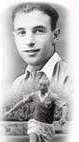
Park'). Hanley became the main shopping centre of the Potteries when, in 1910, it became a federated city with the merger of all six towns. Nowadays the town boasts a large shopping centre and the city's Cultural Quarter comprising two splendidly refurbished theatres, the The Regent, along with one of the country's best concert venues, the Victoria Hall Amongst some of the famous people born in Hanley are football legend Sir Stanley Matthews and Captain E. J. Smith, the captain of the ill-fated Titanic. The centre of Hanley retains its 'village roots' and is made up of "an archipelago of island sites". It is the main shopping area with many 'high street' names both in the town streets and shopping centre. On the site of the old Bell pottery stands the Potteries Museum which houses one of the largest and most important ceramics collection in the world. The museum also contains a Spitfire airplane - a tribute to the designer Reginald Mitchell who was born in the City. Lord of the Manor... "Bagnall, Esq. of London, is lord of the manor, and holds a court baron once a year; the King, as Duke of Lancaster, holds also a court baron once in the same period; and a court is held once a fortnight, for the recovery of debts under forty shillings." "HANLEY a large modern town and chapelry, in the parish of Stoke, is about two miles east by north of Newcastle, and ranks next to Burslem in size, extent and opulence. The town is in an elevated situation, and the streets forming which are irregular, but many of the houses are well built. The chapelry contained, in 1821, 5,622 inhabitants." 1828 journal "Hanley, the most populous town in North
Staffordshire, is generally described as the capital of the Potteries, a
title to which it has certainly the greatest pretensions; ........ it has
during the present century made such strides in the art, as to overtake
and pass all competitors. 1893 journal Dates in the history of Hanley 1227 -
Hanley known as 'Hanlih'. The name means
either a high wood, or a clearing in that wood.
|
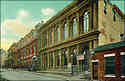
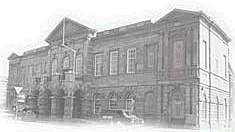 Hanley Town Hall Hanley has had three Town Halls  on
Hanley's Town Halls
on
Hanley's Town Halls
|


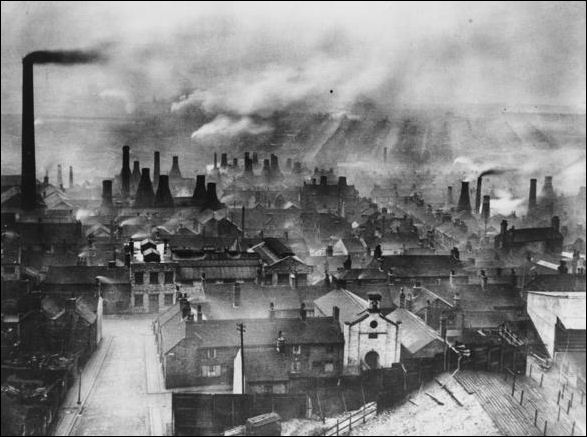
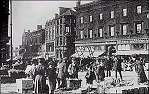
 The centre of Hanley
preserves the irregular layout of the late-18th-century village
and in 1960 Mr. J. W. Plant the City Reconstruction Officer
described it as '
The centre of Hanley
preserves the irregular layout of the late-18th-century village
and in 1960 Mr. J. W. Plant the City Reconstruction Officer
described it as '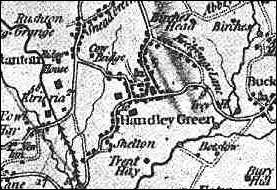
 on Bennett
 'Ragged
Glory'
'Ragged
Glory'


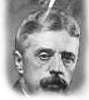 Enoch
Arnold Bennett
was born on 27 May 1867 at 90 Hope Street, Hanley, Stoke-on-Trent.
Enoch
Arnold Bennett
was born on 27 May 1867 at 90 Hope Street, Hanley, Stoke-on-Trent.