|
Thomas
Walker |
    |
Location and period of operation:
|
Thomas
Walker |
Tunstall |
1845 |
1851 |
Earthenware
(particularly Ironstone)
manufacturer at the Lion Works, Sandyford, Tunstall,
Stoke-on-Trent, England
|
The London Gazette
14th November 1848
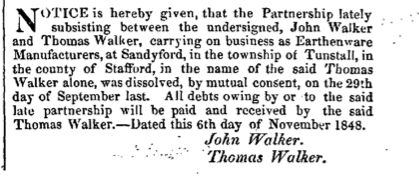
notice of the dissolution
of the partnership between
John Walker & Thomas Walker - Thomas Walker
continued on his own account
|
NOTICE is hereby given, that the Partnership lately subsisting between the undersigned, John Walker and Thomas Walker, carrying on business as Earthenware Manufacturers, at Sandyford, in the township of Tunstall, in the county of Stafford, in the name of the said Thomas Walker alone, was dissolved, by mutual consent, on the 29th day of September last. All debts owing by or to the said late partnership will be paid and received by the said Thomas Walker. — Dated this 6th day of November 1848.
|
|
Lion Works, Sandyford, Tunstall "From 1821 to 1834, James Beech of Lion Works, Sandyford, Tunstall, Staffordshire was in partnership with Abraham Lowndes. After Lowndes retired, Beech continued in his sole name until 1844, using the initials J. B. as a backstamp. When he was ready to retire, he advertised his manufactory to let in the Staffordshire Advertiser on August 31, 1844. Thomas Walker leased the pottery and, it is believed, acquired Beech’s equipment, moulds and patterns, as no advertisement appeared in the Advertiser announcing them for sale. Thomas Walker ran the Lion Works until his death in 1852. Anthony Shaw was operating the nearby Newfield (formerly Child Works), Tunstall, from 1851-1856, after which he moved to Burslem. An auction of Walker’s equipment and engraved copper plates was held in September 1853 and it is known that Anthony Shaw bought engraved plates at that sale and the name A Shaw is also recorded on the Texian Campaigne printed cartouche mark. There is also evidence that all three potters exported to the USA. Transferware Collectors Club, 2008 - https://www.transferwarecollectorsclub.org/bulletin_previews/articles/TCCSummer08-feature.pdf |
Examples of ware produced by Thomas Walker
|
Ironstone China was the main production, known for its durability and "remarkable excellence" in both body and glaze. Patterns: Walker is well-known for decorative transfer patterns, particularly in Mulberry (a dark purplish-brown) and black-and-white.
Service Items: The factory produced a wide range of household items, including dinner, tea, breakfast, dessert, and toilet services. International Trade: A significant portion of his output was specifically designed for the South American market. He also supplied the Colonial, Continental, and American markets. |
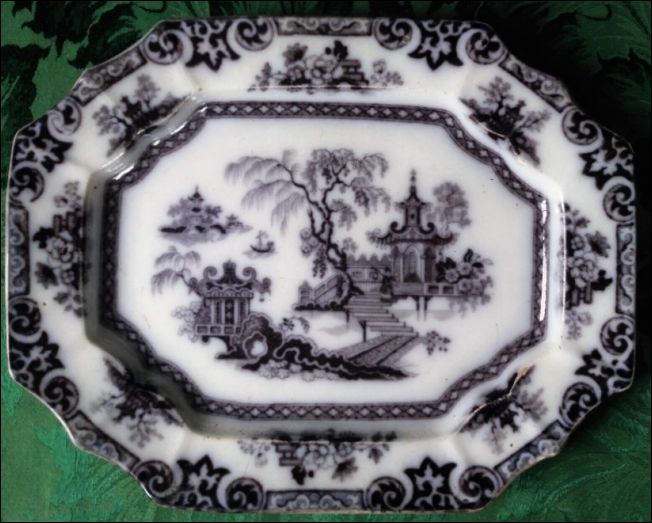 Ironstone platter in the HONG pattern Chinoiserie-style
pattern - many of the Thomas Walker
patterns were in the style |
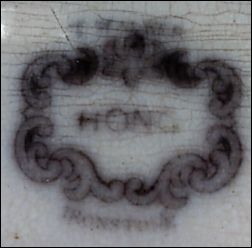 T Walker Ironstone HONG is the pattern name |
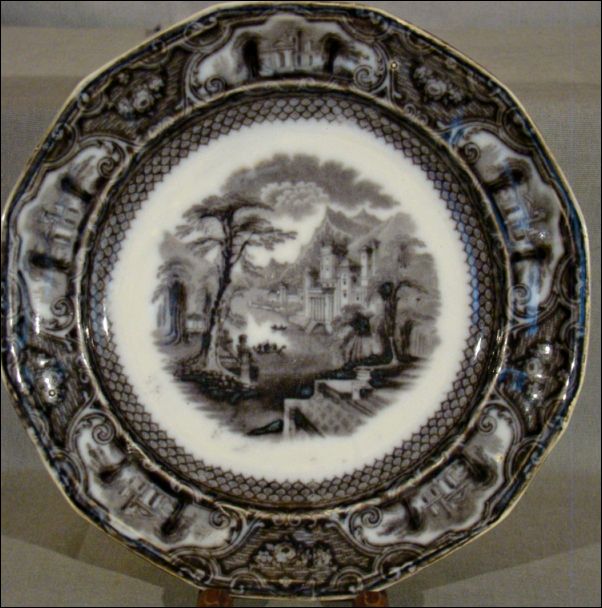 Ironstone platter in the TAVOY pattern
|
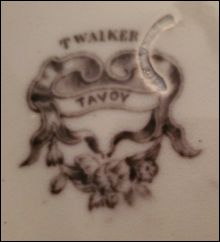
T Walker printed Ironstone |
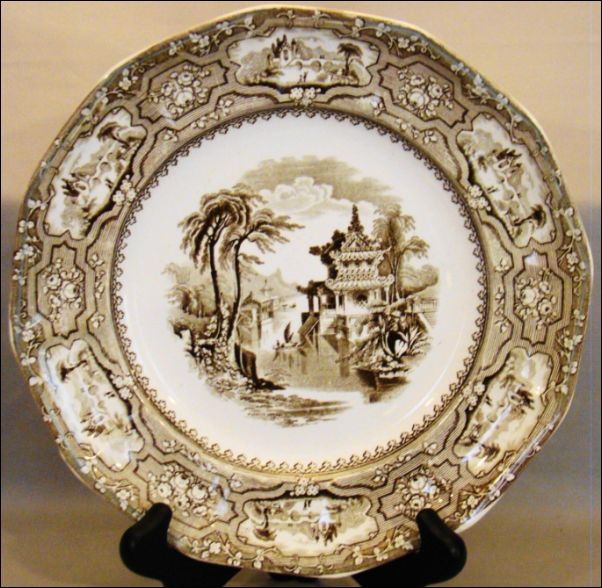 |
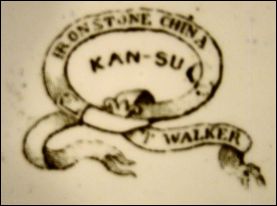 Ironstone China T Walker KAN-SU is the pattern name |
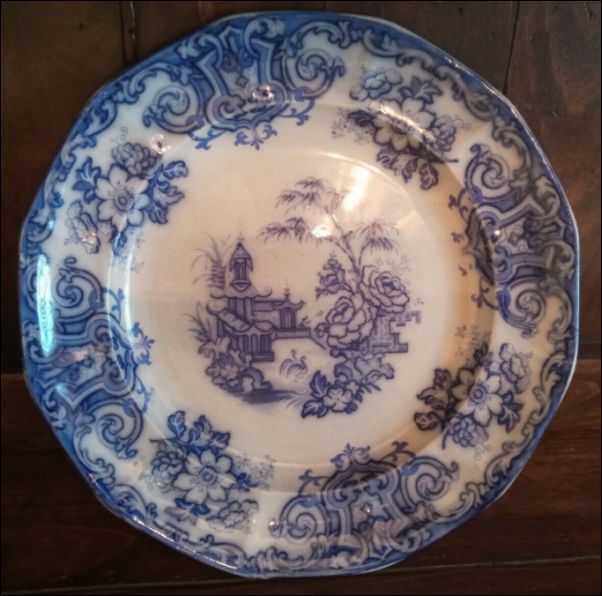 |
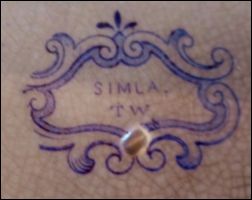 T W SIMLA is the pattern name this pattern and mark is probably correctly attributed to Thomas Walker however there were a number of North Staffordshire potters of this period with the initials TW |
|
The SIMLA pattern was also produced by Elsmore & Forster who operated in Tunstall from 1853 and 1871 and William & Thomas Harding who operated in Hanley from 1863 to 1869. An auction of Thomas Walker’s equipment and engraved copper plates was held in September 1853 and it is probable that plates for the SIMLA pattern were acquired by Elsmore & Forster. |
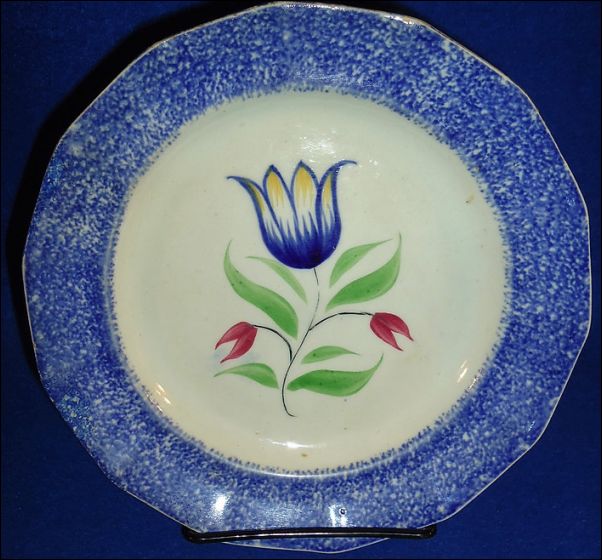 plate with a spatter border and a central stylised, hand painted tulip |
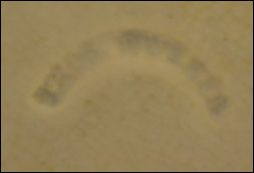 Thos Walker impressed mark |
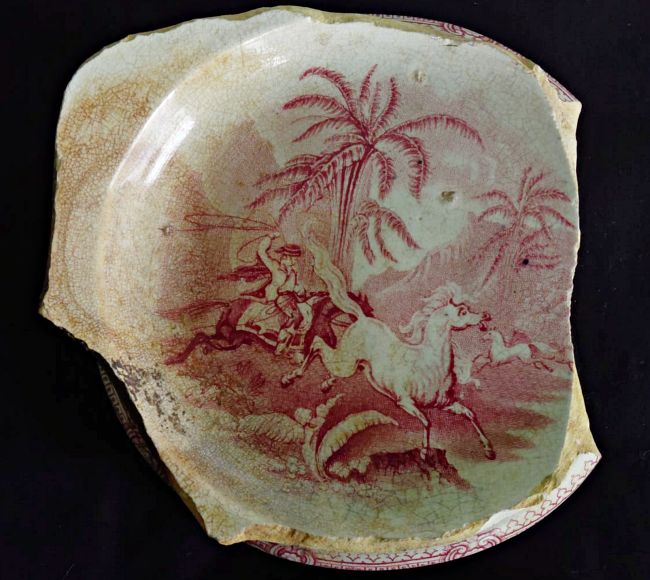 part of household ware in the LASSO pattern
|
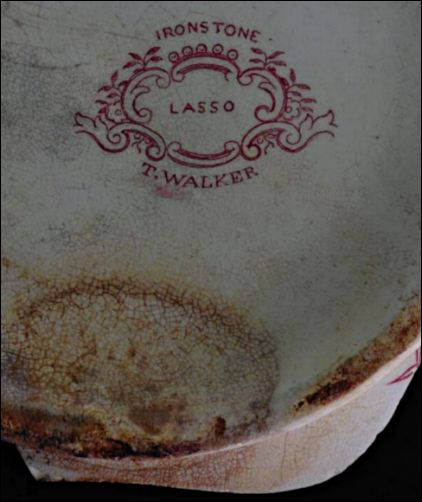 Ironstone China T Walker |
|
Found (2026) During the archaeological work in the historic center of Lima, Peru - specifically in the Martinete area. The work carried out by the Universidad Nacional Federico Villarreal in Lima, Peru as part of the PIA research program "Antiguas Redes Hidráulicas del Centro Histórico de Lima." (Ancient Hydraulic Networks of the Historic Center of Lima) |
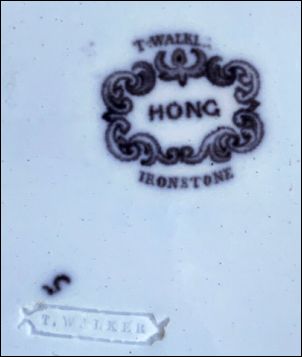
Marks & initials used on ware for identification:
T W
Thos Walker
T Walker
|
T WALKER |
Ironstone China T Walker |
T Walker (printed) Ironstone |
Thos Walker
impressed mark
T W
this pattern and mark is
probably correctly attributed to Thomas Walker
however there were a number of North Staffordshire potters of this
period with the initials TW
Questions, comments, contributions? email: Steve Birks
|
Page created 26 December 2003 Last updated 15 March 2026: added fragment of ware in the Lasso pattern, found in Lima, Peru. |