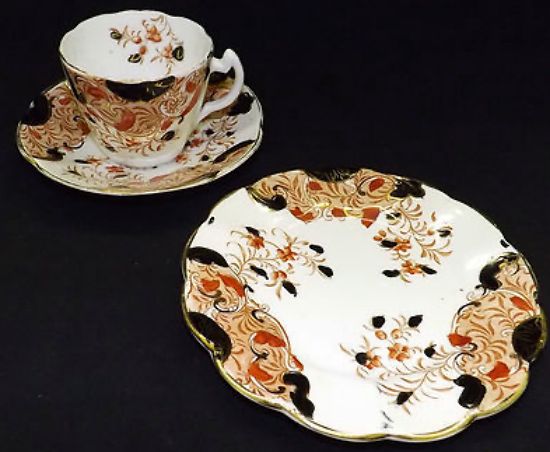
|
Richard Vernon Wildblood |
    |
Location and period of operation:
|
Richard Vernon Wildblood |
Longton |
Dec 1886 |
1888 |
| China
manufacturers at the Peel
Works, Stafford Street, Longton,
Stoke-on-Trent, England
Richard Vernon Wildblood was associated with the Peel Pottery through a sequence of closely linked trading styles spanning the late 19th and early 20th centuries.
|
Formerly: Massey, Wildblood & Co
Subsequently: Wildblood & Heath
|
|
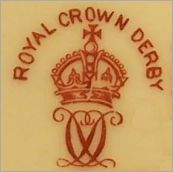 Royal Crown Derby |
 R.V.W |
 W. & H. |
 W. H. & S. L |
| Contemporary Royal Crown Derby crown mark | Richard Vernon Wildblood Dec 1886-1888 |
Wildblood
& Heath 1889-1899 |
Wildblood,
Heath & Sons 1899-1927 |
|
NOTE: Despite similarities in marks and decoration, the Wildblood partnerships had no connection with Royal Crown Derby. Mark shown for comparison |
This style of mark is often found on Imari-style wares from the Peel Works. The crown above the initials with a stylized line was introduced by Wildblood and then continued through the later trading styles, including Wildblood & Heath and Wildblood, Heath & Sons. Its resemblance to the contemporary Royal Crown Derby crown mark was almost certainly intentional, reflecting the widespread Staffordshire practice of adopting prestigious-looking backstamps that echoed the style and perceived quality of leading manufacturers. Despite the similarity in appearance and decoration, these wares were produced at the Peel Pottery, Longton, and are distinct from Royal Crown Derby products. |
||
|
|
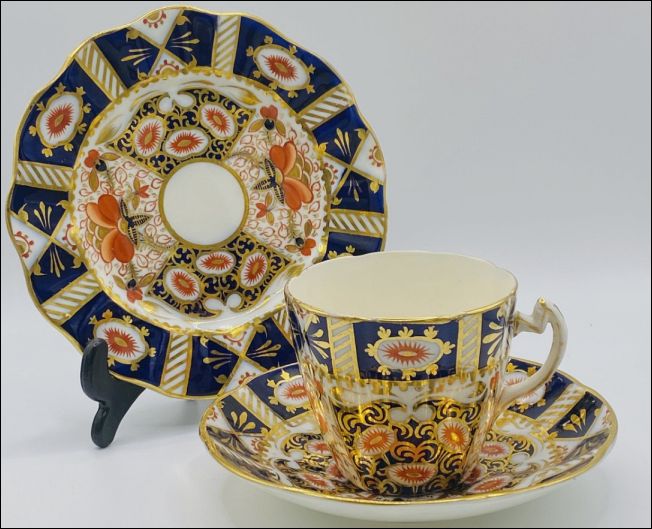
This trio is decorated in the
Imari style, characterised by a palette of cobalt blue, iron red and heavy gilt enrichment arranged in dense floral and geometric patterns. The style was widely produced in England during the late 19th and early 20th centuries, following the popularity of Japanese Imari porcelain and its English interpretations. |
printed mark with a crown above
|
Image source: eBay (online marketplace listing) |
|
|
|
|
|
"A printed design comprising three shaped panels with leafy shoots and foliate scrolls, each panel sprouting a trailing and branching leafy and floral shoot" |
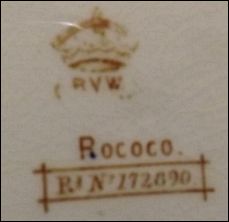 R. V. W. printed mark with a crown above Rococo |
Image source: WorthPoint database
|
|
|
|
|
The Peel Pottery
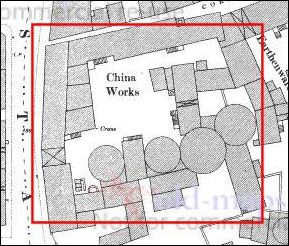
See the
history and occupiers of the Peel Pottery
Questions, comments, contributions? email: Steve Birks
|
|