



|
|
|
Peel Pottery, Stafford Street, Longton |
| The Peel Pottery at a glance | |
| Works name: | Peel Works / Peel Pottery |
| Operating period: |
Earliest known occupier - Thomas Stirrup c. 1798—c. 1818 Latest known occupier - Wildblood, Heath & Sons 1899—1927 |
| Location: | The Strand, Longton (formerly Stafford Street / Flint Street) |
| Maps: | view location on Google Maps |
| Site today: | Longton Exchange shopping centre |
|
"These works originally belonging to Thomas Stirrup, were continued by Bell, Deakin & Proctor; Webb & Walters (1865-7); S. Webb & Co. (1868-72) and John Green, at whose death they passed into the hands of Thomas Hulse (1880-2), and from him to Hulme & Massey (1882-9). The first three firms originally produced common classes of earthenware. China was added by Webb & Walters, and later made alone. It was of more than average excellence in body, and of various styles of decoration. Many were richly gilt and the floral and other decorations carefully painted. In 1887 the works passed into the hands of R. V. Wildblood; and in 1888, the style was Wildblood & Heath. From 1899 to 1927, the title was Wildblood, Heath & Sons (Ltd)." Jewitt's Ceramic Art of Great Britain 1800-1900 - revised by Godden, p. 90
|
|
The Peel Pottery site lay within an area whose street and district names evolved during the late 18th and 19th centuries. Contemporary sources show the works addressed on Flint Street, a name later superseded by Stafford Street. explore further » Lane End
|
Occupiers of the Peel Pottery
| From | To | Occupier | Notes |
| c. 1798 | c. 1818 | Thomas Stirrup |
Earthenware manufacturer - Flint Street, Lane End. Probably also in partnership as Stirrup & Beardmore from c.1809+ |
| c. 1818 | c. 1865 | Bell, Deakin & Proctor | Earthenware manufacturer. |
| 1865 | Feb 1867 | Webb & Walters |
Earthenware & China manufacturer. Partners were Samuel Webb & Thomas Walters. 11th February 1867 the partnership was dissolved and Samuel Webb continued on his own. |
| Feb 1867 | c. 1872 | Samuel Webb & Co | China manufacturer. |
| 1873 | c. 1879 | John Green |
China manufacturer. Listed in various directories from 1873 to 1876. The 1880 Kelly directory notes that Hulse succeeded John Green. |
| c. 1879 | 1882 | Thomas Hulse | China manufacturer. |
| 1882 | Oct 1883 | Hulme & Massey | China manufacturer. Listed in Keates directory for 1882. |
| Oct 1883 | Dec 1886 | Massey, Wildblood & Co |
China manufacturer. Listed in Kelly directory 1884. Massey, Wildblood & Co registered three designs - Jul 1884, Jan 1885, Nov 1885. Note: Godden records the firm as operating in 1887–1889, however London Gazette notices indicate that the partnership was dissolved in December 1886. # |
| Dec 1886 | 1888 | Richard Vernon Wildblood | China manufacturer. Listed in various directories in 1887 and 1888. |
| 1889 | 1899 | Wildblood & Heath |
China manufacturer. The partners were Richard Vernon Wildblood and Mr Heath. Wildblood & Heath registered three designs - Mar 1890, Jun 1891, Sep 1891. |
| 1899 | 1927 | Wildblood, Heath & Sons (Ltd) | China manufacturer. In 1899 the style became Wildblood, Heath & Sons and in 1915 the business was incorporated as a Limited Company. |
|
# Godden gives the operating dates for Massey, Wildblood & Co. as 1887–1889, although this appears inconsistent with contemporary documentary evidence. A London Gazette notice dated December 1886 records the dissolution of the partnership between Enoch Massey junior, Richard Vernon Wildblood and Edward Hughes, stating that the business would thereafter be carried on by Richard Vernon Wildblood alone. The confusion may arise from trade directory entries, as Massey, Wildblood & Co. appeared in Keates’s directories of both 1882 and 1889, although the later entry may simply reflect incomplete updating by the directory publisher. The firm is also recorded in Kelly’s directory of 1884, and registered three ceramic designs in July 1884, January 1885 and November 1885. By contrast, Richard Vernon Wildblood appears individually in trade directories of 1887 and 1888, suggesting that the partnership itself had ceased by the end of 1886, despite some later directory references retaining the earlier firm name. Occupier dates are compiled from published sources including Jewitt, Godden and Henrywood, together with trade directory references. Variations and overlaps between sources are common and some dates are therefore approximate. Full bibliographic details are provided on the
Sources page. |
|
Later redevelopment In 1941, the buildings behind Longton Town Hall and Market, including the area where the Peel Pottery once stood, were cleared to create an open-air central bus station. The site was later redeveloped as part of a wider post-war modernisation programme led by Councillor Albert Bennett. This redevelopment resulted in the Bennett Precinct, a new shopping development designed by Ian Fraser & Associates and opened in 1965. Nikolaus Pevsner described it as “architecturally the best of the Five Towns”, reflecting its contemporary significance within the wider post-war transformation of the town centre. The Bennett Precinct has since been rebranded as the Longton Exchange. Today, no visible remains of the Peel Pottery survive above ground. Further details of this redevelopment are given on the page covering the development of the shopping centre.
|
Peel Pottery in maps and photographs
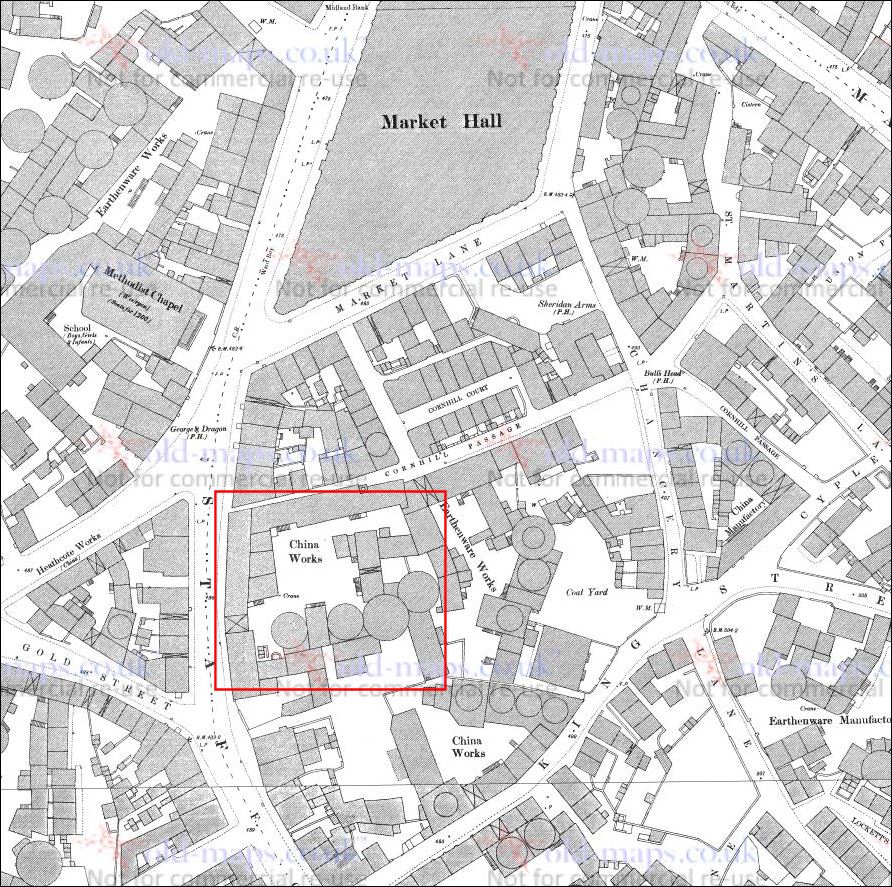
1878 map showing the Peel
Pottery China Works on Stafford Street, Longton
| The Peel Pottery site was originally located on Flint Street,
Lane End. By the mid-19th century the street had been renamed Stafford Street, Longton, and in the 1950s it became The Strand during widespread street renaming in the town.
Flint Street → Stafford Street → The Strand
|
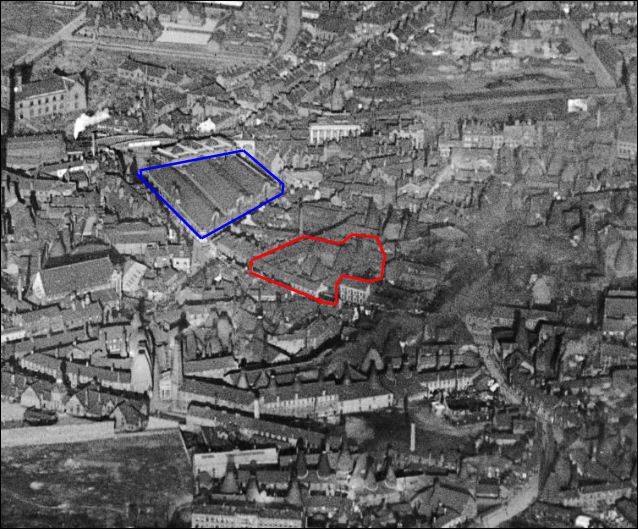
1927 photo of Longton Town
Centre
the Market Hall is outlined in blue and
the Peel Pottery in red
|
|