|
The Story of J. & G. Meakin - 1851-1951 |
    |
| Index Map of the City |
1851
& all that James the Elder |
James
Meakin George Meakin |
Post
WWI George Elliot Meakin |
Reconstruction Neotechnic Works |
Between
the Wars Agents |
|
|
|
1851 This is the story of the first hundred years in the life of a great pottery firm—the story of J. and G. Meakin Ltd., of Eagle and Eastwood Potteries, Hanley. In the pottery industry the law of the survival of the fittest has always operated with ruthless inflexibility. Businesses arise very rapidly in the fertile industrial climate of North Staffordshire—and fade and die with equal suddenness. Only the most efficient manage to survive the violent vicissitudes of fortune which have been the inescapable lot of the potter for centuries. The business of J. and G. Meakin has survived and prospered for a hundred years because it was built by men of vision and integrity, and because it has kept abreast of every significant development in the techniques of production, management and marketing. The impetus derived from the energy, drive and pioneering zeal of the original “J” and “G” has been maintained by their successors, right down to the present day. |
|
Outwardly—that is, materially—the scene has, of course, been transformed.
To the outsider—in this case, the author—the most important contributions made by J. and G. Meakin to the successful development of the British pottery industry have been in manufacturing technique and marketing. From the first the business was organised for production in quantity. A hundred years ago James and George Meakin set out to produce first-rate earthenware for a world market. Their aim was to sell reliable, serviceable and good-looking pottery to the peoples of the Americas, the Dominions and the Colonies, and their factory in Hanley was planned and organised accordingly. Old prints of the works reveal a production layout far in advance of anything then in practice. As the Staffordshire Sentinel reported in 1927—
|
|
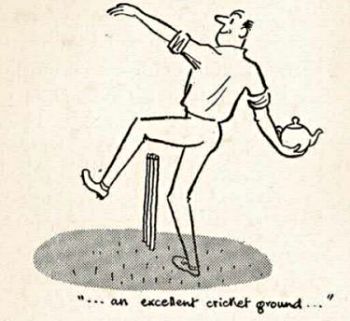
The siting of the Eagle factory was bold and visionary. Ample land was purchased on the rural fringe of Hanley in a position commanding a fine view of the moorlands and with access to cheap transport by canal to the Mersey ports. From this wise decision many advantages have accrued. In recent years a wholesale reconstruction of the Eagle factory has been achieved without any cessation of production and without any encroachment upon the land devoted to the recreation of the employees. It is indeed exceptional in such an old industry as potting to find a factory set in the midst of its own playing fields, with an excellent cricket ground—which is, naturally enough, the pride of the Chairman, Bernard Meakin, a life-long cricket enthusiast. There is also a fine football field and other recreational amenities.
It is, however, one thing to produce in quantity and quite another to win enough support in the world's markets to justify the scale of operations. How was this done? By what means did the brothers set out to win approval and goodwill in the world's markets? In two ways:
George Meakin set an example of missionary zeal which has been faithfully followed by the firm’s directors ever since. His task, when he set out for America in the early eighteen-fifties, was to promote a flourishing trade between Hanley and America: and he succeeded. He soon discovered what designs would please the peoples of the Middle West, and it was largely from his prompting that a highly successful range of shapes and patterns was evolved. In the main they were simple in style, strong and functional in form with very restrained decoration. The almost austere “Wheat” design with its embossed wheat-ears and leaves was an early favourite among the farmers of the plains. It was made in the earthenware known as White Granite or Ironstone China and was as tough as it was elegant. “Wheat”, “Cable”, “Fern”, “Bordeaux”, “Missouri” and “Peerless” were as successful in their day as the best-sellers of this centennial and festival year, 1951. |
|
|
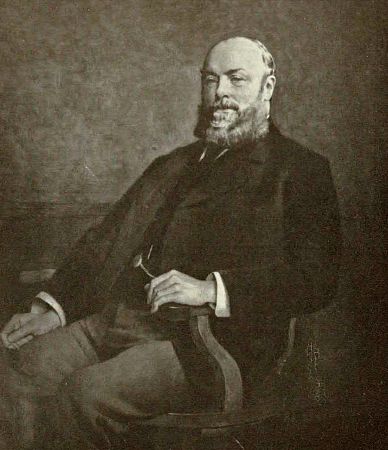 James Meakin |
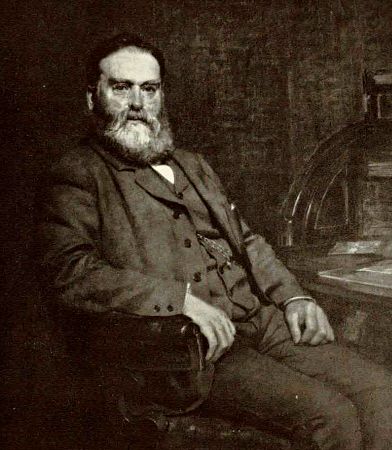 George Meakin |
|
|
|
"JAMES THE ELDER" 1851 is accounted the first year of the J. and G. Meakin enterprise because it marked the opening of the brothers' long and fruitful partnership; but the Meakin story really begins some years earlier, when James the Elder, the father of J. and G., established a potting business at Lane End (now Longton). Of James the Elder we know very little except that he came of yeoman farming stock and was born in 1807 in the agricultural district of Sandon, Staffordshire; that he potted at Longton, first at Stafford Street and then, in 1846, at the Newtown Pottery in High Street; that the success of these ventures enabled him to move again, in 1850, to a larger and more convenient factory in Cannon Street, Hanley; and that he died, poor in years but rich in filial successors in the year 1852. |
|
James and George remained at the
Cannon Street Pottery for only a year: then they transferred their
activities to a factory (previously owned by Joseph Glass) in Market
Street, Hanley.
From the first their partnership was successful. Their seven years in Market Street were a period of preparation, of experience and research. James was the practical potter, the manufacturer, organiser and technician, and George, the ambassador, diplomat and living embodiment of the business's developing goodwill. |
|
|
|
This section created 2 May 2026 |