|
The
Story of J. & G. Meakin - 1851-1951 |
    |
| Index Map of the City |
1851
& all that James the Elder |
James
Meakin George Meakin |
Post
WWI George Elliot Meakin |
Reconstruction Neotechnic Works |
Between
the Wars Agents |
|
|
|
THE EAGLE POTTERY The Market Street venture proved so profitable that before long James was hard at work on plans for the Eagle factory. On its completion, in 1859, it became obvious that the brothers had created a manufactory of exceptional efficiency. Dinner and tea ware, made in White Granite of a strength eminently suitable for the export markets of those days, were the chief products. They soon won a wide popularity throughout North America and subsequently in South America. So rapidly did demand increase that extensions to the Eagle works became necessary: even so the brothers could not themselves satisfy all their customers and it became necessary during the “sixties” to commission work from other manufacturers. In course of time, however, the Eagle works were enlarged and refitted, and another complete factory was built alongside. With this additional productive capacity the business was for a time able to meet the heavy and increasing demand for its wares. |
|
|
|
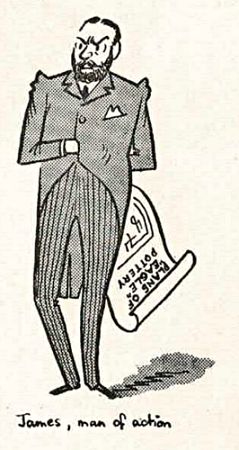
JAMES MEAKIN—MAN OF ACTION “J” precedes “G” in the Meakin hierarchy and trade name not only for reasons of seniority but because James Meakin was the stronger character in the partnership. It was, in the main, his driving force that made the business pre-eminent among the earthenware manufactories of the day.
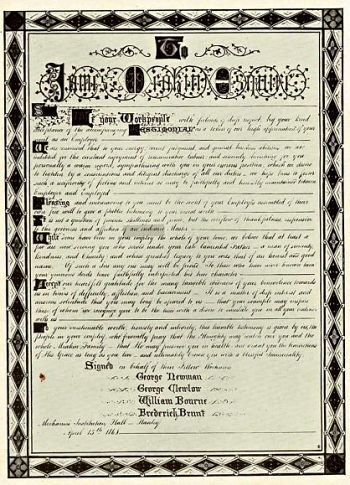
James Meakin was the eldest son of a family of twelve children. On the death of his father—at the early age of forty-five—and when he himself was only twenty-one, he shouldered the burden of breadwinner-in-chief and vowed to his mother that he would not marry until his brothers and sisters had grown up. This promise he kept, and he was therefore the last of the brothers to marry. His bride was Emily Ridgway, a daughter of a well-known potter and potting line, so that the marriage linked two of the leading manufacturers of the period. From this union sprang the American agency of Meakin and Ridgway (of New York, and later also of Toronto), which was established by James' eldest son, Lionel, and John Ridgway, his nephew. James Meakin had eight children, some of whom—including Bernard Meakin, the present chairman of the company—were younger than the grandchildren of his brothers and sister. It was chiefly due to James' vision and enterprise that the Eagle factory was built, that its planning incorporated the most advanced ideas in potting technique, that the firm soon won the esteem of merchants throughout the world and the loyalty of its workers. Some measure of the regard in which he was held in North Staffordshire is afforded by the fact that his portrait, presented by the employees of J. and G. Meakin “as a mark of their esteem and respect”, hangs in the place of honour in the vestibule of Hanley Town Hall. In 1868, at another gathering of workpeople held at the Mechanics’ Institute in Hanley, he was presented with an illuminated address. This is reproduced [below]. When he died, honoured and respected, in 1885, a remarkable tribute was paid to his character and ability by twenty-eight of the leading merchants of New York. In an inscribed memorial addressed to his family they recorded his “sterling integrity, steadfast friendship and untiring benevolence”. One of the Eagle factory’s present employees—he represents the fourth generation of J. and G. Meakin workers in his family—retells a story that underlines the value of James Meakin’s contribution to the firm’s renown. A Yorkshireman came to the Potteries and obtained work at the Eagle factory. He was at a local store buying equipment for his new home, when the manager detected an alien accent, became suspicious and invited his “credit” customer to furnish details of his occupation and place of work. The Yorkshireman announced that he was employed by J. and G. Meakin, whereupon doubts disappeared and a smile of mercantile urbanity spread across the manager’s face. “Right”, he said, “then you have just what you want, without question”. |
|
|
|
|
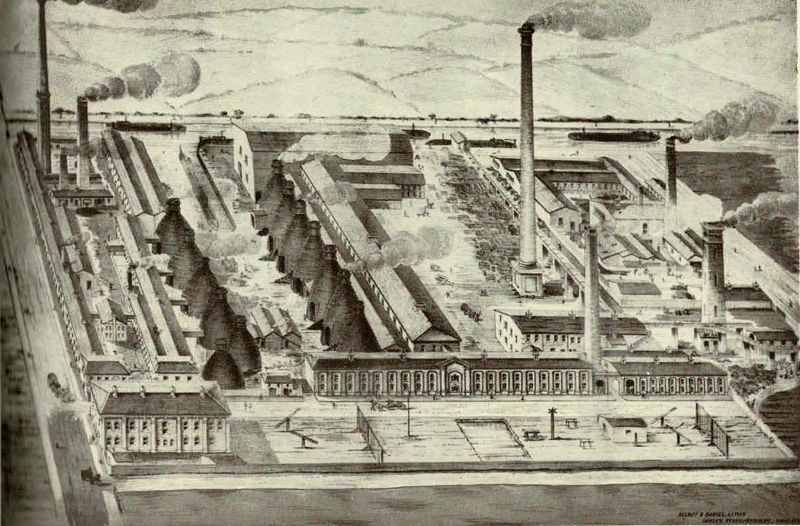
Eagle Pottery in the 1890's
|
|
|
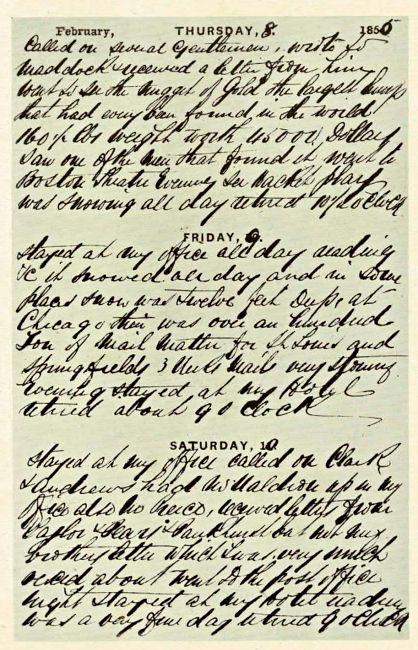
GEORGE MEAKIN—AMBASSADOR There can be few more human documents in existence than the Boston diary of George Meakin. Its closely written pages tell the story of a man bearing his self-inflicted exile with dignity and humour. [Above] a sample page from his diary is reproduced. It will be observed that the printed dates have been altered to give a year-old diary another year of service, a nice touch of Staffordshire economy—and that the space allotted to each day has been completely filled.
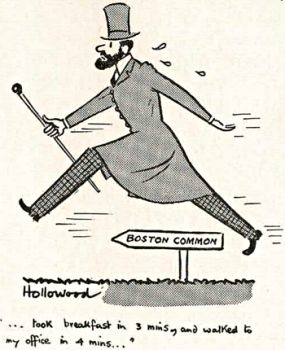
It would appear that he “cleaned out” his office every other day or so, wrote almost daily to his brother James, attended church every Sunday, took regular constitutionals on Boston Common, called regularly upon “several gentlemen” and retired at “about nine o’clock” every night. But he also found time to travel widely in the interior of the continent. And here, perhaps, it is appropriate to recall that George became one of North Staffordshire’s most generous public benefactors. On his death in 1891, the Staffordshire Sentinel published a long obituary notice which contained this passage:
|
|
|
|
EASTWOOD POTTERY The Eastwood Pottery, we may observe, had been established by Charles, another son of James the Elder. It was acquired by J. and G. Meakin in 1887 and thus became part of the largest pottery concern in the country. Eastwood has always been recognised as a well-planned factory. Its three biscuit and four glost ovens are situated conveniently for potters’ shops, warehouses and decorating shops, and the whole is so designed as to facilitate even flow from one department to another without overlapping. Like Eagle Pottery, its position on the canal gives it the advantage of water transport. |
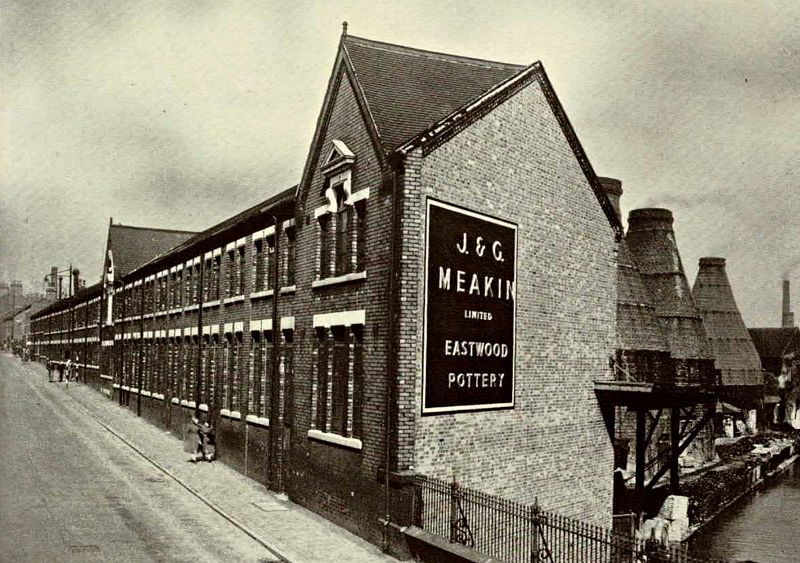
Eastwood Pottery from Lichfield
Street
|
|
|
This section created 2 May 2026 |