Index | Pottery | Pottery manufacturers 

Brownfields Guild Pottery Society Ltd.  
Brownfields Pottery Ltd.  


[Robinson & Wood]
1832-6
[Robinson, Wood & Brownfield]
1836-41
[Wood & Brownfield]
1841-50
[William Brownfield & Son/s]
1850-91
[Brownfields Guild Pottery Society]
1891-98
[Brownfields Pottery Ltd]
1898-9


Location and period of operation:

Brownfields Guild Pottery Society Ltd.

Burslem
Cobridge

1891

1898

Brownfields Pottery Ltd.

1898

1899


Manufacturers of earthenware and china at Cobridge, Stoke-on-Trent, England


Summary of Brownfields Guild Pottery Society Ltd (1891-1898):


Following the financial failure of William Brownfield & Sons, the Cobridge pottery was reorganised as the Brownfields Guild Pottery Society Ltd., a co-operative enterprise intended to preserve the business, its skilled workforce and its established reputation for high-quality ceramics. The venture was an ambitious attempt to combine the manufacture of fine pottery with a system of worker participation and share ownership.

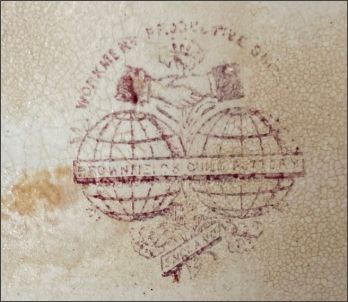
The business continued to produce earthenware and china, retaining much of the craftsmanship and artistic expertise of the former firm. Frederick Rhead succeeded Louis Jahn as art director, bringing considerable experience and artistic ability to the enterprise. The Guild produced a range of decorative wares, including transfer-printed patterns such as Ferncliffe and Boston. Its marks included the familiar Brownfield twin-globe trade mark, supplemented by the clasped hands symbolising the co-operative venture. Many pieces also carried the wording “Workmans Productive Society”.

Despite the quality of its products and the continuation of its established commercial connections, the Guild encountered serious difficulties. The system of management, in which many of the workmen were small shareholders and a committee exercised considerable authority, proved unwieldy. Edward Arthur Brownfield, who remained closely involved in the business, was criticised by Frederick Rhead for his lack of administrative ability.

In his account in Staffordshire Pots & Potters, Rhead described the Guild as having possessed all the elements necessary for success, including fine bodies and glazes, an established business connection and a skilled workforce. Nevertheless, he considered that the management arrangements had become chaotic. The society was wound up around 1898, bringing an end to the co-operative experiment.


Summary of Brownfields Pottery Ltd (1898-1899):

Following the winding-up of the Brownfields Guild Pottery Society, the business briefly continued under the name Brownfields Pottery Ltd. The new company appears to have represented a final attempt to maintain production at the historic Cobridge Works.

Although the Guild had been wound up, pottery manufacture continued for a short period. The surviving pattern registrations provide evidence of this final phase: five patterns were registered in the name of Brownfields Pottery Ltd. between December 1898 and April 1899. Some patterns previously registered by the Guild also continued to be produced.

The new company was short-lived and failed in 1899. The extensive Cobridge Works subsequently entered a period of demolition and redevelopment. By 1900 part of the site had been cleared for housing, while a portion of the former works land was acquired by Myott, Son & Co. A new Myott factory had been completed on the site by 1902.

The closure marked the end of pottery manufacture under the Brownfield name at Cobridge, bringing to a close a business whose products had once enjoyed considerable commercial and artistic distinction.


Key dates/events: 


  • Following the failure of William Brownfield & Sons a co-operative pottery, the Brownfields Guild Pottery Society, was formed to continue the business. This initiative aimed to preserve the craftsmanship and employment associated with the pottery, aligning with the cooperative movement's principles of worker ownership and democratic management.

  • Unfortunately the combination of an unwieldy committee of small shareholders and the poor administrative ability of Edward Arthur Brownfield resulted in the failure of the business around 1898.  A pattern (324028) was registered on the 22nd August 1898 by Wood & Bullock, T&CE, Liquidators of Brownfields, Cobridge. 

  • Later in 1898 the business was in operation as Brownfields Pottery Ltd. Five patterns were registered to them between December 1898 and April 1899. 

  • In 1900 part of the extensive Brownfield works was demolished for housing development, some of the land was acquired by Myott, Son & Co, in 1902 they had completed a new factory


Formerly: William Brownfield & Son(s)


Failure of the Brownfields Guild:

Following the collapse of the business of of William Brownfield & Sons "it was then carried on under the management of Mr. Arthur Brownfield [Edward Arthur] on a reconstructed basis, as a co-operative pottery, called the Brownfield Guild Pottery. Mr. Frederick Rhead succeeded Mt. Jahn, and became art director to this remarkable venture. 

It had all the elements of success - the finest bodies and glazes - an unexcelled business connection, and a host of well-trained and capable craftsmen; but the workmen were nearly all small shareholders, and from these a cumbrous committee, invested with extraordinary powers was selected, with Mr. Brownfield as chairman. 

As workmen, under the old system, they were honest, efficient and valuable servants; but under the "Guild" their performances were grotesque. Mr. Brownfield had delegated to them a considerable share of responsibility, and as he himself possessed very little administrative ability, the proceedings for the space of two or three years became chaotic. Such a state of things could not continue indefinitely, and the Guild was wound up about 1898, and the works demolished and sold for building purposes." - Rhead's Staffordshire Pots & Potters, p.309


part of a tea set in the transferware Ferncliffe pattern 


Workmans Productive Society
Brownfields Guild Pottery
ENGLAND

photos courtesy: Colin Bryers


the Ferncliffe pattern was also produced with hand colouring 


platter in the transferware Boston pattern 


Workmans Productive Society
Brownfields Guild Pottery
ENGLAND

the registration number 226227 shows that the pattern was registered to the Brownfields Guild Pottery Society Ltd on the 
26th January 1894 


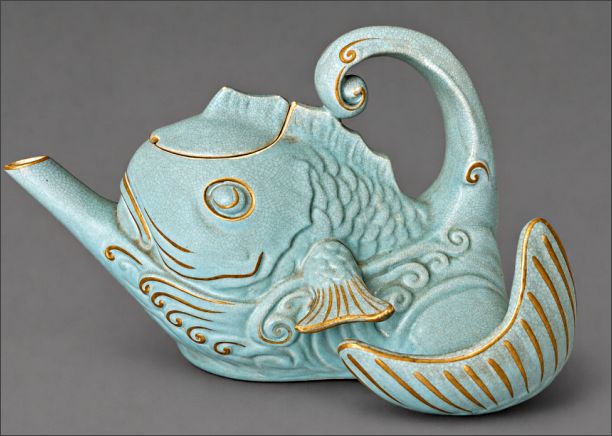
earthenware teapot 
modeled as a
fish leaping out of the sea with tail fin to one side 
and a wave of water forming the handle

Decorated in a matt blue with gilt accents - this design was originally registered by William Brownfield & Sons in 1876 and produced in as a majolica decorated item.  

This design was continued by the Brownfields Guild Pottery but as a much simpler decorated item in order to lower the cost of production. 


Workmans Productive Society
Brownfields Guild Pottery
ENGLAND

images courtesy: Jacky Luxton


Marks used on ware for identification:


Brownfield & Sons
Trade Mark

the twin globe mark was introduced in 1871 by the previous company 
William Brownfield & Son(s)


Brownfields Guild Pottery
England

the twin globe mark was continued in 1891 by Brownfields Guild Pottery - the clasped hands were added


Workmans Productive Society
Brownfields Guild Pottery
England

some marks have the addition of the wording "Workmans Productive Society" 


the registration number 210792 shows that the pattern was registered to the Brownfields Guild Pottery Society Ltd on the 18th April 1893 

- it was not unusual that some of the ware in a set would just have the registration number, occasionally some ware had no mark at all


Brownfields Guild Pottery Ltd

c. 1891-98 

the pattern name is often included
this belt mark was used by the Guild and also by
the subsequent Brownfields Pottery Ltd 


Brownfields 
England

the registration number 284456 shows that the pattern was registered 
to the Brownfields Guild Pottery Society Ltd on the  21st September 1896 

the pattern continued to be produced by Brownfields Pottery Ltd (1898-99)


Questions, comments, contributions? email: Steve Birks


Page History:

  • Last updated: 3 November 2026 - 'Summary of the business' added to the introduction, example of fish teapot added. 

  • Updated: 30 September 2025 - Introduction and content considerably revised. 

  • Page created: 18 February 2021