|
Davenport |
    |
Location and period of operation:
|
Davenport |
Longport
(Burslem)
|
1793 |
1835 |
|
W
Davenport & Co |
1835 |
1881 |
|
|
Davenports Ltd |
1881 |
1887 |
|
Earthenware, porcelain and ironstone manufacturer at Longport, Burslem, Stoke-on-Trent, England.
Davenport was a highly successful English maker of ceramics and glass. The firm operated in Longport, Stoke-on-Trent, from 1793 until 1887. It was started by John Davenport, who bought an existing pottery factory to produce high-quality earthenware. The business grew very fast. By the 1840s, Davenport operated four different factories in the local area and employed over 1,500 workers. The company became famous for its wide variety of beautiful items. They made fine bone china, ironstone, and decorative glass. Their work often featured bright flower designs, openwork rims, and classic blue-and-white transfer patterns. Davenport items were so well made that they attracted royal attention. The firm made special dinner sets for King George IV and Queen Victoria. The company stayed in the Davenport family for nearly a century. However, poor business choices led to later financial struggles eventually forced the business to close down in 1887.
|
|||||||||||||||||||||||||
|
|
The Ceramic Art of Great
Britain
Llewellynn Jewitt - published 1878
|
"Longport. — (Davenport & Co.) The famous works of Messrs. Davenport & Son date back more than a hundred years, the centenary of their establishment having taken place in 1873. In 1773, a manufactory was erected at Longport by John Brindley (brother of the celebrated James Brindley, the engineer, both of whom were natives of Tunstead, in Derbyshire), who also built for himself a handsome residence near at hand. This house was purchased in 1843 for a parsonage for St. Paul's, Burslem, and was again, in 1858, sold to Mr. W. Davenport. Shortly after 1773 Mr. Edward Bourne built another manufactory, and this was followed by a third, erected by Mr. Robert Williamson, who in 1775 married Anne (nee Henshall), widow of James Brindley, the engineer.
In 1803 Mr. Davenport, supported by his neighbours at Longport, offered to raise, clothe, and equip, free of expense to Government, except arms, a volunteer corps of 500 men, and his offer was accepted, the number being limited by Government to four companies of 80 rank and file each. Mr. Davenport became Major of this force, and raised it to a high state of discipline. In connection with this it may be well to note that one of Mr. Davenport's workmen at that time, and a member of his volunteer corps, was William Clowes, a nephew of Aaron Wedgwood, to whom he had been apprenticed. This William Clowes was a co-founder with Hugh Bourne of the now wide-spread sect of Primitive Methodists. About 1830 Mr. Davenport retired from active business, and chiefly resided at Westwood Hall, near Leek, where he died in 1848. The business was then carried on by the second son, Mr. Henry Davenport (who died in 1835), and the youngest son, Mr. William Davenport. Mr. Henry Davenport purchased the manufactory of Mr. Robert Williamson, and also his residence; these he enlarged and improved and added to his other works.
In the earlier years of the Longport manufactory, earthenware alone was produced, but no pieces of Brindley's make are known. Mr. Davenport at first confined
his operations to the manufacture of white, cream-coloured, and blue-printed wares, and these were of good substantial quality; his blue-printed plates with open-work rim of the same general character as those of the Herculaneum Works at Liverpool, are to be seen in most collections. Later on china was commenced, and at the present time this forms an equally extensive branch of the business with the earthenware. In both these, all the usual services and miscellaneous articles are produced, from the plain to the most elaborately decorated, both for the home, the continental, and the Brazilian markets; warehouses having been many years ago established by Mr. Davenport, M.P., at Hamburg and at Lubeck.
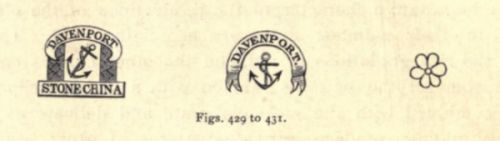
The printed marks are, a circular garter, bearing the words DAVENPORT LONGPORT STAFFORDSHIRE, surrounding an anchor and the words " Stone China " in script. Another is a shield, with the words 30 CANNING PLACE LIVERPOOL 82 FLEET STREET LONDON encircled by a garter bearing the words DAVENPORT LONGPORT STAFFORDSHIRE and surmounted by the crest, an anchor on an heraldic wreath. Another has a circular garter, bearing the words DAVENPORTS & CO. surrounding the address, 82, FLEET STREET LONDON."
|
|
|
Examples of Davenport Ware:
|
|
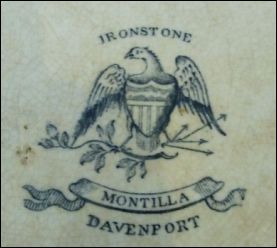
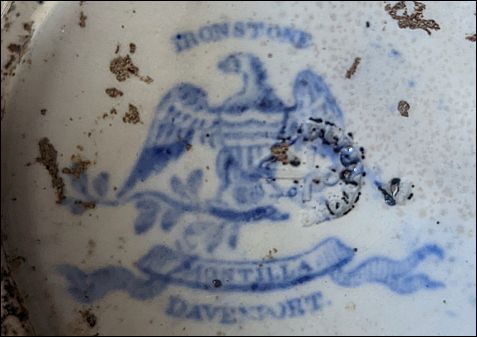
the printed mark features an eagle holding an olive branch in one claw and arrows in the other, it is taken from the Great Seal of the United States - such marks were used by some English potters to try to appeal to the American market |
|
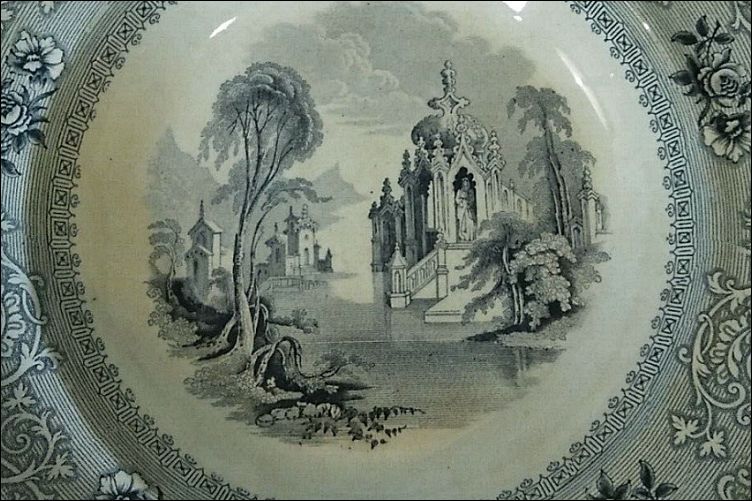
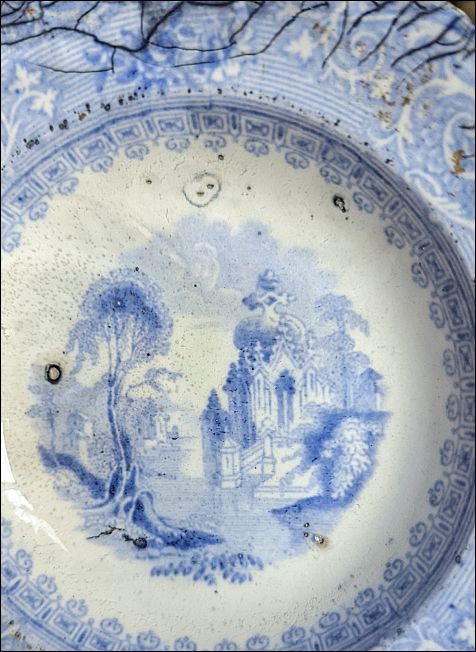
Although marked as Davenport, this is copy of the Davenport pattern. When compared with the example above the lack of detail can be seen in the tree and the temple and the woman in the doorway is missing. There are radial and circumferential stress cracks on the rim
|
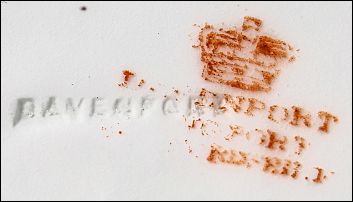
printed and impressed mark on the bowl |
photos courtesy: Mary Kummer
|
|
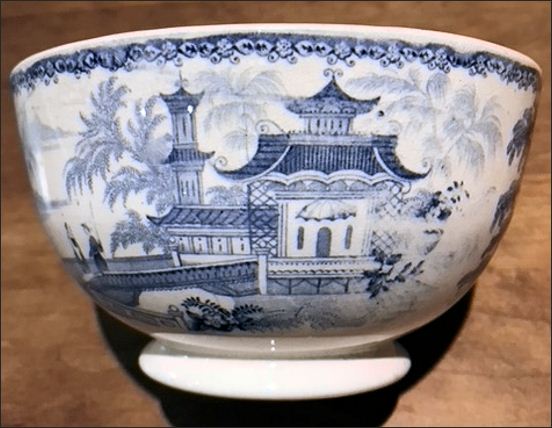
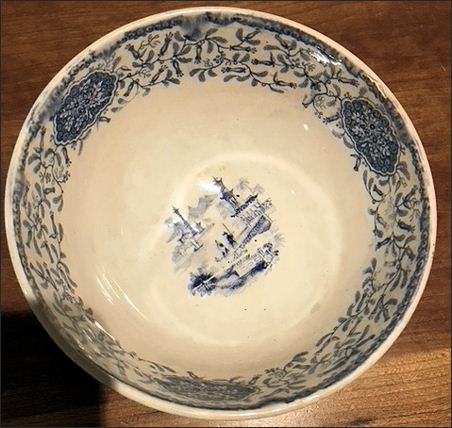
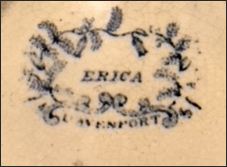
bowl in the ERICA pattern
photos courtesy: Sasha McEwan
|
|
Botanical
patterns
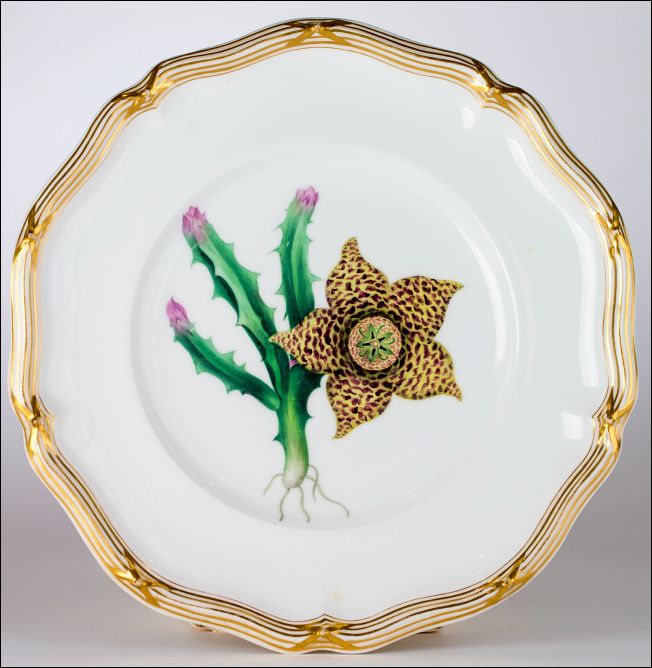
photo courtesy: Michael Tobin
Davenport produced
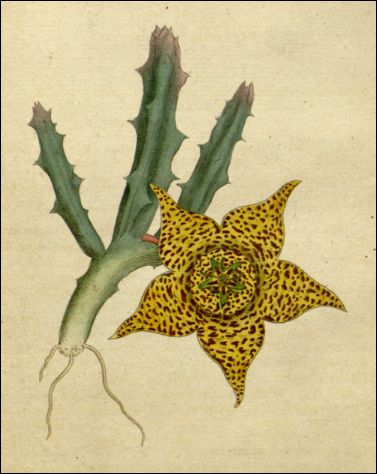
(probably in the 1830-45 period) a series of plates decorated with a hand painted, accurately coloured representation of different flowering plants. Most, if not all, of the illustrations were direct copies of those appearing in
Curtis's Botanical
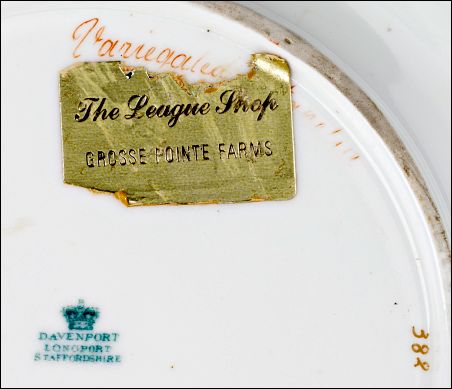
Magazine - an illustrated magazine which began around 1787. Often the number 382 is hand painted on the back - this appears to refer to the plate shape and not the pattern as the same number is used with different patterns.
Other manufacturers including William & John Ridgway, Spode and H & R Daniels appear to have used illustrations from the Botanical Magazine as the basis for some of their patterns
|
Davenport NOTE: This plate has a sellers sticker 'The League Shop, Grosse Point Farms' - this is not contemporaneous with the manufacture of the plate - The League Shop is a giftware seller established in the 1970s Grosse Pointe is a coastal area, comprising five conjoined cities. Situated near Detroit, Michigan, USA.
Plate 26, Stapelia
variegata (Orbea
variegata) |
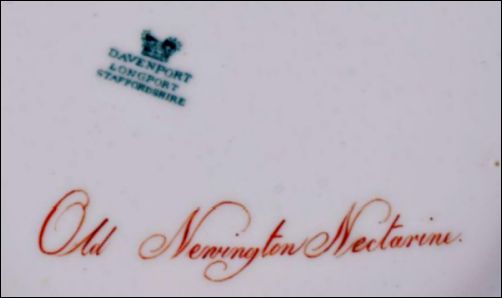
The name of the plant is hand painted in red script and most examples carry the
mark 'Davenport, Longport, Staffordshire' with a crown above and printed in blue.
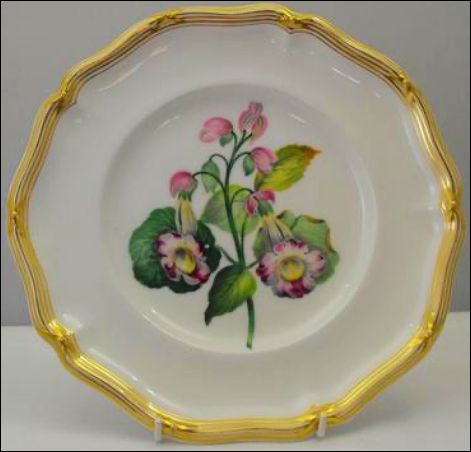 Martynia (Devils Claw) |
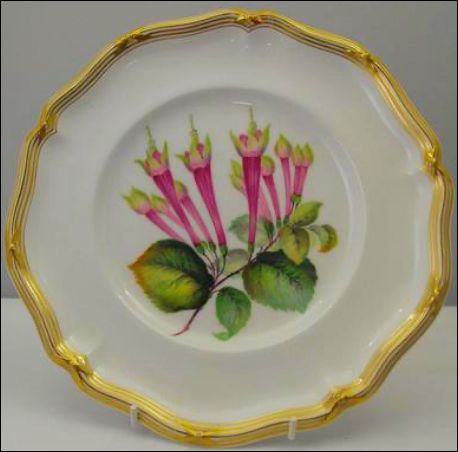 Fuchsia |
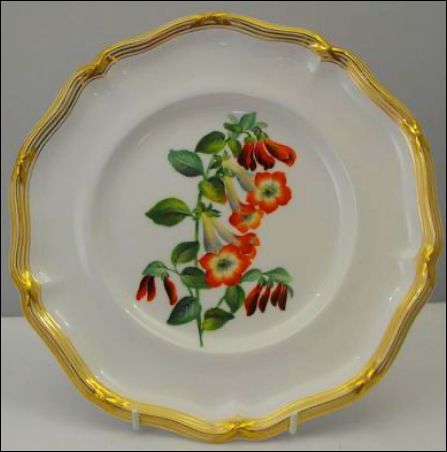 Floribunda |
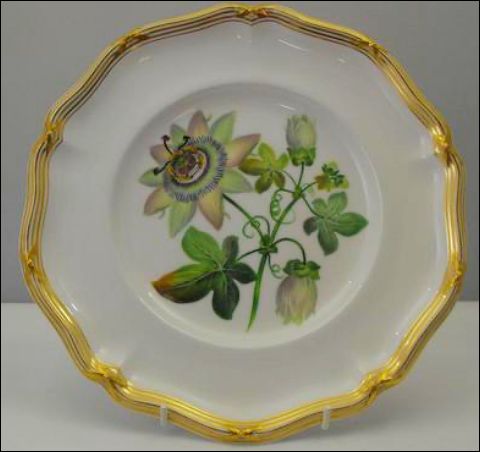 Passion flower |
|
|
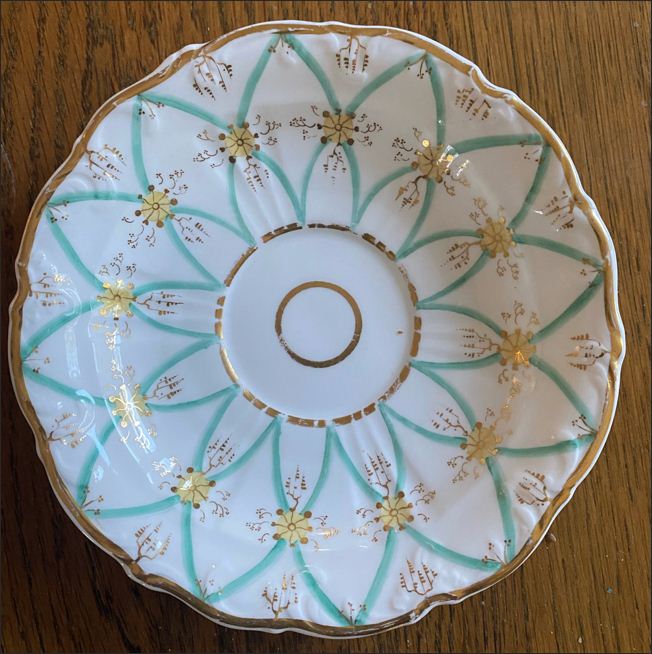 saucer - hand painted with gilding number: 1074 |
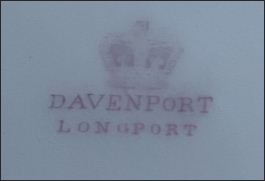 Davenport Longport "A comparatively rare mark,
printed overglaze in a pink-grey shade. ‘Davenport Pottery & Porcelain’ |
photos courtesy: Karen Strelko
|
|
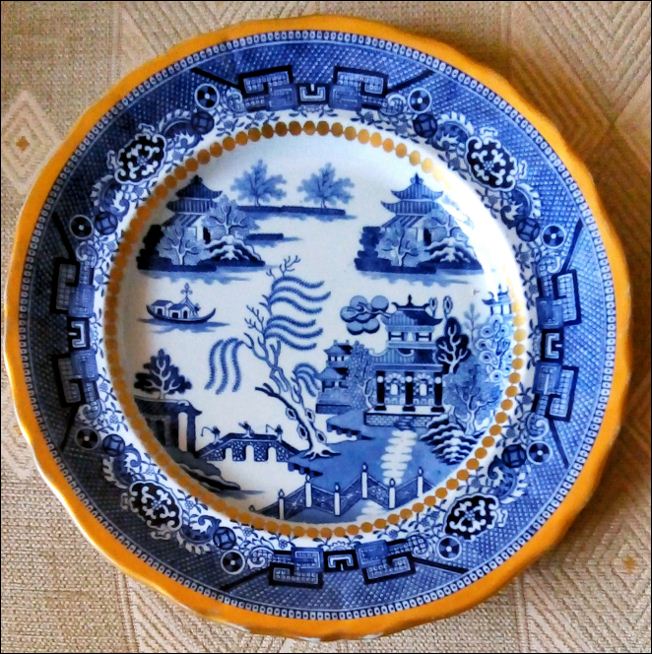 Ironstone plate in a variation on the Willow Pattern mid 19th Century |
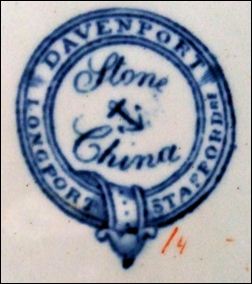 Davenport Longport, Staffordshire Stone China |
photos courtesy: Brendan O'Malley
|
|
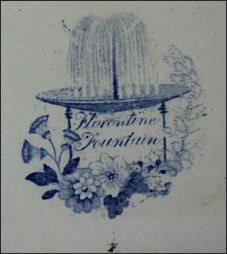
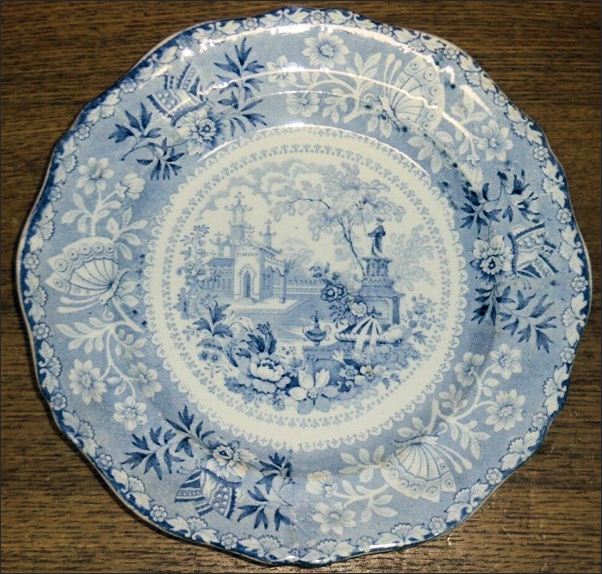
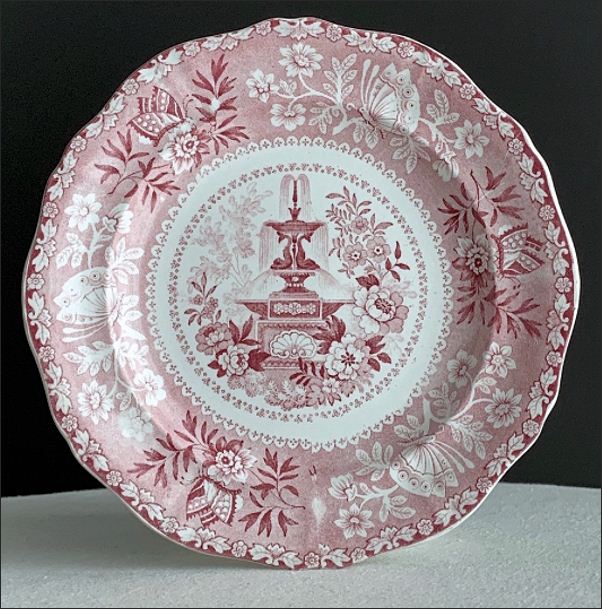
Florentine Fountain
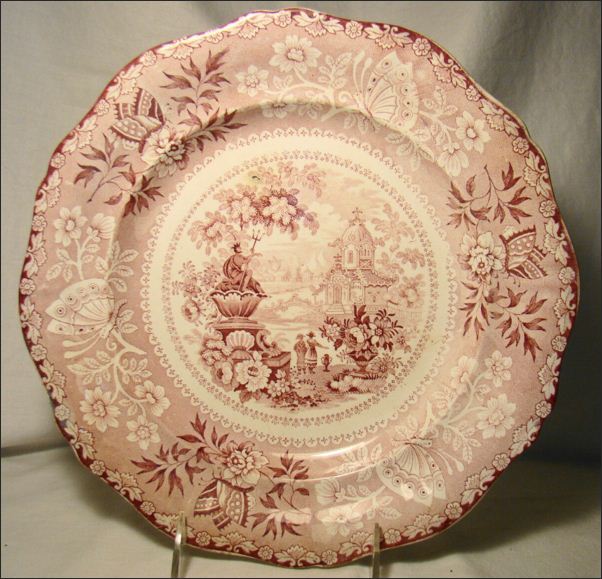 "Florentine Fountain - Davenport. A typical romantic scence in the rococo style with a fountain, bridge, buildings and a statue of Neptune with his trident. The floral border features several butterflies." The Dictionary of Blue & White
Printed Pottery 1780-1880 |
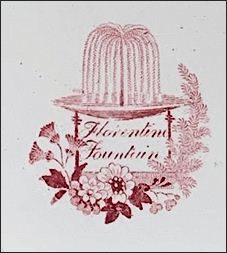
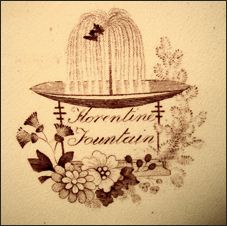 Florentine Fountain typical printed mark - generally the maker name 'DAVENPORT' is not included |
|
|
|
Maker: Davenport Pattern: Florentine Fountain c1840s Florentine Fountain is a series of
various imaginary scenes used on different ware - mainly plates but also
tureens and serving dishes. The border design is notable for the use of
large decorative butterflies. |
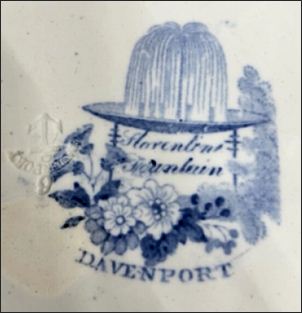 Florentine Fountain DAVENPORT mark including the makers name and typical impressed anchor mark used by Davenport. |
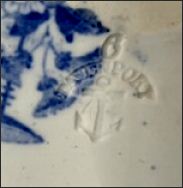 impressed anchor mark - this style used c.1830-60 either side of the anchor are two numbers which give the year of manufacture. In this example a 4 either side (although difficult to read) - giving 1844. The number 6 above the mark perhaps indicates the size of the plate. |
photos courtesy: Judy Davenport
|
|
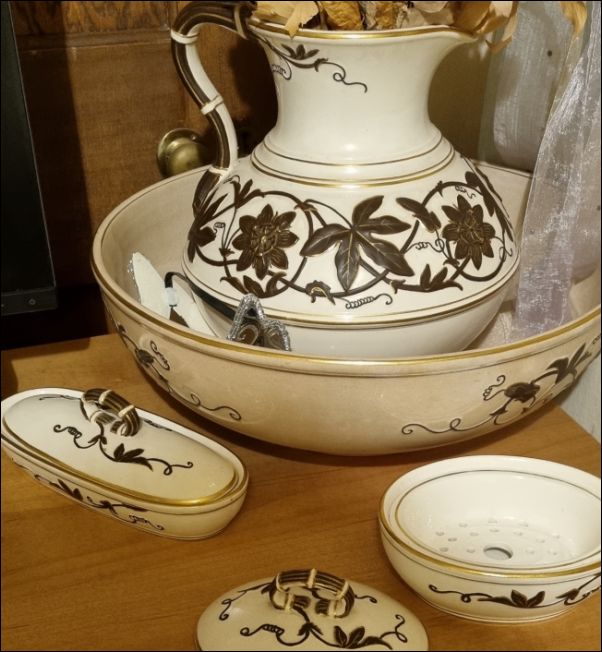 Toilet set in the Grecian pattern |
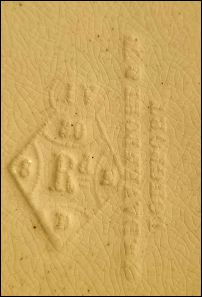 W. Davenport & Co Longport the registration diamond shows that the pattern was first registered on the 30th September 1881 |
photos courtesy: Kirsten Wiggins
|
|
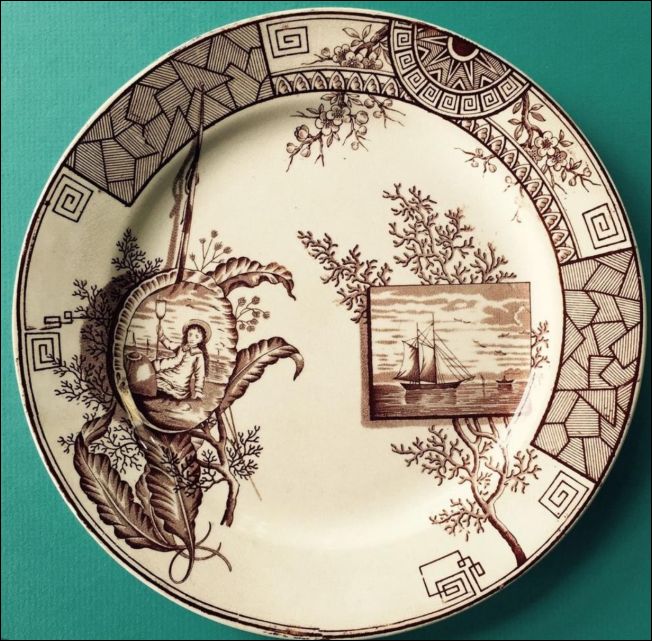 tureen in the Mersey Pattern A printed design in aesthetic
style, to the left a young sailor in shield shaped panel,
|
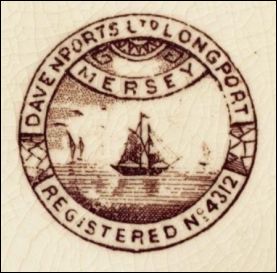 Davenports Limited Longport Mersey the registration number 4312 shows that the pattern was first registered on the 29th March 1884
|
1884-1887
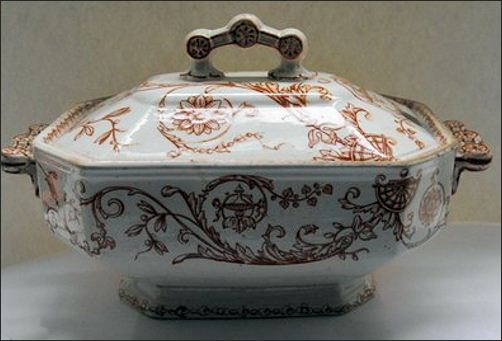 tureen in the Florentine Pattern NOTE: this pattern is not related
to the Florentine Fountain series
|
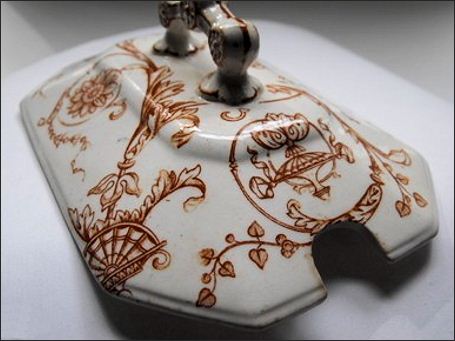
this pattern is in the aesthetic style |
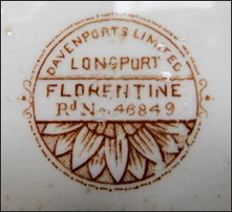 Davenports Limited Longport Florentine the registration number 46849 shows that the pattern was first registered in 1886 - the business closed in 1887 and so the manufacturing date can be accurately positioned to these two years |
1886-1887
|
|
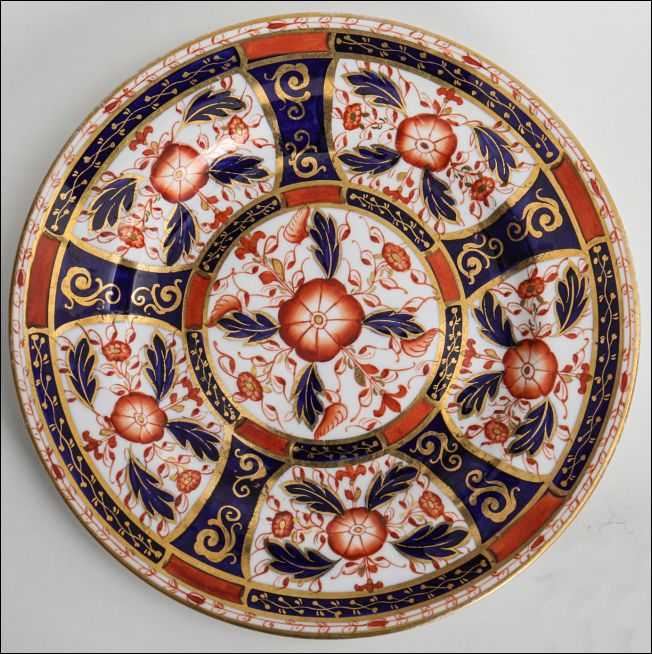 plate in the traditional Imari style, hand painted orange-brown and cobalt blue with gilt accents |
printed with crown over
impressed
c. 1870-87 |
photos courtesy: Jennifer Thomlinson
|
|
Marks used on ware for identification:
| Jewitt - published 1878
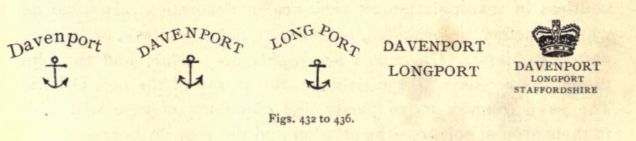
(around 9 years before the business closed) notes "The marks used by Messrs. Davenport have been various, but almost in every instance the anchor has been the distinguishing characteristic ; it is the trade mark of the firm. The crown was first used by them, on the Royal Service for William IV., and is now generally used on porcelain services." The two main sources used for the description and dating of Davenport marks are:
|
Davenport
impressed mark
with or without an anchor
lower case name marks are 1783 to 1810
DAVENPORT
impressed mark
with or without an anchor
upper case name marks are
post 1805
DAVENPORTS LTD
marks with "LTD" or "LIMITED" are c.1881-87


Davenport
impressed mark with an anchor - 'Davenport' in lower case letters
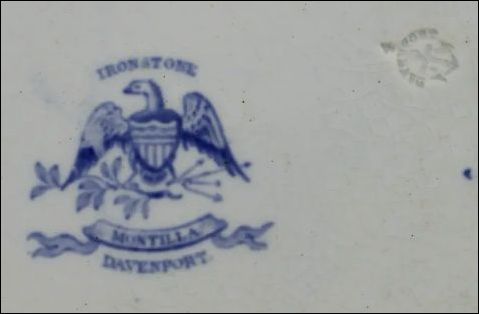 mark used on some ware for the American market - it incorporates the eagle of the Great Seal |
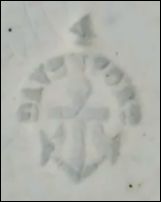 this printed mark is also accompanied by an impressed mark with date numbers either side of the anchor - in this example a 4 and 8, showing that the ware was produced in 1848 The number 4 above the mark perhaps indicates the size of the plate. |
- click for more information
on Davenport marks -
|
|
The Decline of Davenport:
|
Davenport's decline was not the result of a sudden collapse but of decades of weakening financial management, increasing competition, and the gradual sale of assets, culminating in the closure of the Longport works in 1887. During the first half of the nineteenth century Davenport was one of the largest pottery manufacturers in Britain. By the 1840s the company operated several works at Longport and employed more than 1,500 people, with substantial export markets.
One of the most poignant consequences of Davenport's collapse in 1887 was the dispersal of the firm's design archive. During the liquidation the banks and creditors took possession of the Longport works, machinery, moulds and stock, together with an extraordinary eleven tons of engraved copper printing plates. These plates represented more than 300 of the company's most successful transfer-printed patterns and embodied nearly a century of artistic and commercial development.
Equally significant was the disappearance of Davenport's pattern books. Sold or lost during the liquidation, they have never been traced. Without these records many surviving Davenport wares can no longer be matched with certainty to their original pattern names. The bankruptcy therefore marked not only the end of one of Staffordshire's most famous pottery firms, but also the loss of a substantial part of its historical record. Ref:
Frank Davenport, "Database Discoveries" series, Transferware Collectors Club. |
| Date | Event | Significance | Commentary |
|
|
|||
| 1835 | William Davenport becomes sole head of the firm after the death of his brother Henry. | Beginning of the period that later historians associate with weakening management. |
The financial trouble started with William Davenport - the son of one of the founders. William was a strict boss who was not a very talented businessman. Instead of focusing on the factories, William preferred to live like a high-society country gentleman. |
|
|
|||
| 1840s | Company reaches peak size, employing over 1,500 workers. | Commercial success masks underlying financial weaknesses. | |
|
|
|||
| 1850s | William's financial affairs reportedly fall into disorder. | First clear signs of long-term decline. |
William spent vast amounts of money rebuilding Longport Hall. He poured fortunes into social activities, like running the North Staffordshire Hunt for 27 seasons. By the time William died in 1869, the family's financial affairs were in total disarray, leaving the grandson with a mountain of debt |
|
|
|||
| 1860s | Growing competition within the pottery industry. | Davenport loses its former competitive advantage. | |
|
|
|||
| 1869 | Death of William Davenport. | Business inherited in a financially weakened condition. |
When his son, Henry took over the W. Davenport & Co. empire in 1869, he did not want to run it. He had no passion for pottery making and made almost no attempt to fix the deep financial problems he inherited. Because nobody was actively steering the ship, the company just drifted from one financial crisis to the next. |
|
|
|||
| 1869-80 | Repeated financial crises under Henry Davenport. | Problems addressed through asset sales rather than expansion. |
During the late 1870s and 1880s, the entire British pottery industry hit a rough patch. Competition grew fierce, and prices dropped. Because Henry had not modernised the Davenport factories, they could not compete with younger, faster, and more aggressive pottery companies. Instead of fixing the factories or finding new customers, Henry chose the easiest way to get quick cash: he began selling off the family assets. Whenever the bank came calling or a financial crisis hit, he sold off pieces of land, houses, or individual factory buildings. This kept the company afloat for a short time, but it slowly destroyed the business by shrinking it down until there was nothing left to sell. |
|
|
|||
| c.1881 | Sale of the Top Bridge Works. | Evidence that parts of the Davenport estate were being liquidated. | |
|
|
|||
| Sept 1881 | Formation of Davenport's Ltd. | Attempt to reorganise and preserve the business. | In an ultimate attempt to protect himself and salvage what was left, Henry turned the business into a private corporation called Davenport's Ltd in 1881. It did not work. |
|
|
|||
| 1881-87 | Continued contraction of the business. | Reorganisation fails to restore profitability. | |
|
|
|||
| 1887 | Production ceases; works sold. | End of the Davenport pottery business. |
Six years after incorporation, in March 1887, the company officially declared bankruptcy. The banks seized everything. The historic land, the buildings, the machinery, and even eleven tons of copper printing plates used to make their famous patterns were sold off at public auctions, bringing a tragic end to a 93-year-old family empire. |
|
|
|||
| 1888 | Thomas Hughes acquires the works and renames them Unicorn Works | Final disposal of the Davenport manufacturing estate | Final disposal of the Davenport manufacturing estate |
|
Sources: John Ward, The Borough of Stoke-upon-Trent (1843); Llewellynn Jewitt, The Ceramic Art of Great Britain (1878); Terence A. Lockett, Davenport Pottery and Porcelain 1794–1887 (1972); Terence A. Lockett & Geoffrey A. Godden, Davenport: China, Earthenware and Glass 1794–1887 (1989); Geoffrey A. Godden, Encyclopaedia of British Pottery and Porcelain Marks. Research published by The Transferware Collectors Club. |
Questions, comments, contributions? email: Steve Birks
|
|