|
S
Fielding & Co (Ltd) |
    |
Location and period of operation:
|
S Fielding
& Co (Ltd) |
Stoke |
Nov
1879
|
1982 |
|
Manufacturer of earthenware and majolica at the Railway Pottery (renamed Devon Pottery around 1911), Stoke, Stoke-on-Trent, England
Background to the setting up of Fielding:
NOTE:
See the entry on F. Hackney & Co
for detailed information on the colour works at Cresswell and Railway
Pottery at Stoke that Simon and Abraham Fielding were involved in. The expansion of the business under Abraham Fielding:
After Fielding closed:
|
Formerly: F Hackney & Co
the Fielding family members
 Simon 1827-1905 |
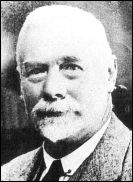 Abraham 1855-1932 |
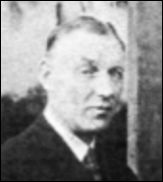 Ross 1880-1947 |
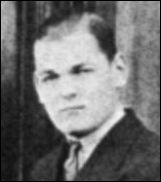 Reginald 1907- |
Family photographs - source: Trentham Heritage
early adverts
for S Fielding
& Co
|
|
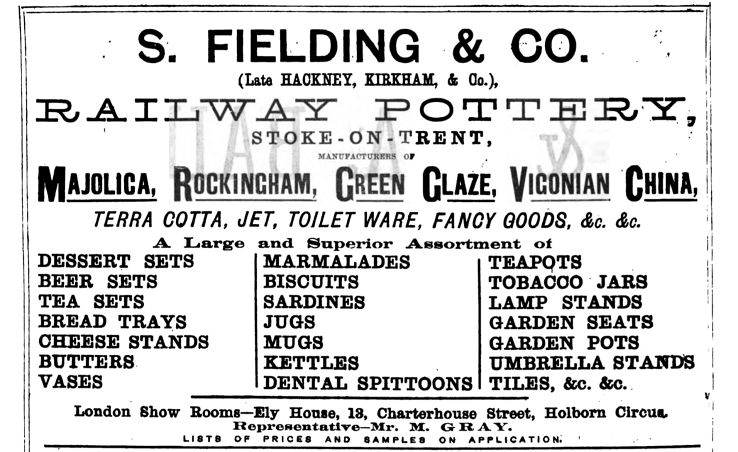
S Fielding
& Co Manufacturers
of Terra Cotta, Jet, Toilet Ware, Fancy Goods, &c. &c.
A Large and Superior Assortment of
|
The Pottery Gazette, December 1879
this
advert was published the following month after the previous
business of Hackney, Kirkham & Co was dissolved in November 1879
|
|
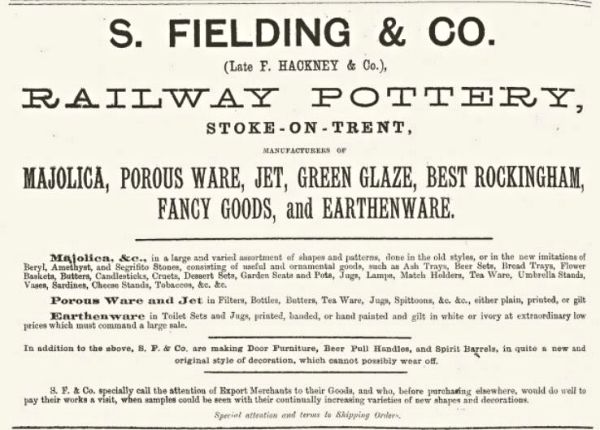
S Fielding
& Co Manufacturers
of Majolica &c., in a large and varied assortment of shapes and patterns, done in the old styles, or in the new imitations of Beryl, Amethyst, and Segrifito Stones, consisting of useful and ornamental goods, such as Ash Trays, Beer Sets, Bread Trays, Flower Baskets, Butters, Candlesticks, Cruets, Dessert Sets, Garden Seats and Pots, Jugs, Lamps, Match Holders, Tea Ware, Umbrella Stands, Vases, Sardines, Cheese Stands, Tobaccos, &c., &c. Porous Ware and Jet in Filters, Bottles, Butters, Tea Ware, Jugs, Spittoons, &c., &c., either plain, printed, or gilt. Earthenware in Toilet Sets and Jugs, printed, banded, or hand painted and gilt in white or ivory at extraordinary low prices which must command a large sale. In addition to the above, S. F. & Co are making Door Furniture, Beer Pull Handles, and Spirit Barrels, in quite a new and original style of decoration, which cannot possibility wear off. S. F. & Co specially call the attention of Export Merchants to their Goods, and who, before purchasing elsewhere, would do well to pay their works a visit, when samples could be seen with their continually increasing varieties of new shapes and decorations. |
The Pottery Gazette, February 2nd 1880
Simon Fielding retires from the business - June 1892
London Gazette
15 February 1898
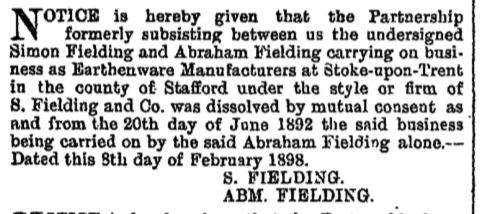
notice of the dissolution of
the partnership between
Simon & Abraham Fielding in June 1892 - Abraham
to continue on his own account
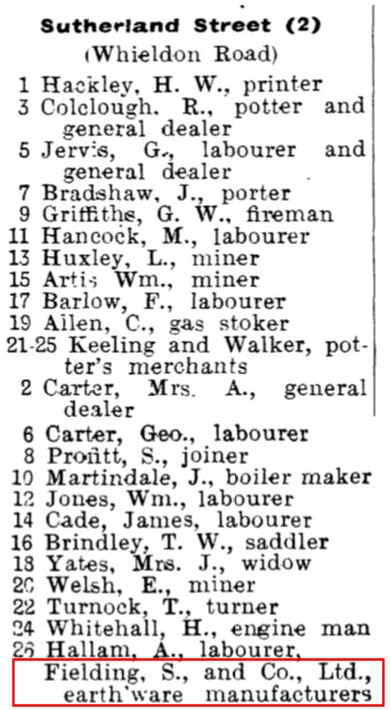
Fielding, S., and Co Ltd
earth'ware manufacturers
from..... 1907
Staffordshire Sentinel
'Business Reference Guide to The Potteries, Newcastle & District'
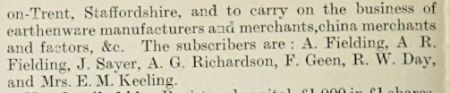
announcement of the incorporation of S. Fielding & Co
|
|
S. Fielding
& Co., Ltd. - Registered, with a capital of £13,000, in £1
shares, to acquire the business carried on by Messrs. S. Fielding &
Co., at the Railway Pottery, Stoke-on-Trent, Staffordshire, and to carry
on the business of earthenware manufacturers and merchants, china
merchants and factors, &c. The subscribers are: A. Fielding, A. R. Fielding, J. Sayer, A. G. Richardson, F. Green, R. W. Day, and Mrs. E. M. Keeling. |
The Pottery Gazette, February 1, 1906 p.206
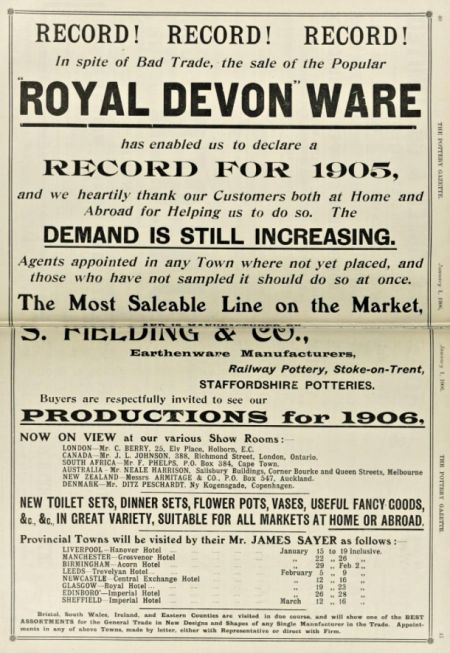
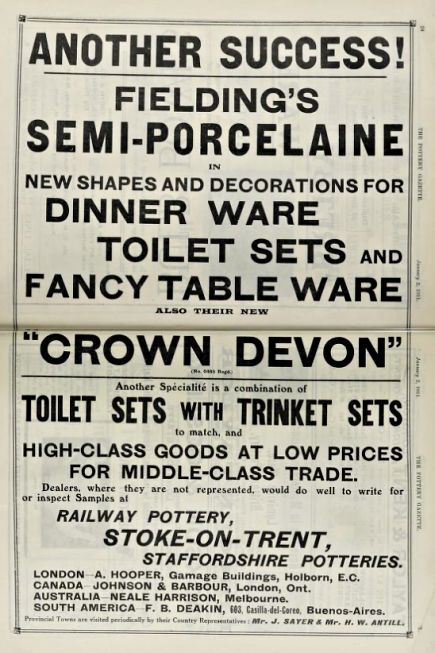
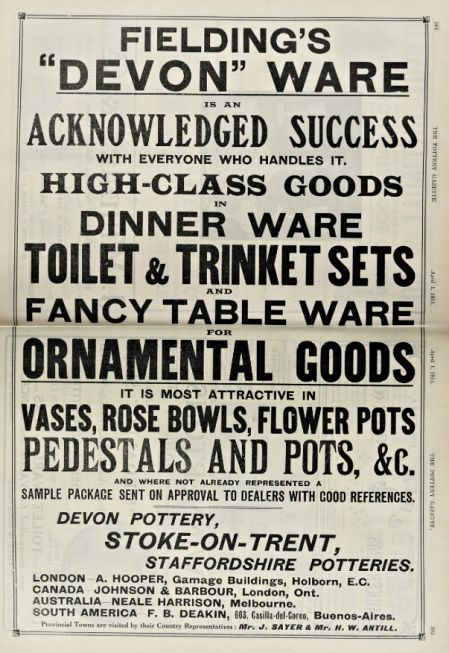
Adverts 1906-11 showing development of the "Devon" name
|
The Pottery Gazette 1 January 1906
|
The Pottery Gazette 1 March 1907
|
|
The Pottery Gazette 2 January 1911 |
The Pottery Gazette 1 April 1911 |
change of factory name from Railway Pottery to Devon Pottery
February 1, 1911
|
S. Fielding & Co., Ltd., Stoke-on-Trent, have a very wide reputation as manufacturers of dinner ware, toilet sets, and fancy table ware, known as "Crown Devon." So intimately is this ware associated with their name that they receive letters from all parts addressed with their initials only, as makers of ‘‘Devon Ware.” They have, therefore, altered the name of their Pottery by substituting the word “Devon” for the word "Railway," so long used in their address. In future, their postal and goods address will be "Devon Pottery," Stoke-on-Trent, instead of "Railway Pottery," Stoke-on-Trent. The company have their London showrooms at Garnage Building, Holborn, E.C., where they are making a large and special display of "Crown Devon" for the Coronation year. Their London representative, Mr. A. Hooper, has received a number of novelties for the coming season, including a variety of pieces suitable for presentation purposes. The company’s productions are all bright and attractive in appearance — the essential features of an acceptable gift. The shaded vellum ground (a characteristic of “Crown Devon”), with its pretty floral and conventional decorations, constitutes a high class ornamentation suitable to many very different forms. The company show a useful collection of samples of toilet ware, including several new forms and decorations for the season. One of the best of the new services is the "Ritz," a tall ewer of graceful proportions with a deep round basin. Another new toilet is the “Leo,” designed expressly for the London trade. It is a bold form with a full-sized deep basin. The list of new toilet shapes is a long one, and several new decorations are applied with success to familiar shapes. In form and decoration all tastes are provided for. The company make a special feature of toilet sets with trinket sets decorated to match. Several pretty additions have been made to the company’s samples of rose bowls, and a new shape of bow l has been introduced for tulips. Tulip bowls are likely to be in demand when once the public see the good use that can be made of them. Suite ware in “Crown Devon” is a popular line, and several new decorations are shown. Some have coloured edges instead of gold edges — a novel and less expensive form of ornament. Messrs. Fielding have a new and registered design in Coronation ware, produced exclusively for them, and very carefully executed. The Royal likenesses and emblems furnish interesting souvenirs of the important national event. They arc applied to useful and ornamental goods. An interesting novelty is the application of Coronation devices to "Easter Eggs." These eggs are very pretty in the bright enamelled colour of the Coronation decorations. The eggs so decorated are adapted for use as ladies’ hair tidies, pin boxes, and other toilet purposes. The Pottery Gazette, February 1, 1911; pp. 173,4. |
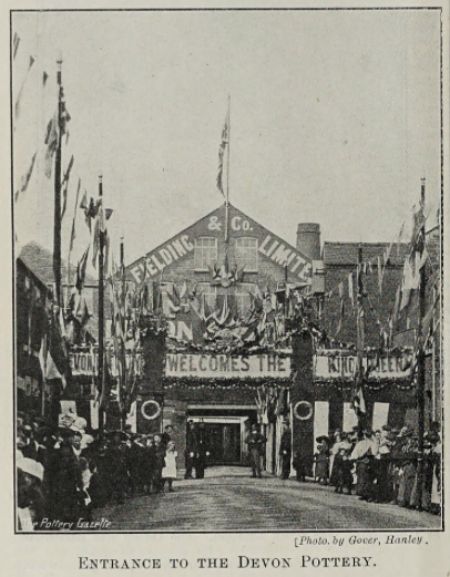
Royal Visit of King George V and Queen Mary - April 1913
|
"After passing through the central parts of Hanley and the Hanley Park, where the school children were massed and greeted their Majesties with the National Anthem, the Royal party proceeded to the Devon Pottery of S. Fielding & Co., Ltd., and were there received by Mr. Abraham Fielding, who, with the assistance of Mr. Ross Fielding and Mr. J. Sayer, escorted the distinguished visitors over the works. The printing shop proved very interesting, and Her Majesty did not hesitate to get all the information she could from the girl transferers in relation to special details of their art. In the aerographing shop the Queen was very much interests also, especially in the ventilation arrangements, and plied Mr. Sayer with numerous questions. Some twelve or fourteen girls were at work here on different patterns. The King in the meantime went down to the kilns and was just as interested in the conditions of the work of the firemen, asking a number of questions, and inspecting trials which were drawn to show him the condition of the ware in process of firing. A very interesting collection of articles was set out on a special table for the benefit of the Royal party, this containing samples of everything used in the manufacture of the Devon ware, right from the raw clay up to the finished article. Their Majesties were particularly interested in the 'Devon Silverine' ware, and the King was quite amused at the 'wooden' effect produced by the black colouration of the handles, and was anxious to see just how it was done. He remarked that they had noticed the 'Silverine' ware at the King's Hall. The same ware, but gold lined inside, also came in for special notice. Everything possible had been done by Messrs. Fielding in order that their Majesties should see as much as possible of the evolution wrought in the materials appreciated. Ten minutes is not long to stay in such a factory as that of Fielding & Co., but in that ten minutes a very great deal was crowded"
The Pottery Gazette 1st May 1913 |
Examples of Fielding ware:
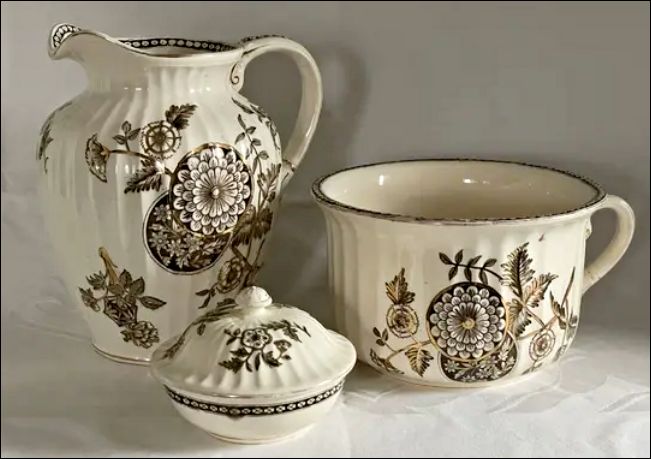 part of a bathroom set in the Delhi pattern this pattern is in the aesthetic
style - a number of pottery manufacturers used |
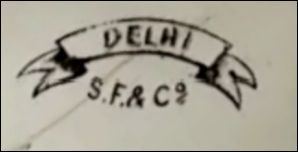 S. F. & Co. this mark is c.1880-1917
'DELHI' is the pattern name |
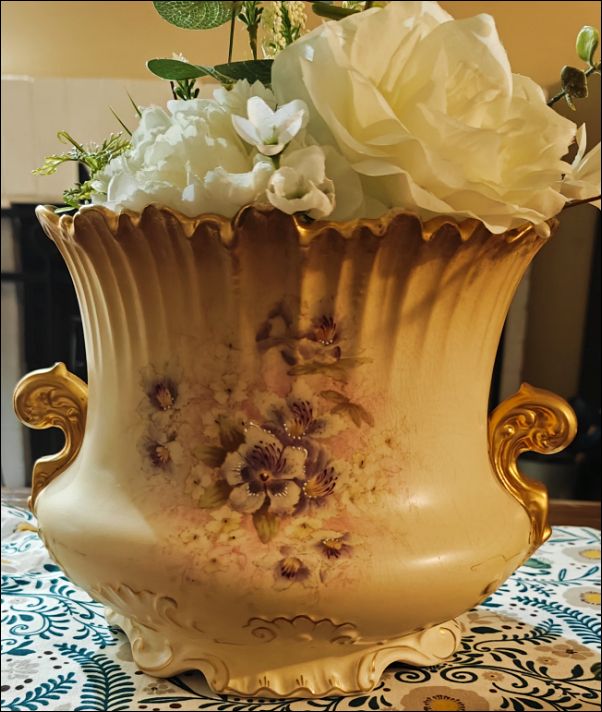 vase in the Royal Key pattern |
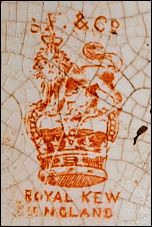 S. F. & Co. Royal Kew England this style of mark with a lion above a
crown was in use |
photos courtesy: Ryan Lee
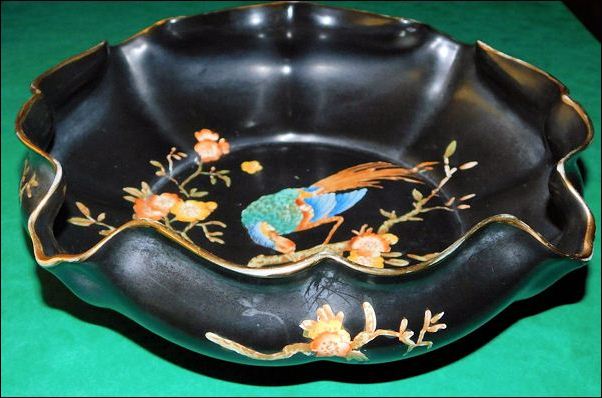 Shallow bowl in the PEEL pattern This matt black background with
brightly coloured flowers and birds |
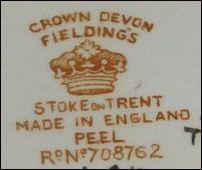 Crown Devon Fielding's Stoke-on-Trent Made in England the registration number 708762 shows that the pattern was registered in 1924 |
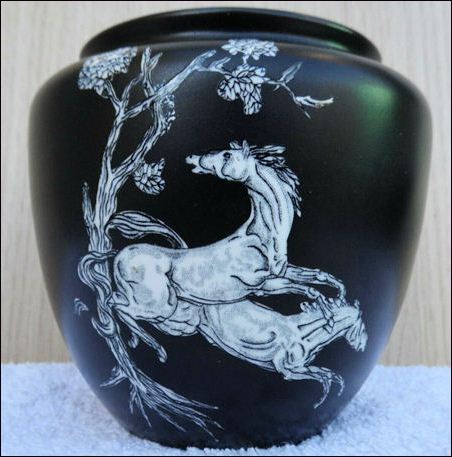 jar in the Pegasus pattern |
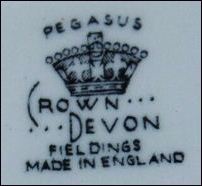 Crown Devon Fieldings Made in England this style of mark 1930s onwards |
Cellulose finish ware
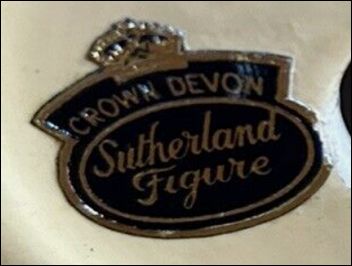
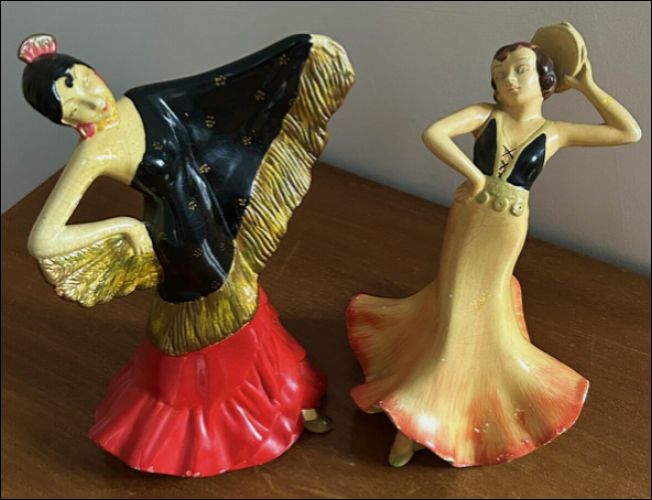 Crown Devon art deco Sutherland Figures - Cellulose finish by Kathleen Parson left - 140 'Juanita' right - 142 'Teresa' produced and marketed by Crown Devon - decorated by the Era Art Pottery
"Kathleen Parsons was also primarily responsible for a series of smaller size models, marketed under the name of Sutherland Figures. Initially made in the conventional manner, i.e. handpainted and glazed, a less expensive alternative was subsequently made available. The cost of these were reduced by having a single firing and then spraying with cellulose directly onto the biscuit ware, the decoration being undertaken by Fielding's subsidiary company, the Era Art Pottery. This cheaper technique resulted a less durable product which is demonstrated by the poor condition of many of the surviving examples" "Many of the models were also produced after World War II although the cellulose Sutherland figures were discontinued circa 1940" - Crown Devon - The History of S. Fielding & Co; Susan Hill |
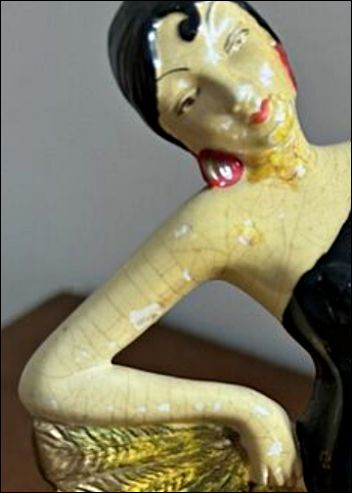
detail shows the crazing and flaking associated with cellulose decoration
|
|
this
jug design & pattern was also sold under the |
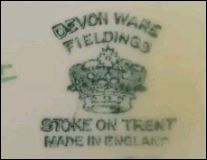 Devon Ware Fielding's Stoke-on-Trent Made in England |
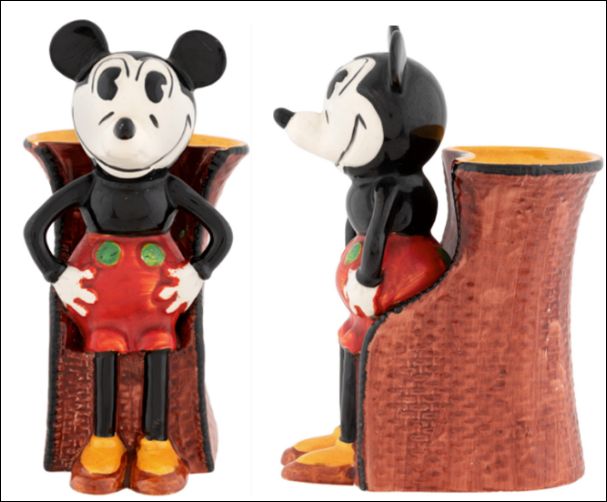 full figure image of Mickey Mouse seated in oversized wicker-like chair which forms a vase Mickey figure is the same design as
that produced by the |
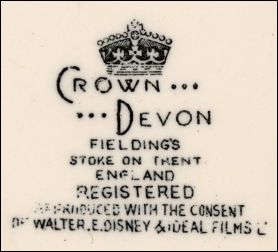 Crown Devon Fielding's Stoke-on-Trent England Registered Produced with the consent of Walter E. Disney & Ideal Films Ltd "Towards the end of the Thirties, permission was sought and granted by Walt Disney to produce small figurines of Mickey and Minnie Mouse. However only a small quantity was ever produced" Crown
Devon - The History of S. Fielding & Co; Susan Hill |
photo source: Hakes Auctions,
York, PA
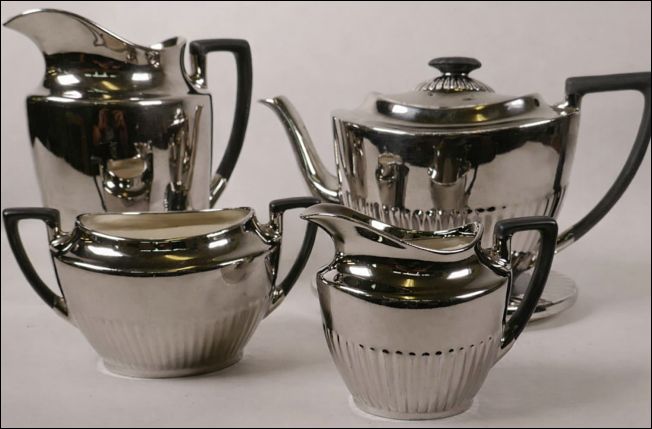 Silverine tea service, in 'Queen Anne' style, including teapot and stand, sugar bowl, milk jug and hot water jug with cover |
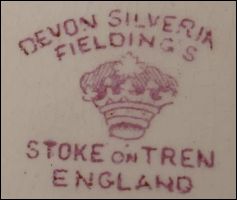 Devon Silverine Fielding's Stoke-on-Trent England
the marks appear on different items in the tea set shown |
photo source: Crow's Auction Gallery
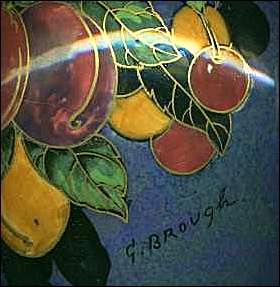
Fielding's
Lusterine Florescent ware
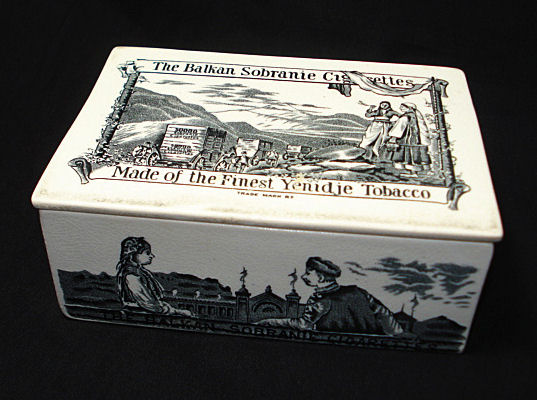
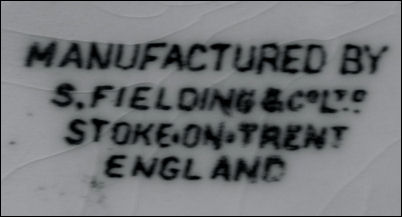
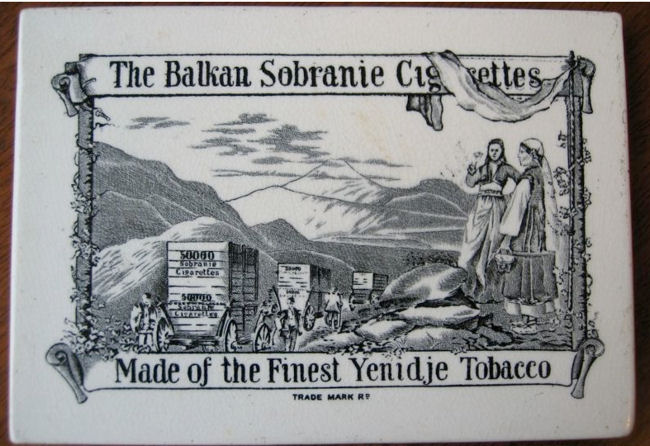
transfer printed cigarette box
made by S. Fielding & Co Ltd for Balkan Sobranie
photos courtesy: David Hoexter
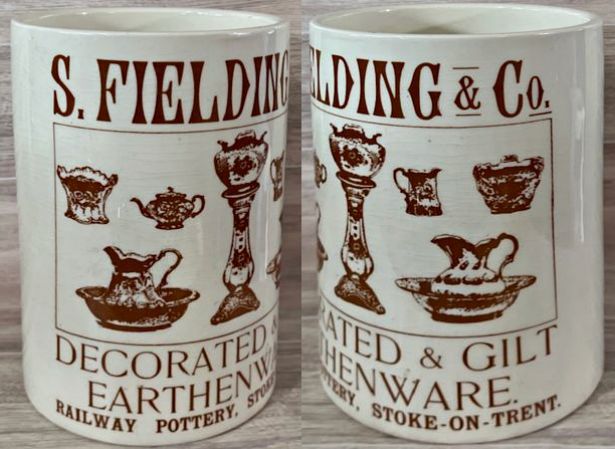 S. Fielding & Co Decorated & Gilt Earthenware Railway Pottery, Stoke-on-Trent |
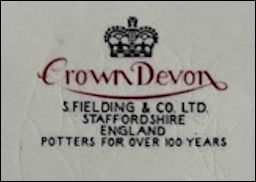 Crown Devon S. Fielding & Co Ltd Staffordshire England Potters for over 100 years A souvenir mug which was produced in
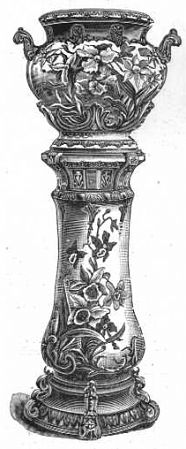
the late 1970s to commemorate the mug illustrates was produced in the late 19th century - it features a stand and jardinière - a similar one was illustrated in a trade journal of 1893 |
 |
photos courtesy: Jennifer Culligan
 1893 trade journal article on S
Fielding.
1893 trade journal article on S
Fielding.
Article
on Crown Devon
Marks used on ware for identification:
Often the name of the pattern was included
S F & CO
FIELDING
CROWN DEVON
Devon Ware
Trade names:
Lusterine
Silverine
S. F. & Co. c.1880-1890 |
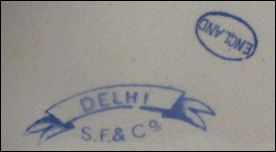 S. F. & Co. England c.1891-1917 |
'DELHI' is the pattern name
this style of mark, with just the initials S. F. & Co, was in use c.1880-1917
the
mark on the right with 'England' will be after the 1890 McKinley
Tariff Act
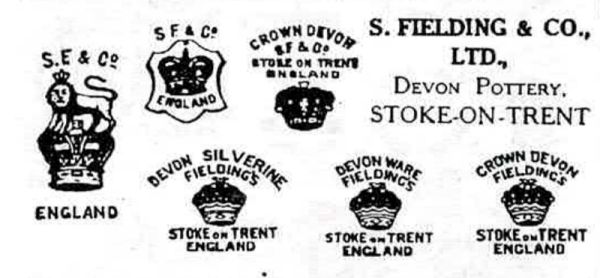
details of marks from 1921 Pottery Gazette Diary
Imperial Crown marks
c.1891-1906
|
The crown used in marks up to c.1906 is similar in style to the British Imperial or St. Edwards Crown. The characteristics are: a circular band set with gemstones, two arched bands sweeping up and meeting at the centre, an orb at top where the bands meet and a small cross mounted on the orb. This crown was used in two forms - one surmounted by a lion and one inside a shield.
|
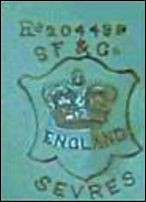
printed marks without the name
'Crown Devon'
often the pattern name is included
c. 1891-1906
crown inside a shield
c.
1891-1906

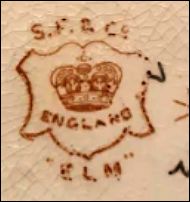
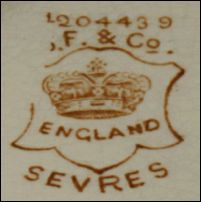
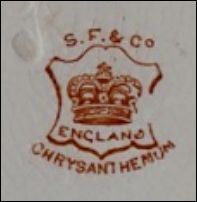
S F & Co
England
c.1891-1906
the
registration number 204439 shows that the 'SEVRES' pattern
was registered on the 17th December 1892
crown mounted by a lion
c.
1891-1906
 |
Royal Kew |
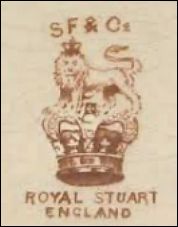 Royal Stuart |
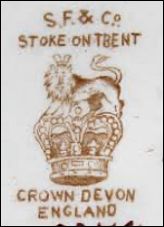 Crown Devon |
S F & Co
England
crown mark mounted by a lion
c. 1891-1906
a
variety of style names were often associated with this mark including
Royal Kew, Royal Stuart, Royal Kent and Royal Windsor
also the Crown Devon name was used
Coronation Crown
Royal Devon
|
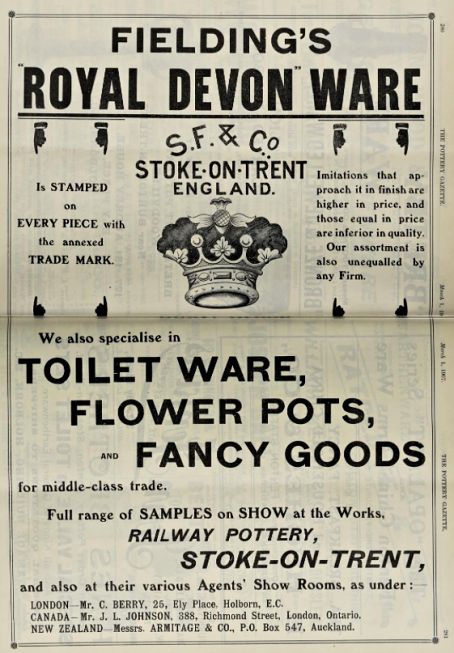
In March 1907 an advert in the Pottery Gazette reads... '"Royal Devon' Ware is stamped on every piece with the annexed Trade Mark" The mark shows a coronet crown, as opposed to the Imperial Crown previously used. It appears that Royal Devon was only used until around 1913 when the trade name Crown Devon was introduced. |

S. F. & Co
Stoke-on-Trent
England
c.1907+
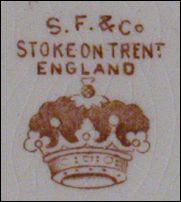 S. F. & Co Stoke-on-Trent England |
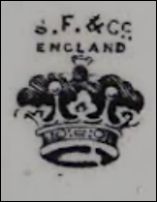 S. F. & Co England |
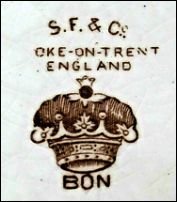 S. F. & Co Stoke-on-Trent England BON |
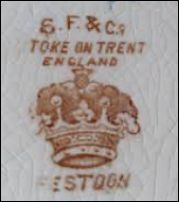 S. F. & Co Stoke-on-Trent England FESTOON |
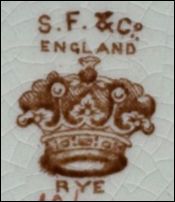 S. F. & Co England RYE |
c.1907+
The coronet crown, which appears
to have been introduced c.1907 was used
with and without pattern names and sometimes with Stoke-on-Trent
By 1913 all ware carried the 'Devon Ware' or 'Crown Devon' name
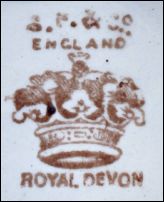
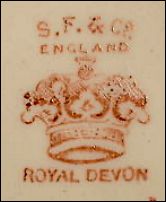
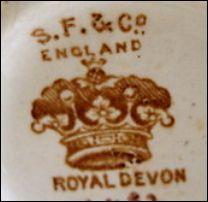
S. F. & Co
England
Royal Devon
c.1907-13
It appears that Royal Devon was only
used until around 1913
when the trade name Crown Devon was introduced
Crown Devon
|
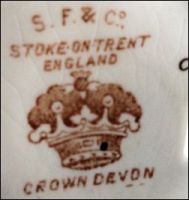
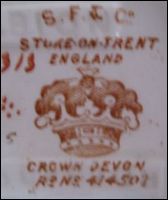
In early 1911 the factory was renamed from the Railway Works to the Devon Pottery The 'Crown Devon' trade name was
consistently used in the pottery marks around 1913 Although note that the Crown Devon name, along with others, was used in conjunction the lion & crown mark which was used c. 1891-1906. |
 |
 |
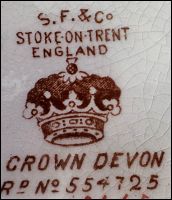 |
S. F. & Co
Stoke-on-Trent
England
Crown Devon
c. 1913-17
In 1917 there was a change from
the use of the company initials S. F. & Co
to the name Fielding's
Silverine Marks
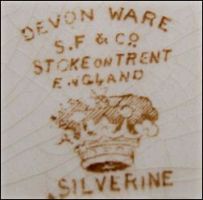 Devon Ware S. F. & Co Stoke-on-Trent England Silverine c.1913-17 |
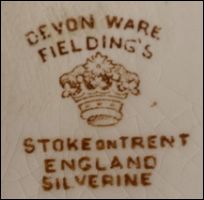 Devon Ware Fielding's Stoke-on-Trent England Silverine c.1917-30 |
Devon Silverine Fielding's Stoke-on-Trent England c.1917-30 |
Crown Devon
Fielding's
Stoke-on-Trent
Made in England
c.1917-30
In 1917 there was a change from
the use of the company initials S. F. & Co
to the name Fielding's - sometimes a pattern name was included
this style of mark 1930s onwards
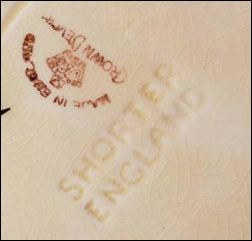
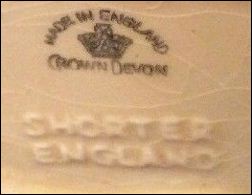
Made in England
Crown Devon
Shorter
England
1963+
Toby Jug ware continued to be
made when Shorter & Son Ltd
became a subsidiary of Crown Devon in 1963
after 1963 ware was marked with both Shorter & Crown Devon
Click for more
information:-

Although the Railway Works were set up by Simon Fielding, it was his son Abraham who was the driving force behind the successful firm:
FIELDING, Abraham (1854/5-1932), pottery manufacturer, Stoke upon Trent.
Abraham Fielding was born in Middleton, Lancashire, the 'son of Simon Fielding (died 1906), an authority on dogs and poultry, who came to Trentham to work for the Duke of Sutherland.
Abraham Fielding was educated at St. Peter's School, Stoke upon Trent, and at Thomas Hemming's school in Copeland Street, where, in 1870, he passed the Cambridge Local Examination.
He served an apprenticeship as a colour maker at Blythe Colour Works, Cresswell, later becoming a partner in this firm. Their productions included majolica argenta.
1955 article on Blythe Colour Works.
Abraham Fielding's father (Simon) lent money to three potters to set up in business at the Railway Pottery, Sutherland Street. The business ran into financial difficulties and Abraham Fielding took it over in 1878, and expanded its operations.
Abraham Fielding became president of the Ceramic Society, and was a freemason. As a young man he had been an athlete, cyclist, swimmer and footballer and served as secretary of the Victoria Cycling Club, often travelling from his home in Cresswell to work on a penny- farthing bicycle. He was president of the North Staffordshire Harriers, and for some years was chairman of Stoke Football Club. He continued to ride to hounds, often three times a week, until an advanced age. His only son, Alec Ross Fielding, played football professionally for Stoke Football Club, Nottingham Forest and West Bromwich Albion. One anecdote told of him concerns West Bromwich club officials who came to the house to sign him up. They were received by the butler who informed them that Master Ross was out riding to hounds.
Abraham Fielding died on 23 March 1932 at Mill House, Blurton.
Sources: Information from D. J Benning; Jewitt.
From Jewitt's 'Ceramic Art of Great Britain 1800-1900' - first published 1878:
Railway Pottery Established by S. Fielding & Co. in Sutherland Street in 1870 for the manufacture of majolica, terra-cotta, jet, Rockingham, green- glaze goods and general earthenware, in all of which the usual useful, ornamental, and fancy articles were made. This firm introduced in the early 1880s a new feature in majolica goods, which they named 'Majolica argenta', in which they produced a vast variety of articles of a remarkably taking, pleasing and useful character. This, as its name implied, consisted of a white body and glaze with the proper majolica colouring liberally and judiciously used either on the body or on the embossed decorations. The effect was extremely pleasing.
Some of the more popular and artistic patterns were 'Shell and Net', 'Ribbon and Leaf', 'Daisy', and 'Fan'; and in each of these, the idea of the pattern was fully carried out on an infinite variety of articles, ranging from large ice-dishes and bread-trays to cups and saucers and al1 the minutiae of the table. One of the distinctive features of the majolica produced by Messrs. Fielding & Co. was the masterly and effective way in which they introduced, on some of their best pieces, hand- modelled flowers and foliage. Modelled and coloured true to nature in every minute detail, and thrown in graceful negligence around the bodies of the vases, they became such perfect reproductions that it was difficult to divest the mind of the idea that the roses were not fresh gathered from the tree and temporarily twined around the vase for its adornment.
In addition to majolica, which had been their staple trade, Messrs. Fielding & Co. extended their works, in about 1880, by adding the manufacture of a good quality of earthenware, in which they produced all the usual services and other articles. Among the novelties in toilet-sets were the 'Spring' and 'Fruit' patterns, the under- glaze decoration of which was of a highly satisfactory character; and another in which the handle of the ewer was formed of a riding-whip, the thong of which was brought round the sides, which were further decorated by a horseshoe in relief suspended from a ribbon. Their mark was FIELDING impressed, or the name of the pattern on a ribbon with the initials S F & Co printed.
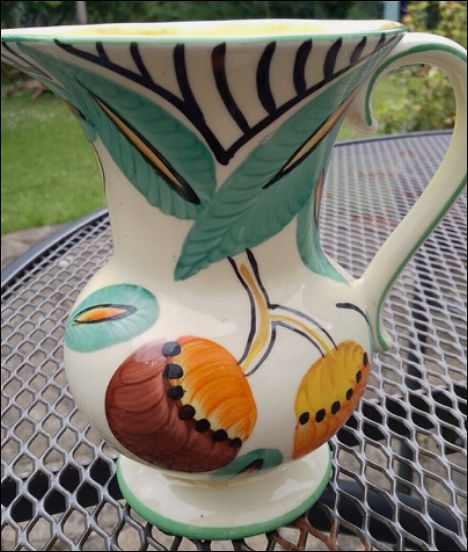
Messers S Fielding continue to the present day (actually to 1982). Their well known trade name is Crown Devon. Hand painted vases and other objects were produced in the twentieth century
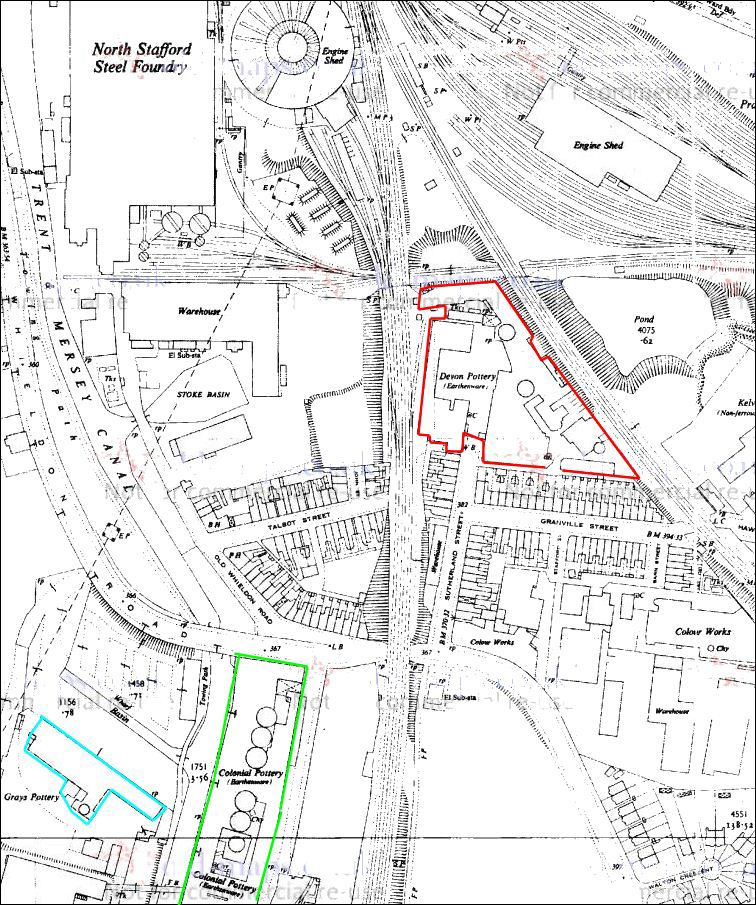
1954 OS map showing the
location of The Devon Pottery (formerly Railway Pottery)
In 1912 the Railway Works was
renamed The Devon Pottery
The pottery works (outlined in red) were situated in Sutherland Street off Whieldon Road
At the top of the map can be seen the engine sheds of the North Staffordshire
Railway,
including the Round House (the engine turntable)
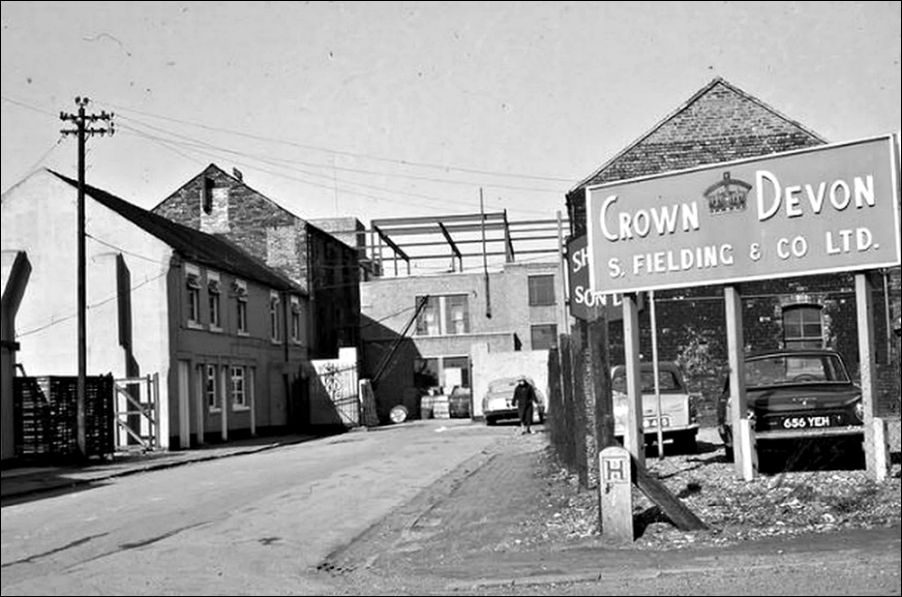
1964 photo of the entrance to
S. Fielding & Co Ltd (Crown Devon Works) in Sutherland Street, off Whieldon
Road
just behind the Crown Devon sign can be see the sign of Shorter & Son Ltd
| In 1963-4 Fielding took over the business of
Shorter & Son Ltd and manufacturing was moved to the Fielding's Whieldon Road site. Shorter operated as a division of Crown Devon Ltd until 1974. Ware was generally marked with both Crown Devon and Shorter. |
photo attribution: Bert Bentley, Staffordshire Sentinel Newspaper
See: Whieldon Grove
Questions, comments, contributions? email: Steve Birks
|
Page created 17 May 2021 Updated 19 April 2025: Introduction greatly expanded, details of the family members added, section of cellulose finished ware added. Last updated 20 February 2026: marks section expanded. |