|
Josiah
Wedgwood & Sons |
    |
|
Josiah Wedgwood & Sons |
Burslem, Etruria, Barlaston |
1759 |
present |
Founded by Josiah Wedgwood in
1759, Wedgwood developed from a small pottery at Burslem into one of the world's best-known manufacturers of fine ceramics. During more than 250 years of operation, the company has played a central role in the history of the Staffordshire pottery industry, producing an extensive range of tableware, ornamental ceramics and art pottery that has been exported throughout the world.
Although the company has undergone significant changes in ownership and organisation since the 1980s, the Wedgwood name remains one of the most recognised and respected in the ceramic industry, reflecting a heritage that continues to be closely associated with Stoke-on-Trent and the Potteries. |
|
|
Wedgwood Pottery Works
[Churchyard ] [Ivy House ] [Brick House ] [Etruria ] [Barlaston ]
|
|
|
|
|
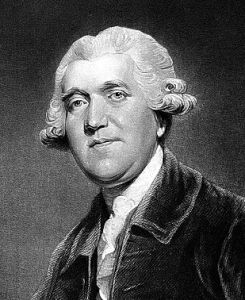
Painted by Sir Joshua Reynolds in 1782. The original oil painting is now part of the V&A Wedgwood Collection in Barlaston, Stoke-on-Trent. |
Josiah Wedgwood – Innovator Josiah Wedgwood (1730–1795) is widely regarded as one of the most influential figures in the history of British ceramics and one of the pioneers of the Industrial Revolution. More than a master potter, he was a scientist, experimenter and entrepreneur whose relentless pursuit of quality transformed pottery manufacture from a traditional craft into a modern industry. Through thousands of carefully recorded experiments he developed new ceramic bodies, perfected manufacturing techniques and introduced rigorous standards of quality control. His inventions included the pyrometer, used to measure the high temperatures within pottery kilns, while his systematic approach to production, together with the division of labour at his Etruria Works, became a model for factories throughout Britain. Wedgwood's interests extended far beyond the pottery industry.
The innovations introduced by Josiah Wedgwood helped establish the Staffordshire Potteries as the world's leading centre for ceramic manufacture, and his influence continues to shape the industry more than two centuries after his death. |

|
|
|
Influence on the Pottery Industry
Few pottery manufacturers have had as great an influence on the ceramics industry as Josiah Wedgwood. During the second half of the eighteenth century he transformed pottery from a traditional craft into a scientifically managed manufacturing industry, combining artistic design with technical innovation and rigorous quality control. His experiments led to the development of internationally acclaimed ceramic bodies many of which remain in production today. Wedgwood was equally innovative in the way he conducted business.
The influence of Josiah Wedgwood extended far beyond his own company. His methods of manufacturing, product development and marketing were widely adopted throughout the Staffordshire Potteries, helping to establish Stoke-on-Trent as the world's leading centre for ceramic production. More than 250 years after the company was founded, the Wedgwood name remains synonymous with innovation, craftsmanship and British ceramic excellence. |
|
|
|
1759–1795 – Josiah Wedgwood and the Foundation of the Business
|
|
|
|
1795–1937 – Expansion of Josiah Wedgwood & Sons
|
Selected
by the Committee for the Staffordshire Potteries
to exhibit at the Paris Universal Exhibition of 1855

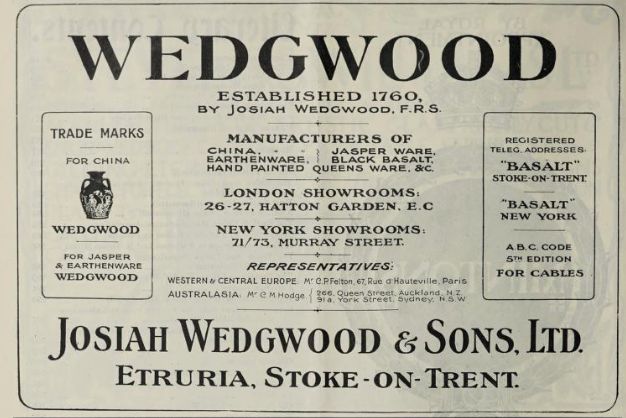
Wedgwood
Established 1760 by Josiah Wedgwood F.R.S.
Josiah Wedgwood & Sons Ltd
Etruria, Stoke-on-Trent
The Pottery Gazette - March 1913
|
Note: Although 1759 is generally accepted as the year in which Josiah Wedgwood established his independent pottery business at the Ivy House Works, some company advertisements published during the early twentieth century state "Established 1760".
|
|
|
|
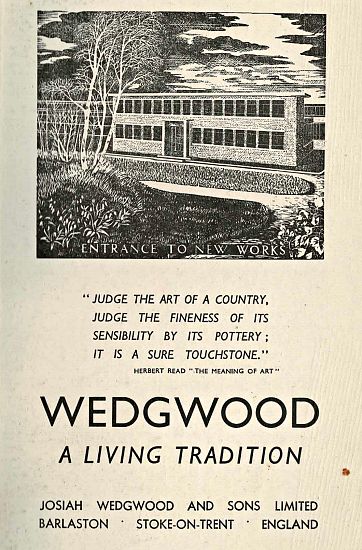
The Pottery Gazette Reference Book 1947 |
« Published in 1947, this advertisement reflects Wedgwood's transition from its historic Etruria Works to the new factory at Barlaston. Although production at Etruria continued until 1950, the company was already presenting Barlaston as its new home. The slogan "A Living Tradition" neatly captured Wedgwood's ambition to combine nearly two centuries of ceramic heritage with modern manufacturing, design and innovation.
|
|
|
|
1960s to 1980's - Expansion and Corporate Development In 1966 the Wedgwood business underwent a major reorganisation. Josiah Wedgwood & Sons Ltd was renamed Josiah Wedgwood Ltd, becoming the holding company for the expanding Wedgwood Group. At the same time, a new subsidiary, Josiah Wedgwood & Sons Ltd, was incorporated to continue the manufacturing and trading activities of the pottery business. The following year, in 1967 Josiah Wedgwood Ltd was listed on the London Stock Exchange, enabling the public to purchase shares in the company for the first time. Despite becoming a public company, control remained with the Wedgwood family. The Chairman was Josiah Wedgwood, the great-great-great-grandson of the founder.
Through these acquisitions the Wedgwood Group acquired the rights to many of the Potteries' best-known trade names, including Adams, Tuscan, Royal Tuscan, Susie Cooper, Coalport, Foley, Johnson Bros, J. & G. Meakin, Midwinter, Shorter, Clarice Cliff, Mason's, Enoch Wedgwood, Crown Ducal and Furnivals. Many of these historic brands continued in production under subsequent owners, while Wedgwood, Adams, Coalport and Johnson Bros remained important brands within the Waterford Wedgwood Group. |
|
|
|
1986–Present - Corporate Change and Global Growth From the mid-1980s onwards, Wedgwood underwent a series of significant changes in ownership and corporate structure. Although the company became part of several international groups, the Wedgwood name remained one of the world's leading brands for fine ceramics, while manufacturing in Staffordshire increasingly focused on its highest-quality and most prestigious products.
Today, Wedgwood continues as one of the world's best-known ceramic brands, with luxury production remaining at Barlaston, while the majority of volume tableware is manufactured overseas.
|
|
|
|
Current Production Today, Wedgwood manufactures only a small proportion of its products at the historic Barlaston factory in Staffordshire. Production in England is concentrated on the company's premium and artisan ranges, while the majority of everyday tableware is manufactured overseas. Although Fiskars Group does not publish detailed production figures, most large-scale bone china manufacture is carried out at its facility in Tangerang, Indonesia. Manufacturing at Barlaston
Overseas Production
Country of Manufacture Wedgwood products have carried country-of-origin marks reflecting where they were manufactured. Collectors may therefore encounter pieces marked:
Note that ware made in Indonesia often has no country of origin in the printed mark but carries a removable label which states "Made in Indonesia" |
|
|
|
Manufacturing Sites - where
it was made |
| From | To | Works & location | Notes |
| 1759 | 1764 | Ivy House Works, Burslem | Josiah Wedgwood established his first independent pottery. |
| 1764 | 1773 | Brick House (Bell Works), Burslem | Production continued in Burslem until 1773. |
| 1769 | 1950 | Etruria Works, Shelton township (Hanley) |
Ornamental wares transferred in 1769; all production moved from Burslem by 1773. |
| 1940 | Barlaston Works, Stoke-on-Trent |
Earthenware production was transferred from Etruria to Barlaston in 1940. Construction was interrupted by the Second World War and completed after 1945. Barlaston became the company's manufacturing site in 1950 when the Etruria Works closed on 13th June 1950. |
|
| 2006 | World of Wedgwood, Barlaston | Since 2006 production has focused on luxury ceramics, including Jasperware and prestige bone china. | |
| 2006 | Tangerang, Indonesia | Manufacture of most volume tableware transferred to Indonesia. Today, the majority of Wedgwood's everyday tableware is produced here. |
|
|
|
Summary of Ownership
Changes |
| Josiah Wedgwood & Sons | Waterford Wedgwood PLC | WWRD Holdings Ltd | Fiskars
Group Finish Owner |
| 1759-1986 | 1986-2009 | 2009-2015 | 2015- |
| Founded by Josiah Wedgwood | Wedgwood & Waterford Crystal | Waterford
- Wedgwood - Royal Doulton - Royal Albert - Johnson Bros |
Waterford
- Wedgwood - Royal Doulton - Royal Albert - and other heritage brands |
|
|
Related Pages
 Wedgwood Index Page |
||
 Josiah Wedgwood Biography |
 Confused by Wedgwood? |
 Misuse of the Wedgwood name |
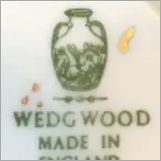 marks |
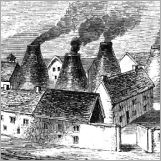 factories |
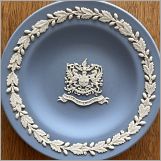 ware |
'walk' around Burslem - origin of Wedgwood
References
The following books and publications were used in researching and compiling this page:
Godden, Geoffrey A. Encyclopaedia of British Pottery and Porcelain Marks. Barrie & Jenkins, London.
Kelly, Alison. The Story of Wedgwood. Barrie & Jenkins, London, 1962.
Mankowitz, Wolf. Wedgwood. Cassell & Co. Ltd., London, 1953.
Meteyard, Eliza. The Life of Josiah Wedgwood: From His Private Correspondence and Family Papers (2 Volumes). Hurst & Blackett, London, 1865–66. (Reprinted by Augustus M. Kelley, New York, 1970.)
Perry, M. Handbook of British Pottery Manufacturers 1900-2010
Reilly, Robin. Wedgwood. Macmillan, London, 1989.
Further ReadingThe following publications provide additional information on the history of Josiah Wedgwood, the Wedgwood company and its ceramics:
Batkin, Maureen. Wedgwood Ceramics 1846–1959. Richard Dennis, 1980.
Dawson, Aileen. Masterpieces of Wedgwood in the British Museum. British Museum Publications, 1984.
Dolan, Brian. Josiah Wedgwood: Entrepreneur to the Enlightenment. HarperCollins, 2004.
Hunt, Tristram. The Radical Potter: Josiah Wedgwood and the Transformation of Britain. Allen Lane, 2021.
Reilly, Robin. Wedgwood Jasper. Richard Dennis, 1992.
For those wishing to explore the subject further, the collections and archives of the Wedgwood Museum, the Victoria and Albert Museum, and The National Archives also provide valuable online resources relating to the history of Josiah Wedgwood and his company.
Questions, comments, contributions? email: Steve Birks
|
|